
Quick Answer: When Should You Aerate?
Aerate when the grass is actively growing and the soil can be worked. For cool-season lawns, core aerate when soil at a 2-inch depth is falling through 60 to 75°F, which means early fall first (September) and spring (April) as a fallback. For warm-season lawns, aerate once soil is sustained above roughly 65°F in late spring or early summer, after full green-up.
A note on where these numbers come from. The calendar is extension guidance: Iowa State names September and April as the two best months for cool-season lawns, and Michigan State puts the window at late summer through early fall. Neither publishes a soil-temperature threshold for aeration; both use "actively growing" plus moist soil as the condition. The temperature bands on this page are our own translation of that condition into a number you can check, anchored to the fall seeding window so aeration opens just ahead of overseeding. Treat the months and the growth condition as the sourced part, and the degrees as a practical guide. The local readings come from USDA SCAN and NOAA USCRN in-ground stations.
What you need
- Small lawns, by hand: Dolibest manual core aerator
- Clay or hard-packed soil, by hand: Hollow-tine core aerator for clay soil
- Large lawns, pulls behind a lawn tractor: Agri-Fab tow-behind plug aerator
Quick Answer
Check your local soil temperature right now
Enter your city or ZIP code to see real-time 2-inch soil temperatures from the nearest USDA or NOAA monitoring station, and find out whether your aeration window is open.
Aeration is one of the highest-return things you can do for a tired lawn, and one of the easiest to do at the wrong time. Pull plugs while the grass is growing hard and the holes close, roots dive into the loosened soil, and the lawn looks better in two weeks. Pull plugs while the grass is dormant or heat-stressed and you have opened thousands of bare seedbeds for weeds with no grass vigor to fill them.
The lever is soil temperature, because soil temperature is what tells you whether the grass is in active growth. This guide pulls the depth and spacing specs from Iowa State and Virginia Tech, the cool-season timing from Iowa State and NC State, the warm-season timing from Clemson and Texas A&M, and the recovery protocol from Purdue. Those sources give months and a growth condition; the soil-temperature bands below are our translation of that condition into a reading you can check against your own ground.
What Core Aeration Actually Does
Soil compaction is the quiet killer of lawns. Foot traffic, mower wheels, pets, and rain all pack soil particles tighter over time, squeezing out the pore space that roots need for air and water. Compacted soil sheds water instead of absorbing it, starves roots of oxygen, and caps rooting depth at an inch or two. Grass on compacted ground stays thin no matter how much you fertilize.
Core aeration is the mechanical fix. A core aerator drives hollow tines into the turf and pulls out cylindrical plugs of soil and thatch, leaving open channels behind. Michigan State University Extension describes the result plainly: core aeration reduces compaction, creates channels for water and gas exchange, and removes some thatch. Those channels let air reach the roots, let water infiltrate instead of running off, and give roots loosened soil to colonize.
Purdue University Extension turf specialist John Orick calls core aeration the most effective option for fixing soil compaction, because the hollow tines remove cores from the lawn and open the soil for air, water, and nutrient movement to the root system. The emphasis on removing cores matters, and it is the dividing line between real aeration and the cheap imitations covered later in this guide.
Aeration and Thatch
Core aeration also helps manage thatch, the layer of dead stems and roots between the green canopy and the soil. Michigan State University Extension notes that a thin thatch layer of half an inch or less is normal and actually helps insulate the grass crown. Action is only needed when thatch exceeds half an inch, and especially when it passes one inch.
Coring pulls thatch plugs to the surface and, just as important, mixes soil microbes up into the thatch layer where they speed its breakdown. For moderate thatch, regular core aeration is often enough to keep it in check. When thatch is over an inch deep, dethatching is the more aggressive standalone fix, and the two practices pair well.
For a small lawn, a hand thatch rake is the cheapest way to pull a thick layer up before it smothers new growth. It is genuine work, so on anything past a few thousand square feet a rented power rake is the better trade.

Walensee 15-Inch Thatch Rake
A 19-tine hand rake for pulling thatch above the half-inch threshold where it stops insulating and starts smothering. Best on small lawns and on warm-season turf ahead of spring greenup; cool-season lawns rarely need dethatching as a routine practice.
Before you rent a machine, confirm you actually have compaction. Push a long screwdriver or a soil probe into moist soil. If it slides in 4 to 6 inches with light pressure, your soil is fine. If it stops at an inch or two, you have compaction. Virginia Cooperative Extension adds a related check: if grass roots extend only into the top 1 to 2 inches of soil, the profile is likely compacted and would benefit from coring.
Why Soil Temperature Is the Timing Lever
The rule that governs every aeration decision is simple: aerate only when the grass is in active growth so it can recover. Iowa State University Extension frames the recovery condition directly, advising that the soil be moist, not dry or saturated, so the tines pull clean plugs and the turf heals quickly.
Active growth is a function of soil temperature far more than air temperature. Cool-season grasses push roots and shoots hardest when soil sits in the 50 to 65°F band, and fall aeration targets the top of that range and just above, so the lawn still has growing weather to heal. Warm-season grasses do not hit full stride until soil is sustained above about 65°F. Aerating outside those bands means the lawn cannot fill the holes before stress arrives, and the openings become weed real estate instead.
This is also why the cool-season fall window is so powerful. The 60 to 75°F aeration window opens just ahead of the 60-70°F fall seeding window, which is why fall aeration and overseeding are almost always done together. See our soil temperature and seed germination rates guide for the species-by-species germination numbers.
| Grass type | Soil temp trigger (2-inch depth) | Primary window | Secondary window |
|---|---|---|---|
| Cool-season (KBG, tall fescue, rye, fine fescue) | 60 to 75°F falling, active growth | Early fall (September) | Spring (April) |
| Warm-season (bermuda, zoysia, St. Augustine, centipede) | Sustained above ~65°F, fully green | Late spring to early summer (May to July) | None recommended |
| Transition-zone cool-season stands | 60 to 75°F falling, active growth | Fall (September to November) | Avoid spring/summer |
Cool-Season Aeration: Fall First, Spring Second
For Kentucky bluegrass, tall fescue, perennial ryegrass, and fine fescue, early fall is the gold-standard aeration window. Iowa State University Extension names September and April as the two best months to core aerate cool-season lawns, allowing the grass to recover during favorable growing periods.
Soil temperature target: falling through 60 to 75°F at a 2-inch depth, with the grass actively growing.
September wins over April for two reasons. First, the lawn has a long stretch of mild weather ahead to heal the holes and push roots before winter. Second, weed pressure is falling in autumn rather than rising, so the open seedbeds you create fill with grass instead of crabgrass. Aim for the 4 to 6 week window before the grass slows for dormancy, so the lawn recovers and any overseed germinates in time.
For tall fescue specifically, NC State Extension is explicit: aerate in fall, September through November, and delay any spring or summer aeration to fall. Aerate lawns subject to heavy traffic or grown on clay soils, and break up the plugs afterward to return soil to the lawn.
Spring Aeration for Cool-Season Grass
If fall is genuinely impossible, Iowa State University Extension lists April as the spring alternative. Aerate in early-to-mid spring once soil reaches roughly 50 to 55°F and the grass is growing, and before summer heat sets in.
Spring is the weaker choice for one structural reason: it opens the canopy right as crabgrass and other summer annuals are germinating. The same holes that help your grass also help the weeds. If you aerate in spring and crabgrass has been a problem, you face a real conflict with pre-emergent herbicide, since coring disturbs the chemical barrier. Read our pre-emergent vs post-emergent guide before you combine the two, and never pair spring aeration with overseeding and a standard pre-emergent on the same lawn.
Summer is the worst time to aerate cool-season grass. The turf is fighting heat and often drought, growth has slowed or stopped, and it has no capacity to recover from thousands of new wounds. NC State Extension specifically advises delaying spring and summer tall fescue aeration to fall. If your lawn is browning out in July, leave the aerator in the shed.
When you aerate cool-season turf in fall, time your nitrogen around it. Our cool-season fertilization schedule covers the full fall feeding program that pairs with aeration and overseeding.
Warm-Season Aeration: Late Spring Into Early Summer
For bermuda, zoysia, St. Augustine, and centipede, aerate during the climb into peak summer growth, not during spring green-up and not during late-summer decline. Clemson Cooperative Extension recommends core aerating warm-season grasses in late spring after the lawn has fully greened and is actively growing, and confirms that core aeration is superior to spike aeration.
Soil temperature target: sustained above roughly 65°F at a 2-inch depth, with the lawn fully green and growing vigorously.
Texas A&M AgriLife Extension calls late spring the optimal time to aerate Texas lawns ahead of summer stress, because core aeration breaks up compacted soil, improves drainage, and creates pathways for deeper rooting that lets the grass reach moisture during the peak-summer heat. The logic is the inverse of the cool-season caution: you aerate warm-season turf before its hardest season precisely so the loosened, deeper-rooting profile is ready when stress hits.
Avoid two mistakes. Do not aerate warm-season grass while it is still greening up and drawing on stored carbohydrates, because the stress diverts energy from recovery. And do not aerate at the peak of mid-summer heat when the lawn is already maxed out. The window is the active-growth shoulder: late green-up complete, full heat not yet arrived.
After aeration, line up your nitrogen program with the warm-season fertilization schedule, which keys feeding to the same soil-temperature signals.
Regional Aeration Timing by Soil Temperature
Calendar months are a starting point, but your soil temperature is the real signal. The table below maps the broad regional windows; verify with your local readings before you commit, because a cool or warm spring shifts these by a week or more.
| Region (USDA zones) | Grass type | Typical window | Source |
|---|---|---|---|
| Upper Midwest / Northern Plains (3-5; MN, WI, ND, SD, NE) | Cool-season | Late August through September | UMN, Nebraska Extension |
| Great Lakes / Midwest (5-6; MI, IN, IL, OH, IA) | Cool-season | September best, early October acceptable | Iowa State, MSU, Purdue |
| Northeast / Mid-Atlantic (5-7; PA, NY, NJ, MD, VA, MA) | Cool-season | Late August to mid-October, early September prime | Penn State, UMD |
| Transition Zone cool-season (6-7; MO, KS, VA, NC piedmont, TN) | Cool-season | September through November | NC State, MU Extension |
| Deep South / Gulf (8-10; TX, LA, MS, AL, GA, FL) | Warm-season | Late May through July, June sweet spot | Texas A&M, UGA |
| Southeast Piedmont (7-8; SC, GA, NC bermuda & zoysia) | Warm-season | May after full green-up through June | Clemson |
| Southwest / arid (8-9; AZ, parts of CA, NM bermuda) | Warm-season | Late spring through early summer | Regional extension consensus |
The two load-bearing numbers behind this whole table: the cool-season window opens as soil falls through 60 to 75°F (just ahead of the fall seeding band), and the warm-season window opens once soil is sustained above ~65°F in late spring with the grass in vigorous growth.
Rental equipment is booked by the day. Before you reserve a machine, check that your soil is actually in the right band and moist enough to pull plugs. A dry August can leave soil too hard to core well even in the right month, and a cold April can leave cool-season soil below 50°F. Confirm the reading first, then book the rental.
How Often to Aerate: Match It to Your Soil
Frequency is driven by how fast your soil recompacts, which comes down to soil type and traffic. Iowa State University Extension gives the clear rule: aerate heavy clay soils and lawns with heavy foot or pet traffic twice a year, while once a year is sufficient for well-drained soils with little traffic.
Michigan State University Extension reinforces the clay case, noting core aeration is very beneficial on high-clay soils because it loosens the profile for better drainage and rooting. Clay holds its compaction stubbornly and benefits from the extra pass.
| Soil and traffic | Frequency | Notes |
|---|---|---|
| Heavy clay, or high foot/pet traffic | Twice per year | Clay recompacts fast; split the passes across the active-growth windows |
| Well-drained loam or sand, normal use | Once per year | A single fall (cool-season) or late-spring (warm-season) pass is plenty |
| New lawns under ~2 years old | Usually skip | Aerate only if visibly compacted; let the stand establish first |
There is no extension-backed number for a hard "you aerated too much and killed the lawn" threshold, so do not chase one. The defensible guardrail is the frequency guidance above plus the timing rule: aerate only when the grass is actively growing and the soil is moist, so the turf can recover from every pass. Aerate a well-drained, low-traffic lawn three times a year and you are wasting effort, not destroying the turf.
Core Aerators vs Spike Aerators: Why Hollow Tines Win
This is the single most important equipment decision, and the market is full of products that get it wrong. Iowa State University Extension is unambiguous: use core aerators with hollow tines that remove plugs of soil, and avoid spike-type devices that simply punch holes, because they compact the soil.
A core aerator pulls a plug out and leaves a void, relieving pressure. A spike device shoves a solid point into the ground, displacing soil sideways and downward, which packs it tighter. On the clay and silt soils that need aeration most, spikes make the problem worse.
The Spike-Sandal Trap
Aerator sandals, the strap-on shoes with spikes on the sole, are the worst offender. Consumer reporting from Family Handyman explains why they fail: the spikes are solid rather than hollow, so they push soil to the side and downward, compacting it further, particularly in clay and silt soils, and they produce inconsistent, labor-intensive results. They are listed here only so you can recognize and skip them.

Punchau Lawn Aerator Shoes (spiked sandals)
Listed as a caution, not a recommendation. These strap-on sandals use solid ~2-inch spikes that compact soil sideways and downward, which is worse on the clay lawns that most need aeration. Spikes punch holes; they do not remove cores. Skip them and use a hollow-tine tool instead.
If a tool punches holes without pulling plugs, it is not relieving compaction. Solid-tine rollers and spiked sandals can be marginally useful as the lightest surface treatment on already-loose soil, but on compacted clay they make things worse. When the goal is fixing compaction, the rule is always core, never spike.
Choosing Your Core Aerator
The right machine depends on lawn size, how often you aerate, and whether you own a riding mower. All of the options below pull real cores.
Manual Plug Aerators for Spot Work
For small lawns, edges, and spot-treating compacted patches a tow-behind cannot reach, a manual hollow-tine plug aerator is the budget entry point. These pull genuine cores rather than punching holes, which is what separates them from the sandals above.

Dolibest Manual Lawn Coring Aerator (4 hollow tines)
A true hollow-tine manual core aerator that pulls plugs rather than punching holes, with a tray that catches the cores. Pre-assembled and built for spot-treating small compacted areas, edges, and bare patches before overseeding. The best budget DIY option for small lawns or touch-up work.

Heavy Duty Steel Hollow Tine Core Aerator for Clay Soil (3 tines)
3 beveled hollow tines · Non-clogging, replaceable · Wide foot plate
A three-tine manual core aerator built for hard-packed clay: beveled hollow tines that resist clogging and keep pulling plugs where softer-soil tools jam, a wide foot plate for a firm push, and tines you can replace instead of retiring the tool. The manual pick when the screwdriver test says your ground is compacted.
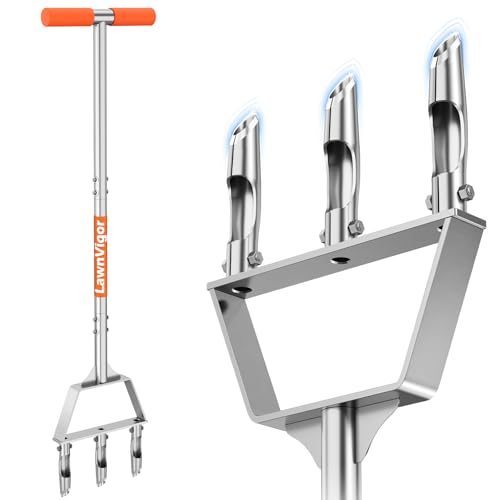
Manual Core Aerator with 3 Hollow Tines (step-style)
A step-down manual plug aerator with three hollow tines, an alternative for spot work and edges where a tow-behind cannot reach. You press it in with your foot and it removes real cores instead of compacting the soil. Useful for filling the gaps a riding-mower attachment leaves behind.
Tow-Behind Plug Aerators for Large Lawns
If you have a riding mower or lawn tractor and a lawn over a quarter acre, a tow-behind plug aerator is the efficient choice. It covers ground fast and pays for itself against repeated rentals within a few seasons.
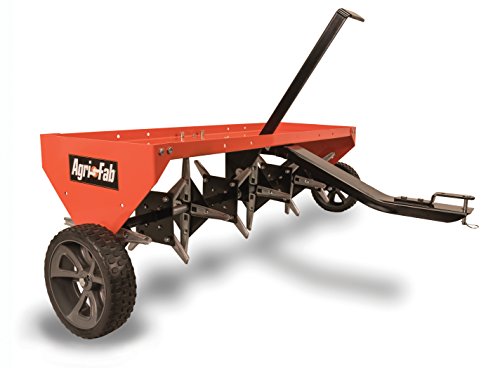
Agri-Fab 45-0299 48-Inch Tow-Behind Plug Aerator
A 48-inch tow-behind core aerator for riding mowers and lawn tractors that covers large lawns efficiently. The weight tray lets the hollow tines pull deeper plugs, and owning it pays off against repeated rental fees on a lawn you aerate every year. Galvanized tines resist rust between seasons.
Rent vs Buy
For a one-time job on a small lawn, renting is usually cheaper. Home Depot rents core aerators around $69 for four hours, and independent rental yards often run $99 to $110 per day (consumer-sourced, from rental listings rather than extension). One homeowner's full DIY cost (rental plus trailer plus cleanup) ran about $107, against roughly $90 for a one-time professional aeration on a small lawn. For small lawns, hiring a pro is often cost-competitive with a DIY rental.
The math flips for large lawns and for anyone aerating every year. A tow-behind plug aerator like the Agri-Fab above runs a little over $300 and pays for itself in about three uses against daily rental fees. Gas walk-behind units start around $3,000, so buying one only pencils out for professionals.
Aeration Specs: Depth, Spacing, and Plug Size
Pulling a few sparse holes does almost nothing. The published targets are aggressive on purpose. Iowa State University Extension specifies that a core aerator should remove plugs about three-fourths of an inch in diameter and roughly 3 inches long, targeting 20 to 40 holes per square foot, which usually requires multiple passes.
Virginia Cooperative Extension (Aveni and Chalmers, Virginia Tech) reports that aeration holes are typically 1 to 6 inches deep and spaced 2 to 6 inches apart. A single pass with most consumer machines lands at the sparse end of that range, so plan on two or three overlapping passes in different directions to hit the 20-to-40-holes-per-square-foot target.
| Spec | Target | Source |
|---|---|---|
| Plug diameter | ~3/4 inch | Iowa State University Extension |
| Plug length | ~3 inches (holes 1 to 6 in deep) | Iowa State; Virginia Cooperative Extension |
| Hole spacing | 2 to 6 inches apart | Virginia Cooperative Extension |
| Hole density | 20 to 40 holes per square foot | Iowa State University Extension |
| Passes | Usually multiple, in crossing directions | Iowa State University Extension |
The soil should be moist before you start. Iowa State stresses that the soil be moist, not dry or saturated. Bone-dry soil resists the tines and yields shallow, broken cores; saturated soil smears and reseals. Watering deeply a day or two before, or aerating after a soaking rain has drained, gets the soil to the right working state.
Leave the Cores: Why You Should Not Rake Them Up
The cores on the surface are not litter, they are free topdressing. Iowa State University Extension recommends dragging a mat or a section of weighted fencing across the lawn to break up the soil cores rather than removing them. Broken-up plugs return soil, microbes, and organic matter to the turf and help the surface heal.
If you skip the drag, the cores still break down on their own within a week or two, especially after a mow or a rain. Dragging them just speeds it up and levels the surface. Either way, do not bag and haul them off. Removing the cores throws away the soil and the microbial activity that make aeration worthwhile.
Aeration is the ideal moment to topdress with a thin layer of finely screened compost. The cores break apart, the compost works down into the open holes, and you add organic matter and level low spots in one pass. Keep the layer thin, about a quarter inch, so you never bury the grass crowns.
Pairing Aeration With Overseeding, Fertilizer, and Topdressing
Aeration rarely stands alone. It is the setup step for the practices that actually thicken the lawn, and the open holes are what make those practices work.
Aerate, Then Overseed
Core aeration creates the seed-to-soil contact that drives germination, and the holes shelter seed from wind and washout. For cool-season lawns the alignment is perfect: the fall aeration window of 60 to 75°F soil opens just ahead of the 60-70°F fall seeding window. Aerate, then immediately broadcast seed so it falls into the open holes. Our fall overseeding for cool-season grass guide walks the full seed-selection and watering program, and the spring overseeding guide covers the spring patch-job version if fall is not an option.
Fertilize Into the Holes
Aeration improves fertilizer uptake because the open channels carry nutrients straight to the root zone. Purdue University Turfgrass Science recommends applying about half a pound of water-soluble nitrogen roughly one week before a late-summer aeration, ensuring the turf is hydrated with the root zone at or near field capacity, and expecting recovery within 5 to 10 days under good conditions. At seeding time, switch to a phosphorus-forward starter fertilizer to fuel new roots.
Topdress and Water In
After overseeding, a thin compost topdress holds moisture around the seed and works into the holes. Then water on the establishment schedule: light and frequent for the first week (2 to 3 short cycles a day to keep the surface damp, not flooded), tapering to deeper, less frequent watering 2 to 3 times a week once the seed germinates, ideally between 5 and 10 AM. For the full watering logic by soil temperature, see our irrigation timing guide.
Common Aeration Mistakes
These are the errors that turn a high-return job into wasted effort.
Aerating dormant or stressed turf. The biggest mistake. Cool-season grass aerated in July heat, or warm-season grass aerated during green-up, cannot recover and just opens weed seedbeds. Aerate only in the active-growth windows.
Using spikes instead of cores. Spiked sandals and solid-tine rollers compact the soil they are supposed to fix. On clay, they make things measurably worse. Always pull plugs.
Aerating dry, hard soil. Dry soil resists the tines and produces shallow, broken cores. Water deeply a day or two before, or wait for a soaking rain to drain, so the soil is moist but not saturated.
Too few holes. One light pass leaves the lawn far short of the 20-to-40-holes-per-square-foot target. Plan on multiple crossing passes.
Raking up the cores. Removing the plugs throws away the soil and microbes that make aeration pay off. Drag them to break them up, or leave them to crumble.
Pairing spring aeration with a standard pre-emergent. Coring disrupts the pre-emergent barrier, and if you overseed at the same time, a standard pre-emergent kills the seed. Read the pre-emergent vs post-emergent guide before combining them.
Verifying Your Window and Recovery
Aeration timing lives and dies on soil temperature, so verify the reading before you start and watch the recovery after. Use a soil thermometer 2 to 3 inches deep in an open part of the lawn, away from pavement, taken mid-morning between 8 and 10 AM, and look for a steady trend across 3 to 5 days rather than reacting to a single number. Our soil thermometer guide covers the right tool and technique.
The cool-season trigger is soil falling through 60 to 75°F with the grass growing. The warm-season trigger is soil sustained above roughly 65°F with the lawn fully green. Confirm you are in the band, confirm the soil is moist, and only then book the machine.
After aerating, watch for recovery. Purdue's benchmark is 5 to 10 days to recover under good conditions for a well-timed, well-watered aeration. If the holes are still gaping and the grass is not filling in after two weeks, you likely aerated outside the active-growth window, and the lesson is to move the next pass into the right soil-temperature band.

Digital Soil Thermometer (instant-read probe)
An instant-read probe for checking soil temperature at the 2-to-3-inch depth where root growth happens. The one tool that confirms whether your aeration window is actually open, instead of guessing from air temperature. Also times overseeding, pre-emergent, and fertilizer applications across the season.
Verify the lever
Is your aeration window open right now?
Enter your city or ZIP code to see real-time 2-inch soil temperatures from the nearest USDA or NOAA monitoring station, and confirm your grass is in the active-growth band before you rent a machine.