
Quick Answer: When Should You Overseed in Fall?
The ideal soil window for cool-season fall overseeding is 60-70°F at 2 inches, usually in late summer to early fall. Your local schedule can open earlier, above that band and up to 75°F, during its calendar window in the local cooling season. Finish seeding at least 45 days before your first fall frost so seedlings get six to eight weeks of root development before growth halts. The calendar and the establish-before-frost rule follow university extension guidance (Michigan State's establishment window, Rutgers' 50°F floor); the 60-70°F band is that guidance translated into a soil reading you can check, and the local readings on this site come from USDA SCAN and NOAA USCRN in-ground stations.
Note the fall band sits higher than the 50-65°F range you may know from spring seeding, and that is deliberate. In spring you seed soil that is warming, so 50°F is the starting gun and the seedling gets warmer weeks ahead of it. In fall the soil is cooling, so waiting for 50°F leaves too little growing weather behind it: Rutgers notes that tall fescue and Kentucky bluegrass seed "does not effectively develop a seedling turf once soil temperatures drop to 50°F." The seed may still sprout at 50°F in October; it just will not become a lawn before dormancy. Seed on the way down through 70°F, not on the way down to 50°F.
SoilTemps can open fall overseeding above the 60-70°F ideal band, up to 75°F at 2 inches, during the task’s calendar window when local historical soil temperatures show the season is cooling. That path does not require a sustained-reading streak, even as the soil enters the ideal band. The 75°F ceiling is a SoilTemps scheduling rule, not an extension seeding threshold. Before the calendar window starts, an early opening still requires sustained readings in the ideal band. Keep the frost-establishment requirement below even when the schedule is open.
Quick Answer
Check your local soil temperature right now
Enter your city or ZIP code to see real-time 2-inch soil temperatures from the nearest USDA or NOAA monitoring station, and find out if your fall overseeding window is open.
The same process works at patch scale: soil contact, seed, starter fertilizer, and disciplined watering apply to a 50 sq ft repair exactly as they do to a whole yard. The small sizes are called out in Step 3 (the 7 lb seed bags) and Step 4 (the 1,000 sq ft starter bag). If large areas are fully dead rather than thin, start with the affordable lawn renovation guide instead; it covers killing off what remains and starting over.
Fall is the single best time of year to overseed a cool-season lawn. Not a marginal improvement over spring. The best window, period. University turfgrass programs from Michigan to North Carolina converge on this point, and the reason is a convergence of conditions that only line up once a year: soil still warm from summer, air cooling into the comfortable range for seedling growth, and weed pressure on the decline rather than the rise.
If your lawn thinned out over the summer, picked up bare patches from drought or disease, or just never filled in the way you wanted, fall overseeding is how you fix it. This guide walks the entire process anchored to soil temperature and your local frost date rather than calendar guesswork: when the window opens in your region, how to prep with aeration or a slit seeder, the species-specific seed rates from extension sources, the high-phosphorus starter fertilizer that drives root growth, the week-by-week watering cascade that keeps seed alive, and when to make that first nervous mow.
Why Fall Beats Every Other Seeding Window
Cool-season turfgrasses, tall fescue, Kentucky bluegrass, perennial ryegrass, and the fine fescues, germinate and establish best inside a specific climate band. Michigan State University Extension sets it precisely: soil temperatures between 50 and 65°F and air temperatures of 60 to 75°F. Late summer to early fall is the only time of year that band holds steady while the soil is also still warm from the season behind it.
The Three Conditions That Only Align in Fall
Warm soil, cool air. In fall the soil retains summer heat while air temperatures drop. That is the textbook "warm days, cool nights" pattern Michigan State Extension calls ideal for germination and seedling growth. Spring is the inverse problem: air warms faster than the soil, so you wait weeks for the ground to catch up while crabgrass races you to the bare spots.
Declining weed competition. Summer annual weeds like crabgrass and foxtail are finishing their life cycle in fall, not starting it. New grass seedlings face far less competition for light, water, and space than they would in spring. The University of Minnesota Extension and Iowa State University Extension both cite reduced weed competition as a primary reason the late-summer window minimizes failures.
A full cool season for roots. Grass seeded in fall has the entire cool season to build a deep root system before facing its first summer. Spring-seeded grass heads into heat stress with shallow roots. That difference in root depth is why fall-seeded stands routinely outperform spring-seeded ones the following summer.
The 45-Day Rule
The one hard deadline in fall overseeding is the first frost. The common extension rule of thumb is to plant cool-season grass seed at least 45 days before the estimated first fall frost so seedlings get six to eight weeks to establish before growth halts. Seed too late and the grass goes into winter underdeveloped, with poor odds of surviving freeze-thaw cycles.
Purdue University Turfgrass Science makes the cost of waiting concrete: seeding one week later in the fall can mean the turf takes two more weeks to mature, because growth slows as the season cools. Every day at the front of the window is worth more than a day at the back. Treat 60-70°F as the ideal soil range, and check the schedule’s earlier-opening rule before postponing an otherwise suitable fall seeding.
When Does the Fall Seeding Window Arrive in Your Region?
The ideal 60-70°F soil window arrives at different calendar dates depending on latitude and elevation; the schedule can open above that band under the rule described above. Below is the extension-sourced regional timing table. Use it as a starting point, then confirm with your actual 2-inch soil temperature and your local first-frost date.
Regional Fall Seeding Windows
| Region / Zone | Representative states | Optimal fall seeding window | Source |
|---|---|---|---|
| Upper Midwest / Northern Plains | MN, WI, northern MI, IA, ND, SD | Mid-Aug to mid-Sep (MN: Aug 15-Sep 15; IA: mid-Aug to mid-Sep) | UMN Ext; Iowa State Ext; MSU Ext |
| Great Lakes / Northern Corn Belt | MI, northern IN, OH, northern IL | Aug 15 - Sep 15 | Purdue Turf; MSU Ext |
| Lower Midwest / Northern transition | southern IN, MO, southern IL | Sep 1 - Sep 30 | Purdue Turf |
| Mid-Atlantic / Northeast | NJ, PA, NY, MD, DE | NJ north Aug 15-Oct 5; NJ south Aug 20-Oct 10; PA through mid-Oct | Rutgers NJAES FS584; Penn State Ext |
| Transition Zone | VA, TN, KY, NC piedmont, northern GA | Sep 15 - Oct 15 (VA); NC tall fescue Sep 1-Oct 1, KBG/fine fescue Aug 15-Sep 1 | Virginia Coop Ext; NC State Ext |
Reading the Table Against Your Frost Date
The published windows already bake in the 45-day rule for typical frost dates in each region. Penn State Extension flags the back edge directly: seeding later than mid-October is not suggested for most of Pennsylvania. If your area runs an early frost or you sit at elevation, slide the whole window earlier. The single most reliable signal is your own soil temperature trending down through the 60-70°F band combined with at least six weeks of growing weather ahead.
In the transition zone, species choice changes your dates. NC State Extension seeds tall fescue in the piedmont between September 1 and October 1, but Kentucky bluegrass and fine fescue blends earlier, between August 15 and September 1, because they germinate and mature more slowly. If you are seeding KBG anywhere, start at the early end of your regional window.
For year-round tracking of where your soil temperature actually sits, see our soil thermometer guide, and for the underlying germination science by species, soil temperature and seed germination rates.
Species Germination Speed Drives Your Timing
Not all cool-season grasses germinate at the same pace, and that single fact determines how early in the window you need to start and how you build a seed blend.
Is your soil warm enough to seed?
Germination temperatures for common lawn grasses, at a 2-inch depth. Enter your ZIP for your live local readiness.
| Grass species | Seeding soil temp (2 in) | Lab optimum (air) | Days to germinate |
|---|---|---|---|
| Kentucky bluegrass | 60–70°F | 59/86°F (16h/8h) | 14-30 |
| Tall fescue | 60–70°F | 68/86°F (16h/8h) | 7-12 |
| Perennial ryegrass | 60–70°F | 68/86°F (16h/8h) | 5-10 |
| Fine fescue | 60–70°F | 59/77°F (16h/8h) | 7-14 |
| Bermudagrass | 75–90°F | — | 10-30 |
| Zoysia | 75–90°F | — | varies |
| Buffalograss | 75–90°F | — | 14-30 |
| Centipede | 75–90°F | — | varies |
Lab optimum is Purdue’s alternating-temperature protocol: 16 hours at the first temperature, then 8 hours at the second, measured in air. It is a laboratory germination test, not a soil target. Seed to the soil column.
How Fast Each Species Comes Up
| Species | Days to germinate (warm soil) | Fall window position | Spreads by |
|---|---|---|---|
| Perennial ryegrass | 5-10 (fastest) | Flexible, tolerates later start | Bunch (no self-repair) |
| Tall fescue | 7-14 | Flexible, early-to-mid window | Bunch (limited tillering) |
| Kentucky bluegrass | 14-28 (slowest) | Seed earliest in window | Rhizomes (self-repairs) |
Penn State Extension germination ranges spell out the consequence: perennial ryegrass is the quickest cool-season grass to germinate at about 5 to 10 days in warm soil, tall fescue follows at roughly 7 to 14 days, and Kentucky bluegrass is the slowest at 14 to 28 days. Because KBG is so slow, it must be seeded early enough in the fall window to get several weeks of growth before the ground freezes. This is why the regional table puts KBG dates ahead of tall fescue dates.
Building a Blend By Zone
Mixing species gives you fast cover from the quick germinators and long-term durability or self-repair from the slower ones. Extension blend guidance by zone:
- Northern sun (Iowa State): 80-90% Kentucky bluegrass plus 10-20% perennial ryegrass. The ryegrass provides fast cover while KBG fills in over time.
- Northern sun and shade mix (Iowa State): 50-60% KBG, 30-40% fine fescue, 10% perennial ryegrass.
- Heavy shade, north (Iowa State): 100% fine fescue.
- KBG/ryegrass establishment blend (NC State): 60% KBG by weight at 2.5 lb per 1,000 sq ft.
- Transition zone: turf-type tall fescue dominant, often 90-100%, with a small percentage of KBG optional for self-repair.
Tall fescue is a bunch grass with deep roots and strong heat and drought tolerance, which is exactly what the transition zone demands. It does not spread aggressively, so a small percentage of Kentucky bluegrass is sometimes added to help the stand knit bare spots back together. For most transition-zone lawns, a turf-type tall fescue blend at 6-8 lb per 1,000 sq ft is the workhorse choice.
The Short List
Five things cover the whole project. Each is detailed in its step below:
- Seed matched to your zone and goal (Step 3): one species path, bought at the overseed rate for your square footage
- A high-phosphorus starter fertilizer (Step 4): the bag with the big middle number, sized to your area
- Weed-free straw or bagged seeding mulch (Step 5): enough to lightly cover the seeded area
- A rental day (Step 2): core aerator for a thin lawn, slit seeder for bare areas
- A way to water on schedule (Step 6): light sessions two to three times a day for the first three weeks, which is harder than it sounds
Step 1: Mow Low and Prep the Surface
Before any seed goes down, set the lawn up for seed-to-soil contact. Cut the existing turf shorter than your normal maintenance height, down to about 2 inches, and bag the clippings. Short turf exposes more soil surface and stops the existing canopy from shading new seedlings. Rake out leaves, sticks, and loose debris so seed can reach soil.
Step 2: Aerate or Slit-Seed for Seed-to-Soil Contact
Seed that lands on thatch or compacted soil dries out and never germinates. The mechanical step that fixes this is the most important one in the whole process, and the right tool depends on how thin your lawn is.
Light Overseeding: Core Aeration
For a lawn that is thinning but not bare, a core aerator does double duty. Michigan State University Extension confirms that for light overseeding a core aerator is viable and improves soil aeration. Penn State Extension is specific on technique: broadcast seed and follow with six to eight passes over the lawn with a core aerator. The holes break up compaction, improve water infiltration, and create pockets where seed makes direct soil contact and stays protected from drying out.
Aerate when the soil is moist but firm, not saturated. Pull cores 2-3 inches deep and leave them on the surface to break down on their own. For the full treatment on timing aeration to soil conditions, see our aeration timing guide.
Most homeowners rent a core aerator for a few hours rather than buy one. Six to eight passes pull enough soil plugs to give the seed direct contact with soil.
Heavy Turf Loss: A Slit Seeder
For areas with extensive turf loss, core aeration alone leaves too much seed sitting on the surface. Michigan State University Extension recommends a slit seeder for these cases: it creates a slice in the soil that the seed falls directly into, ensuring good seed-to-soil contact. Penn State Extension echoes the recommendation for heavily thinned turf, describing a disk or slit-type seeder that drops seed into slits in the soil. A slit seeder is a rental from a home-improvement or equipment rental center, not a homeowner purchase, so budget a rental day rather than a tool.
If your lawn still has a stand of grass and you are thickening it up, broadcast seed then core aerate with six to eight passes. If you are looking at large dead or bare areas, rent a slit seeder and run it in two perpendicular passes at half rate each. For full renovation of a dead lawn, see our affordable lawn renovation guide.
Step 3: Spread Seed at the Right Rate
Overseeding rates are lower than new-lawn rates because you are adding to an existing canopy rather than starting from bare ground. Use too much seed and you create dense, slow-maturing seedlings that hold moisture and invite disease. Use the extension rates below.
Overseed Seed Rates by Species
| Species | Overseed rate (lb / 1,000 sq ft) | New-lawn rate (lb / 1,000 sq ft) |
|---|---|---|
| Perennial ryegrass | 5-7 | 4-6 |
| Tall fescue | 6-8 | 6-10 |
| Kentucky bluegrass | 1.5-2 | 1-2 |
| Fine fescue | 3-5 | 4-6 |
| Mixes with rye or fine fescue | 3-5 | varies by blend |
Michigan State University Extension is the anchor on overseed-specific rates: Kentucky bluegrass at 1.5 to 2 lb per 1,000 sq ft, and mixtures containing perennial ryegrass or fine fescue raised to 3 to 5 lb per 1,000 sq ft. KBG goes down lightest because it spreads by rhizomes and fills in on its own.
Use a broadcast spreader and make two perpendicular passes at half the target rate to avoid striping. For tall fescue at 7 lb total, that is two passes of 3.5 lb each in crossing directions.
Pick One Seed Path
Match the seed to your region and goal instead of buying whatever bag is nearest the register. Three paths cover nearly every cool-season overseed.
Transition zone or lower Midwest: turf-type tall fescue. Deep roots and real heat tolerance make it the workhorse where summers punish lawns:

Scotts Turf Builder Grass Seed Tall Fescue Mix (5.6 lb, covers ~1,400 sq ft)
Turf-type tall fescue · Overseeds ~1,400 sq ft, new lawn 465 · Two crossing passes at half rate
Past about 3,000 sq ft, small bags stop making sense and the 16 lb bag wins on price per pound:

Scotts Turf Builder Grass Seed Tall Fescue Mix (16 lb, covers ~4,000 sq ft)
Same blend, whole-lawn size · Overseeds ~4,000 sq ft, new lawn 1,330
Speed cover, or a patch repair racing the frost date: perennial ryegrass. It is the fastest cool-season grass out of the ground, which buys back calendar time late in the window:
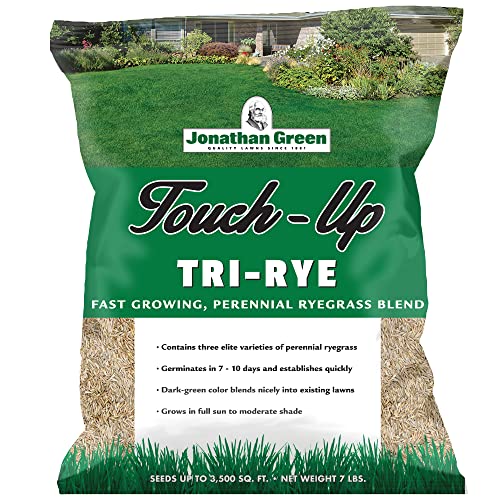
Jonathan Green TRI-RYE Perennial Ryegrass, 7 lb
3 perennial rye cultivars · Germinates 7-10 days · Overseed 5-7 lb per 1,000 sq ft
If you want to know exactly which cultivars you are planting, this blend names them on the bag and ships as pure raw seed with no coating, so the weight you buy is all seed:

Outsidepride OSP Perennial Ryegrass Blend, 5 lb
Shield + Nexus GT cultivars · Pure raw seed, no coating · 0.00% weed seed
Northern tier: Kentucky bluegrass, seeded at the earliest edge of your window. The slow start is the price of the only cool-season grass that repairs itself:
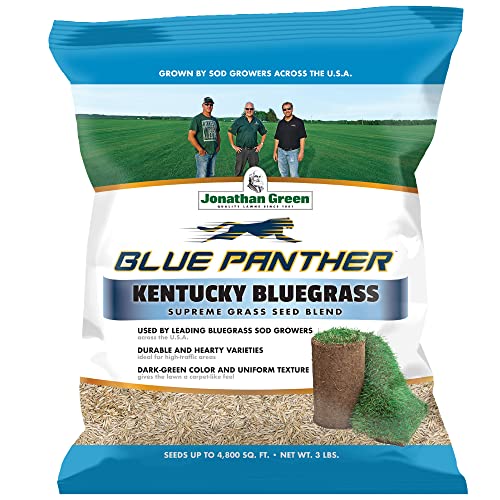
Jonathan Green Blue Panther Kentucky Bluegrass, 3 lb
100% Kentucky bluegrass · 1.5-2 lb per 1,000 sq ft · Germinates 14-28 days
Step 4: Apply a High-Phosphorus Starter Fertilizer
New seedlings need phosphorus to build roots fast. Penn State Extension explains that starter fertilizers contain nitrogen, phosphorus, and usually potassium, and that nitrogen and phosphorus are particularly helpful for rapid turf establishment. The exact phosphorus and potassium your soil needs should be set by a soil test, because surface-applied phosphorus moves slowly through soil, so incorporating it before establishment helps when possible.
NC State Extension gives concrete example rates per 1,000 sq ft for a phosphorus-rich starter: 40 lb of 5-10-10, 20 lb of 10-20-20, or 16 lb of 18-24-6. The common thread is a high middle number. A commercial product like Scotts starter food at 24-25-4 hits the same target in a single bag.
Apply the starter at seeding. Avoid high-nitrogen-only products that push top growth on your existing grass before new seedling roots are established. For the full season-long feeding plan after establishment, see our cool-season fertilization schedule. Once the new stand is established and top growth slows in late fall, the winterizer application is the next feeding, timed to soil falling through 40-55°F.
One bag does the whole job for a typical overseed; the middle number on the label is the one to check:

Scotts Turf Builder Starter Fertilizer for New Grass, 15 lb
24-25-4 starter formula · 15 lb ~ 5,000 sq ft · Apply at seeding
Patching rather than blanketing? The 1,000 sq ft bag matches the small seed bags one-to-one:

Scotts Turf Builder Starter Food for New Grass, 3 lb (1,000 sq ft)
24-25-4 starter formula · Covers 1,000 sq ft · Patch-job size
Step 5: Mulch to Hold Moisture and Stop Crusting
A dry, crusted soil surface is one of the most common reasons seed never comes up. Iowa State University Extension is direct: a dry, crusted soil surface in the germination zone prevents seedling emergence. The fix is a light straw mulch. Mulching with clean, weed-free straw conserves moisture and prevents both soil-surface crusting and erosion. Use about one bale per 1,000 sq ft, spread thin enough that roughly 50% of the soil is still visible through the straw.
Weed-free straw matters. Cheap straw seeds your new lawn with weeds. The same straw layer also reduces seed predation by birds and protects seed from washing out during watering or rain.
Loose straw from a farm store or local supplier is the cheapest cover if someone can vouch for it being weed-free. If nobody can, bagged seeding mulch trades a few dollars for that certainty and stays put on slopes:

EZ Straw Seeding Mulch with Tack, 1 cu ft
Straw + bonding tackifier · ~250 sq ft per bale · Won't seed weeds
Mulch is a thin protective layer, not a blanket. If you cannot see roughly half the soil through the straw, you have applied too much and you will smother the seedlings. The goal is to break the wind and sun on the surface while still letting light and air reach the germinating seed.
Step 6: Run the Watering Cascade
Watering is where most fall overseeding projects are won or lost. The extension consensus across NC State, University of Minnesota, University of Maryland, and Purdue is a cascade: start light and frequent to keep the surface continuously moist, then taper to deep and infrequent as roots reach down.
Weeks 1-3: Light and Frequent (Germination)
Keep the top 1 to 1.5 inches of soil continuously moist. NC State Extension specifies light watering two or three times a day for 7 to 21 days. University of Minnesota Extension allows up to three or four times per day until establishment. University of Maryland Extension sets the per-application amount at 1/16 to 1/4 inch, which is a 5-to-10-minute session for most sprinklers. In warm weather above 75°F, lean toward the higher frequency; in cooler weather below 65°F, one to two times a day is enough. Never let the surface crust or dry out.
This schedule is where overseeds die. Two or three short sessions a day for three weeks is hostile to anyone with a job, and a single missed midday watering during a warm spell can crust the surface over a whole seeding. A hose-end timer runs the schedule so you do not have to:

Orbit Programmable Digital Hose Timer, 1 Outlet
Screws onto the spigot · Repeating short sessions · Rain-delay button
Weeks 3-5: Reduce Frequency (Post-Emergence)
As seedlings emerge and begin rooting, drop to one or two waterings a day and lengthen each session slightly. You are coaxing roots downward by letting the surface dry a little between waterings while keeping the root zone moist.
Weeks 5-8: Deep and Infrequent (Establishment)
After about three mowings, transition to deep, infrequent watering. NC State Extension sets the target at watering to a depth of 6 to 8 inches about once a week. This trains the root system to seek water at depth instead of depending on a wet surface.
University of Maryland Extension warns that overwatering causes erosion, ponding, scalding, and disease, and that nighttime watering in warm weather promotes leaf-wetness disease. Apply your light waterings during the day, not after dark, and stop before water ponds or runs off. For the broader relationship between irrigation and soil temperature, see our irrigation timing guide.
Step 7: The First Mow and Beyond
Mowing too early uproots seedlings; mowing too late lets them get leggy and weak. Iowa State University Extension sets a final mowing height of 3 to 3.5 inches for cool-season lawns, so begin mowing once the new grass is about one-third taller than that target (roughly 4 to 4.5 inches) and cut back to 3 to 3.5 inches.
University of Maryland Extension adds the one-third rule for seedlings: mow only when the grass exceeds the target height by no more than one-third, which means a maximum of 3.25 inches when you cut at 2.5 inches. Use sharp blades. A dull blade tears tender seedlings rather than cutting them cleanly, which stresses the stand and opens the door to disease. And apply any broadleaf herbicides only after two to three mowings, because young seedlings are sensitive to herbicide injury.
- Wait until the new grass hits about 3 inches.
- Sharpen the mower blade first.
- Cut to 2 to 2.5 inches, never removing more than one-third of the blade.
- Mow when grass is dry to reduce tearing and disease spread.
- Hold off on any broadleaf herbicide until after the second or third mow.
Common Fall Overseeding Mistakes
These are the errors that show up most in extension troubleshooting and that quietly kill an otherwise well-timed seeding.
Seeding Too Late
The most common timing mistake is missing the back edge of the window. Penn State Extension does not suggest seeding later than mid-October for most of Pennsylvania, and the 45-day-before-frost rule applies everywhere. Late-seeded grass goes into winter underdeveloped and heaves out during freeze-thaw cycles.
Applying Fall Pre-Emergent to Areas You Plan to Seed
A fall pre-emergent targeting annual bluegrass blocks grass seed exactly the way it blocks weed seed, and the barrier persists for roughly 12 weeks, which closes the entire fall seeding window on treated turf. The two projects are mutually exclusive on the same ground in the same season, and on a cool-season lawn the seeding wins: a dense new stand is itself the best long-term poa annua defense. Skip the pre-emergent on any area you are overseeding this fall and apply it next year instead. The fall pre-emergent timing guide covers the decision per lawn type.
Over-Seeding and Damping-Off
Piling on extra seed feels like insurance but backfires. Purdue University explains the mechanism: high seeding rates encourage damping-off by producing dense, slow-maturing seedlings that stay wet. Penn State Extension identifies the culprits as Pythium, Rhizoctonia, and Fusarium species that attack seed and emerging seedlings. Purdue adds that Pythium causes most damping-off in warm or hot wet weather while Rhizoctonia is more prevalent in cool weather. The defense is using recommended, not excessive, seeding rates and avoiding overwatering, both of which shrink the window during which seedlings are vulnerable.
Letting the Surface Crust or Dry
Skipping mulch or missing a midday watering during a hot spell lets the surface crust over, and seedlings cannot push through. Iowa State Extension's straw-mulch recommendation plus a disciplined light-and-frequent watering schedule are the two-part fix.
Skipping Soil Contact
Broadcasting seed onto thatch or compacted soil without aeration or slit-seeding is the single most common shortcut that ends in failure. No seed-to-soil contact means no germination, no matter how perfect your timing or watering.
Damping-off is a seedling-stage disease, but cool-season lawns face temperature-driven diseases year-round. If you see patches collapsing or water-soaked lesions on new growth, check our guide on lawn disease by temperature to match symptoms to conditions. Recommended seeding rates, daytime watering, and good airflow are the cheapest preventives.
In armyworm states (the South and transition zone), September seedings are also the most vulnerable turf on the block: seedlings eaten below the growing point die rather than regrow. Run soap flush checks twice a week through establishment; the fall armyworm identification guide covers the test and the treatment threshold.
Verify the Lever: Track Your Soil Temperature
Calendar dates and regional averages are estimates. Your yard, your soil, your microclimate. Check your actual 2-inch soil temperature, the depth where germination happens, alongside your city’s open schedule and the 60-70°F ideal band. Preserve at least 45 days before your first frost for establishment, including when the schedule opens above the ideal band.
SoilTemps.com tracks 2-inch soil temperatures from over 380 USDA SCAN and NOAA USCRN monitoring stations nationwide. We show the data alongside germination thresholds so you can seed based on what is happening in the ground rather than what the calendar says. To pair this with a season-long task plan for your city, see your city's lawn care schedule.
Verify the lever
Is your fall overseeding window open?
Enter your city or ZIP code to see real-time 2-inch soil temperatures from your nearest station and see whether your fall seeding window is open, including an earlier opening above the 60-70°F ideal band.
Related Guides
- Spring Overseeding Cool-Season Grass
- Fall Pre-Emergent Timing
- Winterizer Timing
- Fall Armyworm Identification
- Fall Overseeding Warm-Season Lawns
- Aeration Timing
- Cool-Season Fertilization Schedule
- Soil Temperature and Seed Germination Rates
- Soil Thermometer Guide
- Affordable Lawn Renovation for Cool-Season Lawns