
Quick Answer: When to Treat for Grubs
Apply preventive grub control (chlorantraniliprole or imidacloprid) before eggs hatch, when 2-4 inch soil sustains roughly 65-70°F, which lands in late June through July across most regions and early July in the Northeast. Save curative trichlorfon for August and September when grubs are small. Water in 0.5 inch immediately after any application. The hatch-window guidance follows Penn State Extension and UMass Amherst; the local soil readings on this site come from USDA SCAN and NOAA USCRN in-ground stations.
Treatment threshold: 8-10 grubs per square foot (University of Nebraska-Lincoln); healthy, well-rooted turf tolerates about 5 per square foot with no visible damage (Michigan State).
What you need
Quick Answer
Check your local soil temperature right now
Enter your city or ZIP code to see real-time 2-inch soil temperatures from the nearest USDA or NOAA monitoring station, and find out whether your grub-prevention window is open.
Chlorantraniliprole vs. Imidacloprid in One Paragraph
Chlorantraniliprole (GrubEx) is the early, forgiving preventive: applied mid-April to early June, its long residual (up to 4 months) is already in place when eggs hatch in July. Imidacloprid (Merit) is the closer-to-hatch preventive: apply mid-June to early August and water it in immediately; University of Kentucky trials show 75-100 percent grub reduction for applications between June 1 and July 15. Neither rescues a lawn already collapsing in September. That is curative trichlorfon territory: it kills small grubs within one to three days, then breaks down within seven to ten.
Grub control fails for one reason above all others: bad timing. Homeowners buy a bag of grub killer, spread it whenever they happen to think of it, and conclude the product did not work when the lawn collapses in September. The product usually works fine. It was applied at the wrong stage of the beetle life cycle, against the wrong species, or without watering it in.
This guide fixes that. It separates the two jobs grub control actually does (preventing grubs that have not hatched yet versus killing grubs that are already feeding), ties each to a soil-temperature trigger, and names the right active ingredient for each window. The factual backbone comes from Penn State, UMass Amherst, Michigan State, the University of Kentucky, and the University of Nebraska-Lincoln, with peer-reviewed nematode research filling in the biological-control picture. Get the timing right and grub damage becomes a non-event.
Understanding the White Grub Life Cycle
White grubs are the larval stage of scarab beetles. The three that matter most for lawns are Japanese beetles, masked chafers (which produce the annual white grub), and European chafers. They share a roughly one-year cycle, and the cycle is what dictates every treatment decision.
Beetle Flight and Egg-Laying
Adult beetles emerge from the soil in early-to-midsummer, feed on trees, shrubs, and ornamentals for a few weeks, then return to turf to lay eggs. University of Minnesota Extension describes the pattern: beetle flight and egg-laying peak in midsummer, from late June through early August, with eggs laid a few inches below the soil surface. Those eggs hatch in roughly one to two weeks, after which the young grubs begin feeding on grass roots.
Species timing varies. Michigan State University Extension notes that European chafer adults become active at sunset during late June and early July and lay eggs in late June, while Japanese beetles lay eggs through July and August. This is why a single calendar date never works across the country or even across species in one yard.
For Japanese beetles specifically, adult emergence tracks accumulated warmth closely enough that Iowa State University Extension publishes it as a growing-degree-day window, and emergence is the lead indicator for the egg hatch that preventive control targets. Check your state's measured accumulation against that emergence window on the national growing degree day tracker, then confirm with the soil-temperature trigger below.
Why Soil Temperature Is the Real Trigger
Egg-laying and hatch track soil warmth, not the date on the wall. The preventive window opens when 2-4 inch soil sustains approximately 65-70°F, because that is when beetles are laying and eggs are hatching into the small, vulnerable grubs that preventive products target. In the Midwest this is typically late June; in the Northeast it shifts to early July.
The cycle continues underground. Michigan State University IPM reports that white grubs become active and move up in the soil profile once soil temperatures exceed 50°F in spring, and that European chafers stay in the root zone later in fall and return earlier in spring than other species. That spring re-emergence above 50°F is a feeding period, not the ideal treatment window, because the grubs are large and harder to kill by then.
When grubs return toward the surface above 50°F in spring, they are nearly full-grown and about to pupate. Insecticides work far better on small, newly hatched grubs. Spring damage you discover in April or May usually has to be tolerated or repaired by overseeding; the treatment decision belongs to the prior summer. Use the spring sighting as a signal to plan a preventive application for the coming June-July window.
Where Soil Temperature Comes From
Because the whole program hinges on a soil reading, get the measurement right. Insert a soil thermometer 2-3 inches deep in an open turf area away from pavement, take readings mid-morning, and watch for a sustained trend rather than a single warm afternoon. Our soil thermometer guide covers the 65-70°F grub trigger and how to read the probe correctly. For continuous data without daily trips outside, SoilTemps.com pulls 2-inch readings from more than 380 USDA SCAN and NOAA USCRN stations.
Preventive vs. Curative: The Core Distinction
Almost every grub-control mistake collapses into one error: using a preventive product as a rescue treatment, or a curative product as season-long protection. They are not interchangeable.
Preventive products go down before or during egg hatch and persist in the soil, killing young grubs as they begin feeding. They include chlorantraniliprole and imidacloprid. They do little against large, established grubs.
Curative products kill grubs that are already present and feeding. The home-lawn standard is trichlorfon. They act fast and break down fast, so they offer no future protection.
| Strategy | Active Ingredient | Apply When | Soil Temp | Residual | Pollinator Risk |
|---|---|---|---|---|---|
| Preventive (default) | Chlorantraniliprole | Mid-April to early June | Ahead of 65-70°F hatch | Up to 4 months | Low (no activity vs. bees) |
| Preventive (alt) | Imidacloprid | Mid-June to early August | 65-70°F | Weeks to months | Higher (neonicotinoid) |
| Curative (rescue) | Trichlorfon | Late August to early September | 60-70°F | 7-10 days | Use with caution |
If you discover grubs tearing up the lawn in late summer, a bag of preventive chlorantraniliprole is the wrong purchase. By then the grubs are large and the preventive window has closed. You need a curative (trichlorfon), and only if counts exceed the damage threshold. Buying preventer in September wastes money and time the lawn does not have.
Preventive Timing: Chlorantraniliprole
Chlorantraniliprole is the active ingredient sold to homeowners as Scotts GrubEx1 and to professionals as Acelepryn. It is the best default preventive for most lawns, and the timing is earlier than people expect.
When to Apply
UMass Amherst is specific: chlorantraniliprole is best applied between mid-April and early June, and applications after early June may have reduced efficacy. It takes 60-90 days to fully dissipate in the soil, which is exactly why an early application still protects through the July hatch. The long residual is the feature. You apply ahead of the beetles and the chemical is waiting in the root zone when eggs hatch.
This early timing also makes it the easiest product to schedule. You are not chasing a narrow hatch window; you are laying down protection in spring that covers the whole season.
Why It Is the Low-Risk Default
UMass Amherst notes chlorantraniliprole has no activity against bees, ants, or wasps. Penn State Extension separately flags imidacloprid for its negative impact on pollinators. For a homeowner choosing one product, the pollinator-safety contrast points clearly at chlorantraniliprole. It is in a different chemical class (anthranilic diamides) than the neonicotinoids and does not carry their regulatory baggage.
Scotts GrubEx1 uses 0.08% chlorantraniliprole. A single application kills and prevents grubs for up to four months when applied before eggs hatch, in May or June. That single-application, season-long profile is what makes it the workhorse preventive for home lawns.

Scotts GrubEx1 Season Long Grub Killer (5,000 sq ft)
The low-pollinator-risk preventive most extension sources recommend as the homeowner default. Chlorantraniliprole at 0.08% gives up to four months of protection from one spring application. Spread it May to June, ahead of egg hatch, and water in immediately.

Scotts GrubEx1 Season Long Grub Killer (10,000 sq ft)
The same chlorantraniliprole active ingredient in a 28.7 lb bag sized for larger lawns. Up-to-four-month residual and low pollinator risk, applied once in spring before grubs hatch. Cheaper per thousand square feet than the small bag for big properties.
Preventive Timing: Imidacloprid
Imidacloprid (the original Merit active ingredient) is also preventive, but it is applied later than chlorantraniliprole and carries pollinator concerns. It remains effective and inexpensive when timed correctly.
When to Apply
Imidacloprid is timed closer to egg hatch than chlorantraniliprole. University of Kentucky Entomology (ENT-10) found that imidacloprid applied June 1 to July 15, and watered in with 0.5-1 inch of irrigation immediately, consistently reduces grubs 75-100 percent. University of Nebraska-Lincoln Extension puts the right timing at late June and reports excellent control when applied then.
Regional caution applies at the cool end of the range. UMass Amherst advises that imidacloprid should not be applied earlier than mid-June in New England, and notes it no longer shows the long residual activity it once did. So while chlorantraniliprole tolerates an April application, imidacloprid needs to land in the June-to-mid-July band, synced to the hatch.
The Pollinator Tradeoff
Penn State Extension notes imidacloprid has come under scrutiny for its negative impact on pollinators. It is a neonicotinoid, and several states restrict neonicotinoid use on residential turf. Check local regulations before buying, and avoid applying it to a lawn full of blooming clover or other flowering weeds that bees visit. If you want the simplest low-risk choice, use chlorantraniliprole instead.
If you choose imidacloprid and your lawn has blooming clover, dandelions, or other flowers, mow them off before treating and let the area dry before bees return. This is the single most effective step a homeowner can take to reduce pollinator exposure from a neonicotinoid turf application.
Curative Timing: Trichlorfon
Trichlorfon (sold as Dylox) is the rescue treatment for grubs that are already present and over threshold. It is fast, it has no residual, and it is the most toxic of the products discussed here, so it is a last resort, not a routine application.
When and Why
Penn State Extension describes trichlorfon as a curative most effective in late August or early September, when grubs are smallest. UMass Amherst reports it kills grubs within one to three days and breaks down within seven to ten days, and notes it degrades quickly in water with a pH above 7.2. DoMyOwn's Dylox 6.2 (Bayer) product information describes rapid curative control in as little as 24 hours, working by both contact and ingestion.
The window is real and narrow. Apply it on small grubs in late summer, after you have confirmed counts over threshold, and water it in immediately. Large grubs descending for winter are far harder to kill and have usually already done their root damage.
Watering In and Application Cautions
Michigan State University Extension is concrete on watering: run a sprinkler about 60 minutes (roughly a half-inch of water) over treated areas immediately after applying trichlorfon. Without that, the active never reaches the grubs.
Treat trichlorfon as the more hazardous product it is. It is an organophosphate, more toxic than the preventives, and it is restricted in some jurisdictions. UMass notes it is banned on Massachusetts school grounds. Read the label, wear the personal protective equipment the label specifies, and reserve it for documented infestations above the damage threshold rather than spreading it as insurance.
Trichlorfon is not stocked on Amazon. Turf and pest-control suppliers such as DoMyOwn carry it; buy it there rather than from a general marketplace, where a search for it returns preventives instead.
Because trichlorfon breaks down in 7-10 days, applying it in spring or early summer does nothing for the grubs that hatch later. It is purely a knockdown for grubs present at the time of application. If you want season-long protection, that is a preventive product applied earlier. Do not let a retailer sell you a curative for a prevention job.
Timing by State and Region
Beetle emergence and egg hatch shift with latitude and elevation, so the preventive window slides by a few weeks across the country. The state table below shows when 2-inch soil typically crosses the two milestones this guide is built on, computed from our own multi-year station records: chlorantraniliprole goes down ahead of the 65°F date, imidacloprid near it, and the 70°F span is when grubs are actively feeding near the surface. These are soil milestones, not application orders; curative decisions still depend on confirming grubs in your own turf, per the scouting section below.
| State | 2-inch soil typically reaches 65°F | Typically holds 70°F | Stations (65°F / 70°F) |
|---|---|---|---|
| Alabama | April 2 | April 27 to October 10 | 34 / 31 |
| Alaska | rarely reaches 65°F | rarely holds 70°F | 3 / 3 |
| Arizona | April 3 | April 9 to October 17 | 5 / 5 |
| Arkansas | April 23 | May 7 to October 7 | 7 / 7 |
| California | May 10 | May 2 to October 11 | 25 / 18 |
| Colorado | June 4 | June 13 to September 5 | 7 / 6 |
| Florida | February 6 | February 28 to November 23 | 5 / 6 |
| Georgia | March 25 | April 5 to October 16 | 6 / 6 |
| Hawaii | March 16 | June 6 to November 24 | 3 / 2 |
| Idaho | June 1 | June 7 to September 11 | 4 / 2 |
| Illinois | May 18 | June 3 to September 8 | 3 / 3 |
| Iowa | June 3 | June 18 to September 3 | 3 / 2 |
| Kansas | May 14 | June 6 to September 11 | 6 / 6 |
| Kentucky | May 13 | June 4 to September 9 | 3 / 2 |
| Louisiana | March 31 | April 26 to October 30 | 2 / 2 |
| Maine | June 22 | — | 2 / — |
| Minnesota | June 19 | rarely holds 70°F | 3 / 3 |
| Mississippi | April 12 | April 29 to October 9 | 16 / 15 |
| Missouri | May 9 | June 4 to September 7 | 15 / 12 |
| Montana | June 9 | — | 13 / — |
| Nebraska | May 30 | June 11 to September 6 | 6 / 6 |
| Nevada | June 5 | May 31 to September 16 | 11 / 5 |
| New Hampshire | June 20 | — | 2 / — |
| New Mexico | April 11 | May 8 to October 1 | 10 / 9 |
| New York | May 30 | June 20 to September 11 | 3 / 2 |
| North Carolina | May 9 | June 4 to September 30 | 4 / 4 |
| North Dakota | July 2 | — | 4 / — |
| Ohio | June 12 | — | 2 / — |
| Oklahoma | May 9 | June 6 to September 26 | 5 / 5 |
| Oregon | May 16 | June 25 to September 23 | 3 / 2 |
| Pennsylvania | May 22 | June 13 to August 30 | 3 / 3 |
| Rhode Island | June 6 | June 24 to September 2 | 2 / 2 |
| South Carolina | April 14 | May 3 to October 10 | 4 / 4 |
| South Dakota | June 6 | June 24 to August 30 | 5 / 3 |
| Tennessee | May 14 | June 5 to September 7 | 4 / 4 |
| Texas | March 25 | April 17 to October 18 | 22 / 21 |
| Utah | June 1 | June 5 to August 24 | 34 / 27 |
| Vermont | rarely reaches 65°F | rarely holds 70°F | 2 / 2 |
| Virginia | May 15 | June 6 to September 18 | 5 / 5 |
| Washington | June 25 | June 29 to September 15 | 5 / 2 |
| Wisconsin | June 17 | — | 2 / — |
| Wyoming | June 6 | June 17 to August 30 | 4 / 3 |
Computed from multi-year 2-inch soil temperature averages at USDA and NOAA monitoring stations in each state. Each column is a median across the stations that actually cross that threshold, and those two sets are not always the same one, which is what the station counts show. In a few warm states a subset holds 70°F earlier than the broader set averages up through 65°F, so the two dates can read out of order. Your own window depends on your nearest station's current readings, and grub pressure itself varies by region: desert Southwest and Pacific Northwest lawns face different pest complexes, so treat these dates as soil milestones, not a treatment mandate.
The regional table pairs each area with its extension-sourced beetle and egg timing. The unifying rule is the soil reading: preventive products go down before egg hatch when 2-4 inch soil sustains roughly 65-70°F, and curative trichlorfon goes on small grubs in August-September at 60-70°F.
| Region | Beetle / Egg Timing | Preventive Window | Curative Window |
|---|---|---|---|
| Northeast (PA, NY, New England) | European chafer eggs late June; Japanese beetle eggs July-Aug | Chlorantraniliprole May-June; imidacloprid not before mid-June | Trichlorfon late Aug-early Sept |
| Midwest (IL, WI, NE, MI) | Masked chafer / Japanese beetle adults late May-July; larvae hatch mid-to-late June | Imidacloprid right-timed late June; June-July for 90-100% control | Trichlorfon late Aug-early Sept |
| Transition / South (KY) | Earlier emergence; hatch through early-mid summer | Imidacloprid June 1-July 15 (75-100% control) | Trichlorfon late summer on young grubs |
Spring grub activity resumes above 50°F per Michigan State IPM. All products require ~0.5 inch irrigation watered in immediately.
Cool-Season Regions (Northeast, Upper Midwest)
In cool-season turf country, the chlorantraniliprole-first strategy fits cleanly. Lay it down in May to early June while you are already out fertilizing and the soil is still warming. By the time the late-June-to-July hatch arrives, the chemical is established in the root zone. Imidacloprid users in New England specifically wait until mid-June at the earliest. This window dovetails with the spring side of your cool-season fertilization schedule, so you can plan one trip across the lawn.
Transition Zone
The transition zone sees earlier emergence and hot, often dry, mid-summers. Grub feeding compounds drought stress because damaged roots cannot pull water. The University of Kentucky's June 1 to July 15 imidacloprid window is the anchor here, and watering-in is doubly important when the soil is already dry. Coordinate grub watering with your broader summer stress management plan so the half-inch you apply to activate the product does double duty.
Warm-Season and Southern Lawns
Warm-season lawns face the same beetles, and the timing logic is identical. The advantage is that bermuda and zoysia root systems recover aggressively in summer heat, so a vigorous, well-irrigated lawn tolerates higher grub counts before showing damage. Keep the same soil-temperature trigger and watering-in discipline.
How to Water In Grub Control Correctly
Every source agrees on this and it is the step homeowners skip most. The active ingredient must move down through the thatch and into the root zone where grubs feed. A product sitting dry on the surface degrades in sunlight and accomplishes nothing.
The consensus is 0.5 inch of irrigation immediately after application. The University of Kentucky cites 0.5-1 inch for imidacloprid. Michigan State describes about 60 minutes of sprinkler time, roughly a half-inch, for curative trichlorfon. Apply the water the same day, not "sometime this week."
Practical Watering Steps
- Place a few straight-sided cans or a rain gauge on the lawn and run the sprinkler until they collect a half-inch. That tells you how long your specific system takes to deliver the right amount.
- Mow one to two days before application so the granules reach the soil instead of getting trapped in tall grass and clippings.
- Avoid applying right before a heavy downpour, which can wash granules off the lawn into storm drains before they settle. Light rain or your own irrigation is ideal for watering in.
For the full method on translating soil readings into an irrigation schedule, see our irrigation timing by soil temperature guide. It covers how to measure output and time runs so the watering-in step is precise rather than guesswork.
Across every product class discussed here, watering in 0.5 inch immediately is the difference between 90 percent control and near-zero control. If rain is not in the forecast within 24 hours, plan to irrigate. A perfectly timed application that never gets watered in is a wasted application.
Damage Thresholds and Scouting
Not every grub triggers treatment. Healthy turf tolerates a population that would devastate a stressed lawn, so the decision to apply a curative should follow a count, not a hunch.
Grub Threshold Per Square Foot
University of Nebraska-Lincoln Extension sets the damage threshold for masked chafer larvae at 8-10 white grubs per square foot. Japanese beetle damage shows around 10 per square foot. Michigan State University Extension adds the practical floor: healthy, well-rooted turf can support about five grubs per square foot with no obvious damage. The takeaway is that a vigorously rooted, irrigated lawn tolerates more grubs than a thin, drought-stressed one.
| Grub Species | Damage Threshold | Healthy-Turf Tolerance |
|---|---|---|
| Masked chafer | 8-10 / sq ft | ~5 / sq ft with no visible damage |
| Japanese beetle | ~10 / sq ft | ~5 / sq ft with no visible damage |
How to Scout
Cut a one-square-foot flap of sod about two inches deep at the edge of a thinning or browning area, fold it back, and count the white, C-shaped larvae in the sod and the top inch of soil. Repeat in three or four spots and average. Other field signs: turf that lifts like loose carpet because the roots are chewed off, spongy footing underfoot, and raccoons, skunks, or birds digging the lawn to feed on grubs. If your average is below threshold and the turf is otherwise healthy, hold off and reassess. Grub damage can also be confused with summer disease, so cross-check our lawn disease by temperature guide before concluding the cause.
Biological Controls: Milky Spore and Nematodes
Biologicals appeal to homeowners who want to avoid synthetic insecticides. Both have real but limited roles. Treat them as supplemental or organic-preference options, not reliable standalone rescue treatments.
Milky Spore
Penn State Extension is explicit: milky spore (Paenibacillus popilliae) works only on Japanese beetle grubs. It does nothing against masked chafers or European chafers, which cause much of the grub damage across the Midwest and Northeast. It is also slow, taking two to three years to build a soil population dense enough to suppress grubs, though it is long-lived once established. Identify your beetle species before buying it. If your damage is from chafers, milky spore is the wrong product.

St. Gabriel Organics Milky Spore Powder (40 oz)
A biological control effective only against Japanese beetle grubs, not chafers. Slow to establish, taking two to three years, but long-lived in the soil once present. Choose it only if you have confirmed Japanese beetles and want a long-horizon organic suppression layer alongside other tactics.
Beneficial Nematodes
Beneficial nematodes are microscopic roundworms that seek out and infect grubs. Penn State Extension recommends Heterorhabditis bacteriophora specifically (not Steinernema species) and notes they require adequate soil moisture and protection from peak sun, a practical limitation. Published research on entomopathogenic nematodes has found efficacy against white grubs to be variable, largely because susceptibility differs widely among grub species, which has limited their use.
Apply nematodes to pre-moistened soil, in the evening or on an overcast day, and irrigate after to wash them into the root zone. Keep expectations modest and fold them into an integrated program rather than relying on them to rescue an established infestation.
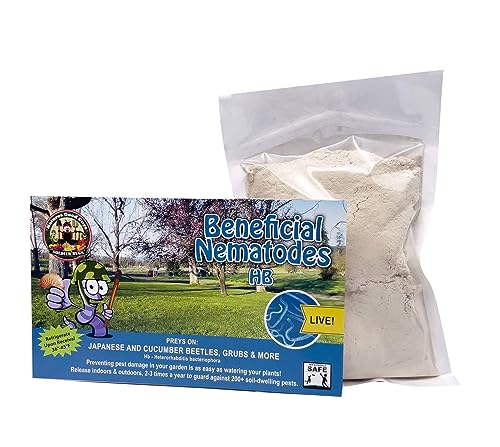
NaturesGoodGuys Beneficial Nematodes Heterorhabditis bacteriophora (10 Million)
The exact Hb species extension sources name for grub control. Apply to moist soil in the evening and avoid peak sun, which kills nematodes fast. Efficacy is variable by grub species, so use it as the IPM-compatible supplemental option, not a guaranteed standalone cure.
The most common biological-control failure is applying milky spore against chafer grubs, where it is inert. Before spending money on any biological, confirm the beetle species by inspecting the adults in midsummer or having a county extension office identify a grub. The wrong biological is not a weak treatment; it is no treatment.
Cultural Practices That Reduce Grub Damage
Chemistry and biologicals are not the whole picture. A vigorous, deeply rooted lawn shrugs off grub feeding that would kill a thin one, and several cultural habits raise that tolerance.
Build Root Mass
Michigan State's five-grubs-per-square-foot tolerance figure assumes healthy, well-rooted turf. The way you get there is deep, infrequent irrigation that drives roots down, appropriate mowing height, and a sound fertilization program. Mowing too short and watering shallowly produce a shallow root system that collapses the moment grubs start feeding. Proper irrigation timing and a season-appropriate fertilization schedule do more for grub resilience than most homeowners expect.
Reduce Drought Stress
Grub damage and drought stress compound each other. Chewed roots cannot pull water, and a water-stressed lawn shows grub damage at far lower counts. During hot, dry stretches, keeping the lawn adequately watered both reduces visible grub symptoms and supports the recovery of damaged roots. Our summer stress management guide covers the double-stress scenario directly.
Repair After the Fact
If grubs thinned an area despite your best timing, the recovery move is overseeding once temperatures cooperate, not another insecticide. Plan the renovation alongside fall seeding so the new grass establishes in the cool-season window rather than fighting summer heat.
Common Grub-Control Mistakes
These are the errors that turn a sound product into a failure.
Treating on the calendar instead of the soil. Beetle hatch shifts by weeks across regions and years. A mid-July application that is perfect in Nebraska may miss the window in a warm spring or a southern lawn. Watch the soil temperature and the beetle activity, not the date.
Using a preventer as a rescue. Chlorantraniliprole and imidacloprid do little against the large grubs you discover in September. If you are reacting to visible damage, you need a curative, applied only if counts are over threshold.
Using a curative as prevention. Trichlorfon breaks down in 7-10 days. Applied in spring, it is gone long before the grubs hatch. It is a knockdown for present grubs, nothing more.
Skipping the water-in. The single most common reason grub products "do not work." A half-inch of irrigation immediately after application is required for the active to reach the root zone.
Applying the wrong biological. Milky spore against chafers is money spent on nothing. Confirm the species first.
Treating without counting. Healthy turf tolerates roughly five grubs per square foot. Spreading a curative across a whole lawn over a count of two grubs is unnecessary pesticide exposure. Scout first.
If it is spring and you have a grub history: spread chlorantraniliprole and water it in. If it is late summer and you have confirmed counts over 8-10 per square foot: apply trichlorfon and water it in. If counts are below threshold and the turf is healthy: do nothing and reassess next season. Everything else is a variation on those three calls.
Verify the Timing With Real Soil Data
Every recommendation in this guide ultimately points back to one number: the 2-inch soil temperature, and the beetle activity it drives. Regional averages and calendar rules get you close, but your yard has its own microclimate, and a warm or cool spring shifts the hatch by weeks. The preventive window opens as soil sustains 65-70°F ahead of egg hatch; the curative window follows on small grubs at 60-70°F in late summer.
SoilTemps.com tracks 2-inch soil temperatures from more than 380 USDA SCAN and NOAA USCRN monitoring stations nationwide, so you can confirm when your soil enters the egg-hatch range instead of guessing. Pair that with a quick check for beetle activity (adults flying at dusk, feeding damage on ornamentals) and you will hit the preventive window with confidence.
Verify the lever
Confirm your grub-prevention window
Enter your city or ZIP code to see real-time 2-inch soil temperatures from the nearest station and check whether your soil has reached the 65-70°F egg-hatch range that triggers preventive grub control.