
Quick Answer: When Does Nutsedge Emerge and When Should You Treat It?
Yellow nutsedge tubers begin sprouting when soil at the 2–4 inch depth consistently reaches 54–55°F. Purple nutsedge requires 59°F. The optimal window for post-emergent herbicide (halosulfuron, sulfentrazone) is the 3–8 leaf stage, typically June through early July in most temperate regions, before new tuber formation begins in late July. Identify which species you have — yellow (bright yellow-green, tapered leaf tips, single tubers) or purple (glossy dark green, blunt leaf tips, chained tubers) — because they respond differently to different herbicides.
Quick Answer
Check your local 2-inch soil temperatures now
Enter your city or ZIP code to see real-time soil temperature data from the nearest USDA monitoring station — and find out whether nutsedge tubers in your lawn have started sprouting.
If there is one weed that makes homeowners throw up their hands, it is nutsedge. You spray it, it comes back. You pull it, it comes back thicker. You apply your standard crabgrass pre-emergent, and it erupts straight through the barrier as if nothing happened. Most lawn care articles on the internet lump nutsedge in with the usual list of broadleaf weeds and summer grasses, which is part of the problem.
Nutsedge is not a grass. It is not even a broadleaf. It is a sedge, which is a completely different plant family with a completely different life cycle — and understanding that distinction is the key to every decision you will make about controlling it. This guide walks through exactly how to identify nutsedge, how to tell yellow from purple, why its underground tuber network makes it so difficult to kill, and how to use real-time soil temperature data to time your treatments for maximum effect.
Why Nutsedge Is Different From Every Other Lawn Weed
Both yellow nutsedge (Cyperus esculentus) and purple nutsedge (Cyperus rotundus) spread primarily through underground tuber networks rather than seed. That single fact explains almost everything about why they are so persistent. Yellow nutsedge seeds require cross-pollination and produce seedlings so fragile they rarely survive in the field. Purple nutsedge produces virtually no viable seed in the United States. The tuber network is the plant.
The scale of that tuber network is staggering. A single yellow nutsedge tuber can produce 1,900 shoots and 6,900 new tubers in a single growing season, and a single tuber can generate a patch six feet in diameter. Densely infested soils may contain 10 to 35 million tubers per acre, with over 75% concentrated in the top 6 inches of soil but some reaching depths of 18 inches. Each tuber has up to 7 viable buds, and each bud can sprout independently. If the first sprout is destroyed, the next bud activates. A single tuber can resprout three or more times before exhausting its reserves.
And those tubers can lie dormant in the soil for years. Most tubers remain viable for one to four years, with rare reports of viability up to 10 years at greater depths. This dormant tuber bank is the fundamental reason why Purdue Extension estimates two to three years of consistent treatment are needed to reduce the viable tuber bank by 90%.
Because nutsedge sprouts from tubers rather than seeds, and because those tubers respond to very specific soil temperature thresholds, real-time soil temperature data is the single most actionable piece of information in the entire nutsedge management equation. Yellow nutsedge wakes up at 54–55°F. Purple nutsedge wakes up at 59°F. Knowing when you cross those thresholds tells you exactly when to start watching for emergence — and when herbicide applications will translocate most effectively to the tuber network.
How to Identify Nutsedge in Your Lawn
Nutsedge announces itself. It grows significantly faster than the surrounding turfgrass, producing visible clumps that stick up above the mowed lawn within two to three days after mowing. If you mowed on Saturday and by Tuesday there are bright, glossy spears poking an inch above everything else, you are almost certainly looking at nutsedge.
The Definitive Field Test: Roll the Stem
The most reliable identification test takes about five seconds. Pull up a stem and roll it between your thumb and forefinger.
Grass stems are round and hollow. They spin freely between your fingers with no edges.
Nutsedge stems are solid and triangular. You can feel three distinct corners as the stem rolls. This is the origin of the classic mnemonic taught in every turfgrass identification course: "sedges have edges."
That single test settles the question. Triangular stem with solid interior equals sedge. Round hollow stem equals grass.
The Three-Ranked Leaf Arrangement
Look straight down at a nutsedge plant from above. The leaves emerge in a distinctive three-ranked arrangement at 120° angles from each other, forming a Y shape when viewed from the top. Grass leaves, by contrast, alternate on opposite sides of the stem at 180°.
Nutsedge leaves also have a V-shaped cross-section, a glossy or waxy surface, and a prominent midvein running down the center. Unlike grasses, nutsedge lacks a collar, ligule, or auricles at the leaf base — the features turf identification guides use to distinguish cool-season grass species from each other.
Color and Growth Habit
Yellow nutsedge stands out with a distinctly bright yellow-green color — almost neon compared to the darker green of most lawns. Purple nutsedge has glossy dark green foliage that can be harder to spot in warm-season turf. Both species grow strictly erect, not sprawling, and both produce visible clumps that tower above the surrounding lawn within days of mowing.
Yellow vs. Purple: The Differences That Matter
Telling the two species apart matters because they respond differently to herbicides. An herbicide that provides 90% control of yellow nutsedge may deliver only 50% control of purple nutsedge, and vice versa. Guessing wrong wastes an entire treatment window.
Leaf Shape and Color
The easiest field distinction is the leaf tip. Yellow nutsedge leaves taper to a long, gradually narrowing point. Purple nutsedge leaves end more abruptly, with a blunter tip. Yellow nutsedge leaves are also wider (4–9 mm) and lighter colored — the bright yellow-green that gives the species its name. Purple nutsedge leaves are narrower (3–6 mm) and darker, glossier green.
Seed Heads (If You Let It Flower)
Regular mowing prevents nutsedge from flowering, so seed heads usually appear only in unmowed areas, edges, and neglected spots. When they do form, the color is unmistakable:
- Yellow nutsedge produces straw-colored to golden-yellow spikelets in umbrella-shaped clusters.
- Purple nutsedge produces distinctly reddish-purple to purplish-brown flower clusters.
Below Ground: Singles vs. Chains
The tuber arrangement is where the two species diverge critically. Yellow nutsedge tubers form singly at the tips of rhizomes — you pull up a plant and find one tuber at the end of a runner. Purple nutsedge tubers form in chains along rhizomes, spaced 2–10 inches apart, with multiple tubers linked like beads on a string.
That chain structure is the reason purple nutsedge is so much harder to eradicate. Tubers along a chain exhibit apical dominance: the terminal (newest) tuber chemically suppresses sprouting of the older tubers behind it. Breaking the chain — by pulling, tilling, or even vigorous cultivation — releases all the suppressed tubers from dormancy simultaneously. An aggressive weeding session on purple nutsedge can multiply the infestation instead of reducing it.
Yellow vs. Purple at a Glance
| Trait | Yellow Nutsedge | Purple Nutsedge |
|---|---|---|
| Scientific name | Cyperus esculentus | Cyperus rotundus |
| Leaf color | Bright yellow-green | Glossy dark green |
| Leaf width | 4–9 mm | 3–6 mm |
| Leaf tip | Long, gradually tapered | Abrupt, blunter |
| Seed head color | Straw / golden-yellow | Reddish-purple |
| Tuber arrangement | Single at rhizome tips | Chained along rhizomes |
| USDA zone range | 3–11 | 7–11 |
| Best-responding herbicide | Halosulfuron, sulfentrazone | Halosulfuron, sulfosulfuron, imazaquin |
Distinguishing Nutsedge From Common Look-Alikes
Nutsedge is sometimes confused with crabgrass or clumpy tall fescue, but the differences are clear once you know what to look for.
Crabgrass sprawls outward in a star-shaped, mat-forming habit with round stems and hairy leaves. Nutsedge grows strictly erect with smooth, glossy leaves and triangular stems. Crabgrass prefers hot, compacted areas near pavement. Nutsedge gravitates toward moist, poorly drained soil.
Clumpy tall fescue can look similar from a distance but has round stems, matte leaf surfaces, and visible auricles at the leaf base. Tall fescue persists year-round rather than dying back to tubers at frost.
- Does it grow noticeably faster than the surrounding lawn, standing tall within 2–3 days after mowing?
- Rolled between your fingers, is the stem triangular and solid?
- Looking down from above, do the leaves form a Y at 120° angles?
- Is the leaf glossy, V-shaped in cross-section, with a prominent midvein?
Four yeses = nutsedge. Now determine yellow or purple by leaf color, width, and tip shape.
Where Yellow and Purple Nutsedge Grow in North America
Yellow nutsedge has an enormous range, persisting across USDA Hardiness Zones 3 through 11 — essentially the entire continental United States and into southern Canada. Its tubers overwinter deep enough to avoid lethal soil temperatures even in cold climates. Yellow nutsedge is the dominant nutsedge species in cool-season turf regions including the Northeast, Mid-Atlantic, Midwest, and Pacific Northwest, where its rapid summer growth and yellow-green color contrast sharply with dormant or slow-growing cool-season grasses.
Purple nutsedge has a far more restricted range, limited to approximately Zones 7 through 11. It cannot persist where soils freeze for extended periods. The Flora of North America notes it does not grow north of the mean 34°F (1°C) January isotherm. Its core U.S. range runs from Virginia through the Gulf Coast states to central Texas, with established populations in California's Central Valley and low desert, Arizona, and Hawaii. While purple nutsedge has been documented as far north as New York and Pennsylvania, there is no evidence of persistent overwintering populations in those states.
In the Southeast and Southwest, purple nutsedge often co-occurs with yellow nutsedge and is widely regarded as the more aggressive of the two — it is classified as the world's worst agricultural weed in tropical and subtropical regions.
The Nutsedge Life Cycle: Soil Temperature Is the Trigger
This is where real-time soil temperature data becomes a decisive advantage. Nutsedge emergence is not driven by a calendar date. It is driven by a specific soil temperature crossed at a specific depth.
Emergence Thresholds
Yellow nutsedge tubers initiate sprouting when soil temperatures at the 2–4 inch depth consistently reach 54–55°F (12–13°C). This threshold comes from peer-reviewed research by Stoller and Wax (1973) and has been confirmed by multiple university extension sources.
Purple nutsedge requires warmer soil. Continuous emergence begins when soil temperatures exceed 59°F (15°C), with optimal sprouting at 77–95°F (25–35°C), according to research by Horowitz (1972).
A degree-day model developed by Wilen, Holt, and McCloskey (1996) uses a base temperature of 53°F (11.7°C) and an upper threshold of 78°F (25.6°C) to predict yellow nutsedge emergence. First emergence occurs after approximately 204 growing degree-day units accumulate from January 1.
Research by Miles et al. (1996) and Wallace et al. (2013) also demonstrates that fluctuating diurnal temperatures — warm days followed by cool nights — significantly accelerate both the percentage and speed of tuber sprouting compared to constant temperatures of the same average. A 65°F day with a 45°F night produces more emergence than a steady 55°F.
Regional Emergence Windows
In practical terms, yellow nutsedge typically emerges:
- Late April through May across the Midwest and Mid-Atlantic
- May through June in the Northeast
- March or April in the Southeast and Southwest
Purple nutsedge emerges later, typically May through June in the southeastern U.S., with peak emergence in July.
The Critical Inflection Point: Tuber Formation Begins in Late July
After emergence, both nutsedge species grow rapidly through the summer heat. They use C4 photosynthesis, which gives them a metabolic advantage over cool-season grasses during exactly the months those grasses are stressed. Peak vegetative growth runs from June through August.
The critical inflection point comes when daylength begins to shorten. Yellow nutsedge begins forming new tubers when daylength drops below approximately 14 hours — which occurs in late July in Ohio, early August in Illinois, and mid-to-late August in more northern locations. All above-ground foliage, rhizomes, roots, and basal bulbs die at the first hard frost. Only tubers and (rarely) seeds survive winter.
The seasonal cycle creates a clear treatment window: after emergence but before new tuber formation — roughly June through early July in most temperate regions. Herbicides applied during this window translocate to the existing tuber network most effectively, and killing plants before they produce new tubers prevents the underground bank from replenishing. Applications made after late July kill visible foliage but miss the tubers already forming underground. You are mowing the lawn while the enemy digs trenches.
Chemical Control: What Actually Works on Nutsedge
Five active ingredients account for the vast majority of successful nutsedge control in residential lawns. Choosing the right one depends on your species (yellow or purple) and your turfgrass type.
Halosulfuron-Methyl (SedgeHammer, Prosedge) — The Most Versatile Option
Halosulfuron is an ALS-inhibitor absorbed through foliage and translocated systemically to rhizomes and tubers. It provides excellent control (≥90%) of yellow nutsedge and good-to-excellent control (75–90%+) of purple nutsedge. Its greatest advantage is the broadest turfgrass tolerance of any nutsedge herbicide — it is safe on bermudagrass, tall fescue, Kentucky bluegrass, zoysiagrass, St. Augustinegrass, centipedegrass, fine fescue, and perennial ryegrass.
The tradeoff is speed. Injury symptoms don't appear for about a week, and complete control takes three weeks. A nonionic surfactant is required for the standard WDG formulation (SedgeHammer+ includes surfactant). Sequential applications at 6–10 week intervals maximize control. Research by Li et al. (2021) showed greater than 95% control with two applications spaced three weeks apart.
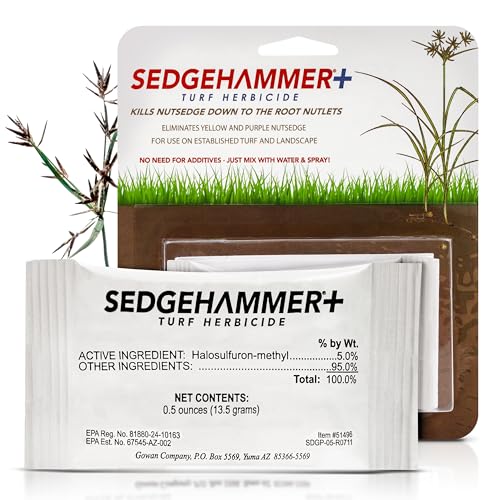
SedgeHammer+ (Halosulfuron-Methyl)
The most versatile nutsedge herbicide for residential lawns. Effective on both yellow and purple nutsedge, safe on virtually all warm- and cool-season turfgrasses. The "+" formulation includes a surfactant.
Sulfentrazone (Dismiss, Surepyc) — Fastest Visible Results
Sulfentrazone delivers the fastest visible results of any nutsedge herbicide — pronounced injury within 48 hours, and treated plants no longer visible within 10 days. It provides excellent control of yellow nutsedge but is poor to fair (≤50–75%) against purple nutsedge.
This distinction matters. Homeowners using sulfentrazone-based products like Ortho Nutsedge Killer on purple nutsedge will get disappointing results and may blame the product when the real issue is species mismatch.
Sulfentrazone also offers some pre-emergent suppression when applied in April and has soil residual activity exceeding 200 days. No surfactant is needed — in fact, adding surfactant risks turf damage. It is safe on most cool- and warm-season grasses, though some zoysiagrass and fine fescue cultivars show sensitivity.
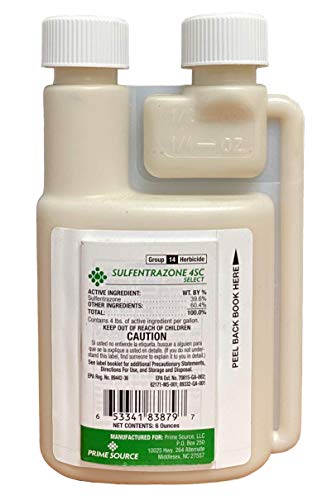
Dismiss (Sulfentrazone)
Fastest visible results for yellow nutsedge — treated plants wilt within 48 hours and are gone within 10 days. Also provides some pre-emergent suppression when applied in April. Not effective on purple nutsedge.
Imazaquin (Image Nutsedge Killer) — Best for Purple Nutsedge in Warm-Season Turf
Imazaquin reverses the usual pattern: it provides better control of purple nutsedge (75–90%) than yellow nutsedge (50–75%), making it a valuable option in the Southeast where purple nutsedge dominates. However, it is safe only on warm-season grasses — bermudagrass, centipedegrass, St. Augustinegrass, zoysiagrass, and buffalograss. It will injure or kill any cool-season turfgrass.
Mesotrione (Tenacity) — Cool-Season Niche
Mesotrione provides good control of yellow nutsedge (75–90%) but is poor against purple nutsedge (≤50%). It requires two applications 14–21 days apart and causes distinctive bleaching (whitening) of treated plants. Its primary niche is cool-season lawns — it is safe on Kentucky bluegrass and tall fescue, and can be used during lawn renovation on newly seeded turf. It should not be applied to actively growing bermudagrass or zoysiagrass.
Bentazon (Basagran T&O) — Broad Tolerance, Yellow Only
Bentazon offers good yellow nutsedge control (75–90%) with the broadest turf tolerance of any nutsedge herbicide — safe on essentially all warm- and cool-season grasses. It acts faster than halosulfuron, with injury symptoms appearing in 5–7 days. Its weakness is poor performance against purple nutsedge. A methylated seed oil adjuvant improves efficacy.
Purple Nutsedge Specialists
For purple nutsedge specifically, the best options beyond halosulfuron include sulfosulfuron (Certainty) and trifloxysulfuron (Monument), both rated excellent (≥90%) against purple nutsedge — though both are restricted to warm-season turfgrasses. Dismiss South, a combination of sulfentrazone and imazethapyr specifically formulated for purple nutsedge in warm-season turf, provides both fast contact burndown and systemic tuber control. It is explicitly not labeled for St. Augustinegrass.
Turfgrass Tolerance at a Glance
| Herbicide | Cool-Season | Bermuda | Zoysia | St. Augustine | Centipede |
|---|---|---|---|---|---|
| Halosulfuron (SedgeHammer) | ✓ All | ✓ | ✓ | ✓ | ✓ |
| Sulfentrazone (Dismiss) | ✓ Most* | ✓ | Caution | ✓ | ✓ |
| Imazaquin (Image) | ✗ None | ✓ | ✓ | ✓ | ✓ |
| Mesotrione (Tenacity) | ✓ KBG, Fescue, Rye | ✗ | ✗ | ✗ | ✗ |
| Bentazon (Basagran) | ✓ All | ✓ | ✓ | ✓ | ✓ |
| Sulfosulfuron (Certainty) | ✗ None | ✓ | ✓ | Caution | ✓ |
Some fine fescue cultivars may show injury from sulfentrazone.
The Pre-Emergent Myth
This is one of the most common misconceptions in lawn care. No true pre-emergent exists for nutsedge in residential turf. UC IPM states it directly: "No preemergent herbicides that effectively control nutsedge can be used on turfgrass."
Standard pre-emergent herbicides like prodiamine, pendimethalin, and dithiopyr create a chemical barrier in the top soil layer that prevents seed germination. That barrier works great against crabgrass, which germinates from seed sitting in the top inch of soil. It does nothing against nutsedge, because nutsedge tubers sit 8 to 18 inches deep and send vigorous shoots straight through the barrier as if it were not there.
The partial exception is sulfentrazone (Dismiss), which provides some pre-emergent suppression of yellow nutsedge when applied in April, though Penn State notes "preemergence control is usually not 100%." Professional-use products like dimethenamid-P (Tower) and S-metolachlor (Pennant Magnum) offer pre-emergent suppression but are restricted to golf courses or commercial applications.
For homeowners, post-emergent timing is everything — and that timing is defined by soil temperature.
Application Timing Anchored to Soil Temperature
Herbicide efficacy is directly tied to nutsedge growth stage, which is driven by soil temperature. The optimal treatment sequence unfolds like this:
At 54–55°F soil temperature (2–4 inch depth): Yellow nutsedge tubers begin sprouting. Pre-emergent sulfentrazone applications can reduce emergence.
At 59°F soil temperature: Purple nutsedge tubers begin sprouting.
At the 3–8 leaf stage (typically June through early July): This is the optimal post-emergent window. Plants are young enough that herbicide translocates effectively to tubers, but old enough to absorb adequate product through leaf surfaces. The University of Arizona specifically recommends repeated applications at 7–14 day intervals before the summer solstice for best results.
After late July: New tuber formation has begun. Herbicides applied now kill foliage but miss the dormant tubers already forming underground. Control is significantly reduced.
Fall applications (4–5 weeks before first frost): Can provide supplemental control by translocating to tubers as the plant prepares for dormancy.
- Do not mow for 2–3 days before or after spraying. Foliage needs to be intact to absorb the herbicide.
- Water the lawn the day before treatment so plants are actively growing.
- Avoid applications when air temperatures exceed 90°F.
- Do not irrigate for 24 hours after foliar-applied herbicides.
- Drought-stressed nutsedge absorbs herbicide poorly. Water deeply 1–2 days before spraying if conditions are dry.
Cultural Control: The Long Game That Makes Herbicides Work
Chemical control kills existing plants and prevents new tuber formation, but it does not kill dormant tubers already banked in the soil. Cultural practices determine whether those dormant tubers find conditions hospitable enough to thrive — or hostile enough to suppress.
Mow High to Shade Out Tubers
Nutsedge is shade-intolerant. Research demonstrates that 60–80% shade reduces total nutsedge biomass by more than half and tuber biomass by 75% or more. Mowing at the upper end of the recommended range for your turfgrass species creates a denser canopy that shades the soil surface and directly suppresses nutsedge vigor.
- Cool-season lawns: Maintain a 3.5–4 inch mowing height.
- Bermudagrass and zoysiagrass: Mow at the high end of the species range, 1.5–2.5 inches.
- St. Augustinegrass: 3–4 inches.
Virginia Tech Extension specifically advises increasing mowing height during summer stress periods, when cool-season grasses are weakest and nutsedge is most competitive.
Deep, Infrequent Watering Starves Nutsedge's Advantage
Every university extension source reviewed confirms that excessive irrigation promotes nutsedge. A remarkable study from Oregon quantified the effect: under frequent, shallow irrigation (0.3 inch) that kept soil near field capacity, a single tuber produced 19,000–20,000 new tubers. Under infrequent, deeper irrigation (1.0–1.4 inches) that allowed soil to dry between waterings, nutsedge spread several-fold more slowly.
The prescription is consistent: water 1 to 1.5 inches per week in one to two sessions, allowing the soil surface to dry between applications. Then inspect your irrigation system for leaks. Dripping sprinkler heads and leaking valves are among the most commonly overlooked causes of the persistent moisture nutsedge exploits.
Correct the Underlying Drainage Problem
Nutsedge presence in a lawn is itself a diagnostic indicator. UC IPM, Purdue, and Clemson all describe nutsedge as an indicator plant for poor drainage or overwatering. Addressing the underlying drainage issue — regrading low spots, core-aerating compacted soil, installing French drains, or redirecting downspouts — removes the environmental advantage nutsedge depends on.
However, Purdue notes that nutsedge can also invade well-drained areas with thin turf, so drainage correction alone will not solve every infestation. It is one leg of a three-legged stool: herbicides, cultural practices, and prevention.
A Multi-Year Tuber Depletion Strategy
Eliminating a nutsedge infestation is a multi-year commitment. The integrated approach looks like this:
Year 1:
- Correct drainage and irrigation problems.
- Raise mowing height to the upper end of your turf species' range.
- Apply post-emergent herbicide at the 3–8 leaf stage (June–early July), with a follow-up application 6–10 weeks later.
- Fertilize turf properly, emphasizing fall nitrogen for cool-season grasses.
- Overseed thin areas in autumn to close gaps where nutsedge can establish.
Year 2:
- Apply post-emergent at first emergence, as soon as soil temperatures cross the 54°F (yellow) or 59°F (purple) threshold and plants reach the 3-leaf stage.
- Follow up 6–10 weeks later.
- Maintain cultural practices and monitor for re-emergence from dormant tubers.
Year 3:
- Spot-treatment of remaining plants should be sufficient, with the tuber bank substantially depleted.
- Continue cultural practices to prevent re-invasion.
Hand-pulling is viable only for very small, isolated patches — fewer than a dozen plants — if done before the 5–6 leaf stage and repeated every 2–3 weeks through summer. Each pull forces the tuber to use stored energy for regrowth, with UC IPM noting that 60% of tuber reserves go to the first sprout and 20% to the second.
But for purple nutsedge, pulling can backfire badly. Breaking tuber chains releases dormant tubers from apical dominance and can multiply the infestation. For anything beyond a tiny patch of yellow nutsedge, herbicides are essential.
Prevention: Stop Tubers Before They Arrive
The most common introduction pathway for nutsedge is contaminated topsoil or fill dirt. Tubers are invisible within bulk soil and ride along in every load. Purchased sod, nursery container plants, and soil carried on equipment and tools are also common vectors.
To prevent introduction:
- Ask soil suppliers whether their product is nutsedge-free (and understand that many will not know).
- Inspect new sod for glossy, triangular-stemmed shoots before installation.
- Clean equipment after working in infested areas.
- In landscape beds, use polypropylene landscape fabric covered with mulch. Standard polyethylene plastic fails because nutsedge punctures through it.
Soil Temperature Is Your Early Warning System
Nutsedge control comes down to timing, persistence, and the right chemistry matched to the right species. The single most actionable data point in this entire equation is soil temperature at the 2–4 inch depth.
When it crosses 54–55°F in spring, yellow nutsedge tubers are waking up. When it reaches 59°F, purple nutsedge follows. Monitoring real-time soil temperatures transforms nutsedge management from reactive guesswork — spraying when you notice the problem — into a proactive, data-driven strategy: apply pre-emergent sulfentrazone as soils warm through the 50s, then time post-emergent halosulfuron or sulfentrazone applications to hit young plants at the 3–8 leaf stage before the tuber formation window opens in late July.
The most effective overall herbicide for both species remains halosulfuron (SedgeHammer), with the broadest turf tolerance and strong efficacy against both yellow and purple nutsedge. For yellow nutsedge when speed matters, sulfentrazone (Dismiss) delivers visible results in 48 hours. For purple nutsedge in warm-season turf, sulfosulfuron (Certainty) or Dismiss South are the strongest options. Pair chemical applications with high mowing, deep infrequent irrigation, and drainage correction, commit to a two-to-three-year program, and the tuber bank will steadily deplete.
Skip a year, and a single surviving tuber can rebuild the entire colony.
Track Your Local Soil Temperatures and Stay Ahead of Emergence
Calendar dates are lagging indicators. Your yard, your soil, your microclimate. The only way to catch nutsedge at the exact moment its tubers begin sprouting — when herbicides translocate most effectively and before new tubers form underground — is to monitor soil temperature at the depth where emergence happens.
SoilTemps.com tracks 2-inch soil temperatures from over 380 USDA SCAN, CSCAN, and NOAA USCRN monitoring stations nationwide. We show you the data alongside the exact thresholds that matter for nutsedge emergence, so you can make treatment decisions based on what is actually happening in the ground rather than what the calendar says.
Ready to check your soil temperature?
Enter your city or ZIP code to see real-time 2-inch soil temperature data from the nearest monitoring station — and find out whether the nutsedge tubers in your lawn have crossed the 54°F and 59°F sprouting thresholds.