
Quick Answer
Water deeply and infrequently, targeting about 1 inch per week (including rainfall) delivered in one or two sessions, then raise the total toward 1.5 inches as soil temperature climbs into the mid-70s and 80s. For cool-season lawns, scale from roughly 1 inch/week at 50-65°F up to about 1.5 inches/week when soil sustains 75-85°F, and always water in the early-morning window of 4 to 9 a.m. The scaling rule follows university extension guidance (University of Missouri, Penn State Extension); the local readings on this site come from USDA SCAN and NOAA USCRN in-ground stations.
What you need
- Measures what your sprinkler puts down: Orbit sprinkler catch cups
- Waters on a schedule: Orbit digital hose timer
- Checks the soil before you water: XLUX soil moisture meter
Quick Answer
Check your local soil temperature right now
Enter your city or ZIP code to see real-time 2-inch soil temperatures from the nearest USDA or NOAA monitoring station, so you can dial irrigation to actual ground conditions instead of guessing.
Most lawns are watered on the wrong signal. The sprinkler clock runs on a calendar, the homeowner waters when the grass looks dry, and the timer never changes from April to August. The result is predictable: shallow roots that fold the moment a heat wave arrives, fungal disease from overwatering, and a water bill that climbs while the lawn stays stressed.
The better signal is soil temperature. It tracks how fast the soil and plant are losing water far more closely than a date on the calendar does. As soil warms, evapotranspiration rises, the lawn drinks faster, and the irrigation total has to climb with it. This guide translates that relationship into a practical schedule: how much water, how often, and at what time of day, tuned to soil temperature and adjusted for your soil texture. The numbers come from more than a dozen university turfgrass programs, and the method is the same whether you have an eight-zone in-ground system or a single oscillating sprinkler on a hose.
The Deep-and-Infrequent Rule Is the Foundation
Before any soil-temperature tuning, one principle governs everything: water deeply and infrequently. Every major turfgrass program agrees on it.
University of Missouri Extension (G6720): turfgrass generally needs about 1 inch of water per week including rainfall, and it is more beneficial to water deeply and infrequently than lightly and often, because deep watering encourages deeper roots and better drought resistance. The mechanism is simple. Roots chase moisture. When you wet only the top inch of soil every day, roots have no reason to grow down, so they cluster near the surface where the first hot, dry day cooks them. When you soak the full root zone and then let the surface dry before the next session, roots follow the water down and build the deep system that carries a lawn through summer.
Penn State Extension (Principles of Turfgrass Irrigation) states the failure mode plainly: frequent shallow watering keeps the upper soil layers near saturation, encourages shallow rooting, and promotes weak turf that is more susceptible to disease and insect attack. Their practical rule is to water deeply only when the plant begins to show mild stress, not on a fixed daily schedule.
UMass Amherst put this to the test. Deep, infrequent irrigation applied at the onset of mild water stress (the first sign of leaf roll) produced deeper rooting and higher turf quality during drought than turf irrigated daily. The takeaway is counterintuitive but consistent across the research: letting the lawn get slightly thirsty between deep soaks builds a tougher, more drought-resistant plant than keeping it constantly wet.
The 1-inch-per-week baseline is not arbitrary. Penn State puts daily evapotranspiration (water use) at roughly 3 to 8 mm per day for cool-season turfgrass and 2 to 5 mm per day for warm-season turfgrass. Over a week, the high end of cool-season use lands close to an inch, and that is what irrigation plus rainfall has to replace during active growth. As soil and air warm, ET climbs toward the top of that range, which is exactly why the weekly total rises with soil temperature.
Why Soil Temperature Is the Right Lever
Air temperature swings hour to hour. Soil temperature changes slowly and tracks the lawn's actual water demand, which is driven by the combination of warmth, sunlight, and plant activity that ET measures.
UMass Amherst notes that the optimum soil temperature for cool-season root growth is 50 to 65 degrees F, which is about 10 degrees F lower than the optimum air temperature for cool-season shoot growth. In other words, the roots that pull water out of the soil are happiest in a cooler band than the top growth. As soil climbs past 65 degrees F, the plant is working harder, losing water faster, and rooting slows. That is the signal to add water, in larger deep sessions rather than more frequent shallow ones.
The tables below translate rising ET into a practical weekly target by soil-temperature tier. Treat them as a field-tested translation of the deep-and-infrequent plus ET logic, not as a verbatim extension chart. Extensions tie water use to ET and grass type rather than publishing a tier-by-soil-temp inch table, so these tiers are the bridge between the science and a number you can set on a controller.
Cool-Season Lawns (Tall Fescue, Ryegrass, Kentucky Bluegrass)
| Soil Temp (2 in) | Water Demand | Weekly Target | Sessions |
|---|---|---|---|
| 50 to 65 degrees F | Low | ~1 inch | 1 |
| 65 to 75 degrees F | Moderate | 1 to 1.25 inches | 1 to 2 |
| 75 to 85 degrees F | High | ~1.5 inches | 2 |
| 85 degrees F+ (drought) | Critical | 1.5 inches, or allow dormancy | 2, or 1/2 inch every 2 to 3 weeks |
Backbone: Penn State ET (cool-season 3 to 8 mm/day) plus the 1-inch baseline from Missouri and Virginia Tech. The dormancy option follows Michigan State (below).
Warm-Season Lawns (Bermuda, Zoysia, St. Augustine, Centipede)
| Soil Temp (2 in) | Water Demand | Weekly Target | Sessions |
|---|---|---|---|
| 60 to 70 degrees F | Low to moderate | ~1 inch | 1 |
| 70 to 85 degrees F | Moderate to high | 1 to 1.5 inches | 1 to 2 |
| 85 degrees F+ | High | ~1.5 inches | 2 |
Backbone: Penn State ET (warm-season 2 to 5 mm/day) plus Texas A&M's bermudagrass guidance below. Warm-season grasses use less water than cool-season turf at the same temperature, which is why the tier totals run a touch lower for the same band.
Higher soil temperature raises the weekly total, not the number of light daily waterings. The deep-and-infrequent rule holds at every tier. When a cool-season lawn hits the 75 to 85 degree F band, you go from one ~1-inch soak to two ~0.75-inch soaks, not from one session to seven. More frequent shallow watering at high soil temperature is the single fastest way to invite disease.
Measuring soil temperature at 2 inches is the input that drives this whole table. See the soil thermometer guide for how to take a stable reading, or check the live 2-inch data from the nearest monitoring station by entering your ZIP at the top of this page.
Time of Day: The 4-to-9 a.m. Window
When you water matters almost as much as how much. The rule is early morning.
Iowa State University Extension (Watering Home Lawns): the ideal time to irrigate is from about 4:00 to 8:00 a.m., when water pressure is highest, wind distortion is minimal, and evaporation loss is negligible. Early morning is preferred over evening. We stretch the window slightly to 9 a.m. for homeowners on hose-end timers, but the principle is the same. Water before the day heats up and the wind picks up, so the water lands where you aim it and soaks in instead of evaporating off the blades.
The second reason is disease, and it is the bigger one. Iowa State also warns that watering in late evening or overnight keeps grass blades wet for extended periods, creating conditions favorable to fungal diseases such as brown patch and dollar spot. Morning watering limits the hours of leaf wetness because the sun dries the blades within a couple of hours. The real rule, as recent extension nuance makes clear, is not the clock itself but leaf-wetness duration: do not extend the hours the grass stays wet. Early-morning watering achieves that because dew is already on the blades and the sun will burn it off shortly. Evening watering adds 8 to 12 hours of darkness to the wet window, which is when fungal pathogens move.
If your only option is midday (some municipal restrictions force odd windows), it will not raise disease pressure because the blades dry fast. It just wastes a meaningful fraction of the water to evaporation and wind. Early morning remains best on both counts: low evaporation and short leaf-wetness duration.
Overwatering Is a Disease Engine
The most expensive irrigation mistake is not underwatering. It is keeping the soil and canopy wet enough to grow fungus.
University of Georgia CAES is direct: excess moisture, including overwatering, fosters brown patch disease, which is driven by excessive moisture during hot weather. Brown patch is the classic summer disease of tall fescue, and an overzealous sprinkler schedule is one of its most reliable triggers. Penn State ties the same overwatering pattern to weak, shallow-rooted turf that is broadly more vulnerable to disease and insects.
The other moisture disease to fear is Pythium. It thrives in moisture-rich environments; excessive rainfall, overwatering, or poor drainage create ideal conditions for the fungus, and overwatering can push it into the more severe Pythium root rot. Pythium moves fast and can kill turf in a day under the right heat-and-water conditions, so the margin for sloppy overwatering shrinks in summer exactly when many homeowners crank the timer up.
If your lawn is browning in patches during hot, humid weather and the soil is staying wet, suspect a disease driven by overwatering before you add more water. The lawn disease by temperature guide maps which pathogen shows up in which soil-temperature band, and overwatering is the common accelerant across most of them. The fix is usually to water less often and deeper, and to move the schedule to early morning.
The Catch-Can Audit: Calibrate Your Sprinklers
Every number above is meaningless until you know how much water your system actually delivers. Two identical-looking sprinkler zones can put down wildly different amounts. The catch-can audit, the upgraded tuna-can method, is how you find out.
How to Run the Audit
University of Minnesota Extension (Auditing home lawn irrigation systems): place 5 to 9 straight-sided cans across a single sprinkler zone, spaced to sample the whole coverage area. Tuna or cat-food cans work; purpose-made catch cups work better because they have markings. Run the zone for a set time, then measure the depth of water in each can.
The cans tell you two things at once:
Distribution uniformity. If the cans hold near-equal levels, coverage is even. If one can is half-full and another is overflowing, you have dry spots and soggy spots, and no single runtime will water the zone correctly. That points to a clogged head, wrong nozzle, bad spacing, or a tilted sprinkler.
Application rate. Average the can depths, then scale the timed run to an hourly rate. New Mexico State University Extension (H510) spells out the conversion: a 15-minute run multiplied by 4, or a 30-minute run multiplied by 2, estimates inches per hour. From there, the runtime to deliver 1 inch is 60 divided by the inches-per-hour figure, in minutes.
Suppose a 15-minute run leaves an average of 0.2 inch in the cans. Multiply by 4: the zone applies 0.8 inch per hour. To deliver 1 inch, run it 60 / 0.8 = 75 minutes. On clay, you would split that into two 37-minute cycles with a soak break between. Do this audit once per zone in spring and you will never guess at runtimes again.

Orbit Sprinkler Catch Cups, 2-Pack (24 cups + stakes)
A purpose-built audit kit that turns the tuna-can method into a precise measurement. The 24 staked cups with inch and milliliter markings let you map both application rate and distribution uniformity across a full zone in one run, so you can set exact runtimes.
Soil Texture Changes Frequency, Not the Total
Once you know your application rate, soil texture tells you how to split the weekly inch. This is where a lot of advice goes wrong by treating all lawns the same.
Clemson Cooperative Extension (Landscape Irrigation Management Part 6) quantifies why: water-holding capacity differs sharply by texture. Coarse sand holds about 0.05 inch of water per inch of soil depth, loam up to 0.18 inch, and clay up to 0.17 inch. Over a 10-inch root zone, that is roughly 0.5 inch of plant-available water in sand versus about 1.7 inches in clay. Sand cannot hold a full inch in the root zone, so dumping an inch on sand just drains the excess below the roots. Clay can hold the whole inch but takes it in slowly.
The result is a frequency adjustment, with the weekly total staying near 1 inch:
| Soil Texture | Frequency | Per Application | Notes |
|---|---|---|---|
| Coarse sand | ~3x per week | 0.3 to 0.35 inch | Drains fast, low holding capacity |
| Sandy / sandy loam | ~2x per week | ~0.5 inch | High infiltration, little runoff |
| Loam | ~1x per week | ~1.0 inch | Ideal holding and infiltration |
| Clay / clay loam | ~1x per week | ~1.0 inch (split) | Slow infiltration, use cycle-and-soak |
Weekly total stays near 1 inch in all cases; only the split changes.
Cycle-and-Soak for Clay
Clay holds water well but takes it slowly. University of Arizona Turfgrass Research notes that heavy clay and silt soils have poor infiltration and are prone to puddling and runoff, while sandy and sandy-loam soils take water quickly without runoff. Clay infiltrates at around 0.2 inch per hour, so a single 1-inch soak runs off into the street long before it sinks in.
The fix from Clemson is cycle-and-soak: apply about 0.5 inch, pause to let it infiltrate, then apply another 0.5 inch later the same morning. The pause lets the first half sink past the surface so the second half has somewhere to go. Most smart controllers automate this with a soak-interval setting. If you are auditing your own runtimes from the catch-can math, simply split the calculated runtime in half with a 30-to-60-minute gap on clay.
Wet a handful of soil and try to roll it into a ribbon. Sand falls apart and feels gritty. Loam forms a short, crumbly ribbon. Clay rolls into a long, smooth ribbon and feels sticky. That ribbon test, paired with the catch-can rate, is enough to set frequency and decide whether you need cycle-and-soak.
Watering an Even Surface Without an In-Ground System
If you water by hose, the catch-can audit still applies, and the limiting factor becomes even coverage. An oscillating sprinkler that throws more water near the center than the edges will create the same uneven pattern an in-ground system can, so the cans matter just as much.
For a hose-fed deep-watering session, an adjustable oscillating sprinkler covers a rectangular zone evenly and lets you match the throw to the area. Pair it with the catch cups to calibrate the runtime, then a built-in timer lets you start it before sunrise without standing in the yard at 5 a.m.
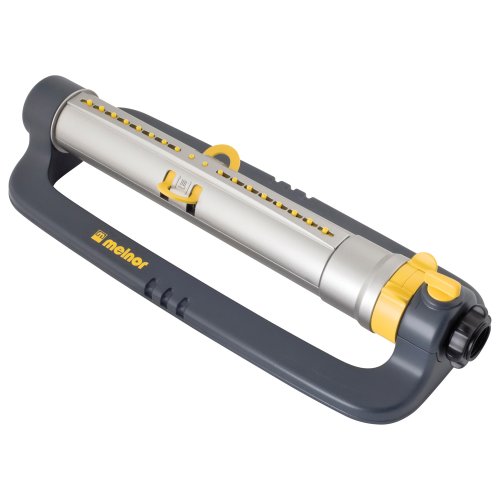
Melnor XT Turbo Oscillating Sprinkler (XT4200-IN, up to 4,500 sq ft)
An adjustable oscillating sprinkler that delivers even rectangular coverage during a catch-cup-calibrated deep-watering session. TwinTouch width and flow controls let you match the spray pattern to the exact area you are soaking, which is what even, runoff-free deep watering needs.

Melnor 65133AMZ XT Turbo Oscillating Sprinkler with Timer (4,000 sq ft)
The same even oscillating coverage with a built-in mechanical timer that shuts the water off after up to about two hours. For homeowners without an in-ground system, this is how you run a controlled, deep early-morning session on a hose without being awake to turn it off.
Subtract the Rain: Fill the Gap, Not the Whole Inch
The weekly target includes rainfall. Irrigation only needs to cover the deficit, which is the target minus whatever the sky delivered. Watering a full inch the day after a half-inch storm is how lawns get overwatered into disease.
A simple rain gauge after each storm is the real input here. Climatological averages set expectations, but a gauge tells you what actually fell on your yard this week. The regional table below shows how much of the inch summer rainfall typically covers, and how big a gap you are usually filling.
Summer Rainfall vs. the 1-Inch-Per-Week Target by Region
| Region (representative state) | Summer rain (Jun-Aug, in) | Approx. weekly rain (in) | Irrigation gap vs ~1 in/wk |
|---|---|---|---|
| Deep South / Gulf (Florida) | 21.4 | ~1.6 | Usually surplus; often skip or minimal supplement |
| Southeast (Georgia) | 14.1 | ~1.1 | Near break-even; supplement in dry spells |
| Mid-Atlantic (Pennsylvania) | 12.4 | ~0.95 | Roughly break-even; supplement hot/dry weeks |
| Northeast (New York) | 11.7 | ~0.90 | Small gap, ~0.1 to 0.5 in/wk supplemental |
| Upper Midwest (Minnesota) | 11.7 | ~0.90 | Small gap; supplement July-Aug peaks |
| Midwest (Ohio) | 12.0 | ~0.92 | Small gap; supplement during dry stretches |
| Central Plains (Kansas) | 10.7 | ~0.82 | Moderate gap ~0.2 in/wk, more in heat |
| Northern Plains (Nebraska) | 9.3 | ~0.72 | Moderate gap ~0.3 in/wk |
| Texas (statewide) | 8.1 | ~0.62 | Large gap ~0.4 in/wk; warm-season lawns |
| Mountain West (Colorado) | 5.4 | ~0.42 | Large gap ~0.6 in/wk |
| Desert SW (Arizona) | 4.1 | ~0.32 | Most of the inch irrigated (monsoon helps Jul-Aug) |
| Great Basin (Nevada) | 1.8 | ~0.14 | Nearly all irrigation |
| California (statewide) | 0.8 | ~0.06 | Essentially all irrigation in summer |
Treat these as climatological context, not a substitute for a rain gauge. Published rainfall is gross, not effective: an intense thunderstorm that runs off counts for less than the gauge suggests, which is exactly why a gauge after each storm beats a regional average.
A region averaging 0.95 inch a week does not mean you can skip irrigation every week. Rain arrives in bursts. A two-week dry spell inside a wet-average month still bakes a shallow-rooted lawn. Read your own gauge, fill the gap that is actually there, and skip the session when the gauge already shows an inch.
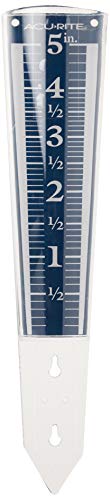
AcuRite 5-inch Magnifying Acrylic Rain Gauge (00850A3)
A simple analog gauge with a magnified scale that reads down to small increments. Empty it after each storm, subtract the reading from your weekly 1-inch target, and irrigate only the remaining deficit. It is the cheapest tool here and the one that prevents the most overwatering.

AcuRite Wireless Digital Rain Gauge with Self-Emptying Collector (00899)
A wireless gauge that logs rainfall automatically and keeps a 7-day history, so you can see the rolling weekly total without walking to the yard. Useful for readers who want the rainfall side of the deficit math tracked for them against the weekly target.
Smart Controllers: Automating the Deficit and the Skip
If you have an in-ground system, a weather-based smart controller is the single highest-impact upgrade for irrigation efficiency. It applies the deep-and-infrequent logic, skips on rain, and adjusts runtimes to local weather without your daily attention.
The savings are documented. U.S. EPA WaterSense reports that replacing a standard clock-based controller with a WaterSense-labeled weather-based controller saves an average home nearly 7,600 gallons of water per year by tailoring schedules to local weather and landscape conditions. The WaterSense label, not any one brand's marketing, is the spec to look for: it verifies measured water-efficiency performance. EPA lists certified manufacturers including Rachio, Orbit (B-hyve), Rain Bird, Hunter, Toro, and Weathermatic.
Three certified picks cover most homeowners, from full-featured to budget to ecosystem-specific:

Rachio 3 Smart Sprinkler Controller (8-Zone)
The default recommendation. This WaterSense-certified weather-based controller pulls local weather to skip rain days and tailor runtimes automatically, which is exactly the deep-infrequent plus skip-on-rain logic this guide describes, handled for you. Eight zones suit most residential systems.

Orbit B-hyve Smart Indoor/Outdoor Sprinkler Controller (6-Zone, 57946)
The budget pick with no subscription fees. WaterSense-certified and weather-based like the Rachio, it pairs naturally with Orbit catch cups for an app-guided audit. The choice for readers who want smart watering without a recurring cost or a premium price.

Rain Bird ARC6 App-Based Smart WiFi Irrigation Controller (6-Zone)
A WaterSense-certified, subscription-free alternative for readers already in the Rain Bird ecosystem or pairing it with Rain Bird heads and valves. Same weather-based scheduling and rain-skip behavior in a different app and hardware family.
A smart controller does not replace the catch-can audit. It still needs to know your application rate per zone to convert a target depth into a runtime, so audit first, then program the controller with real numbers.
Cool-Season vs. Warm-Season vs. Transition Zone
The tiers above already split cool-season and warm-season targets. The deeper differences are in drought strategy.
Cool-Season: Dormancy Is a Valid Strategy
Cool-season lawns can be allowed to go protectively dormant in summer drought rather than irrigated at full rate. Michigan State University Extension (E3180): to keep dormant crowns alive during extended dry spells of 3 to 4 weeks with temperatures in the mid-80s or higher, apply about 1/2 inch of water every 2 to 3 weeks. That is survival watering, not growth watering. A brown dormant lawn is conserving energy, not dying. The mistake is the in-between: a little water twice a week keeps the lawn stressed and green-tinted but never lets it commit to either dormancy or active growth, which is harder on the plant than either extreme. See the summer stress management guide for the full peak-heat playbook, including mowing height and traffic during dormancy.
Warm-Season: Replace ET, Water Deeply
Warm-season grasses use less water and recover from drought faster. Texas A&M AgriLife Extension (Bermudagrass Home Lawn Management Calendar): once bermudagrass breaks dormancy it needs about 1 inch of water per week from rainfall and/or irrigation, delivered in one or two deep applications rather than many shallow ones, and turf performs well when at least 60 percent of ET is replaced. The same deep-and-infrequent rule applies; the total is just a touch lower than cool-season turf at the same soil temperature.
Transition Zone: Match the Grass You Have
In the transition zone, the controlling factor is the grass species, not the region. A tall fescue lawn in Tennessee follows the cool-season table and can go dormant in July; a bermuda lawn two streets over follows the warm-season table and stays active. Identify the grass first, then pick the table.
University of Georgia Extension ties the whole approach together for warm-season regions: water deeply but infrequently, roughly 1 inch once per week, aiming to wet the soil 6 to 8 inches deep each cycle, and time irrigation for early morning to reduce evaporation and limit leaf wetness. Virginia Tech (430-010) gives the cool-season mirror: supply about 1 inch of water per week including rainfall to maintain a growing cool-season lawn, applied deeply and infrequently to encourage deep rooting. Purdue Extension (AY-7-W) adds the same two-part rule for home lawns: deep, infrequent irrigation timed to the early morning to minimize evaporative loss and disease pressure. Four programs, one consistent prescription.
Special Situations
New Seed Needs the Opposite Schedule
Everything above is for established turf. New seed is the exception. Germinating seed needs the top inch of soil kept continuously moist with light, frequent watering until it roots, which is the reverse of deep-and-infrequent. Only after the seedlings establish, around eight weeks, do you transition to the deep weekly schedule. The full progression is in the fall overseeding cool-season guide. Do not apply the 1-inch deep-soak rule to a freshly seeded lawn; it will dry the surface between soaks and kill germinating seed.
Watering In Grub Control
When you apply a preventive grub insecticide, most products need to be watered in to move the active ingredient down to the root zone where grubs feed. That is a one-time deep watering tied to the application, not a change to the seasonal schedule. The grub prevention timing guide covers the soil-temperature window for the application itself; the watering-in step is usually about 0.25 to 0.5 inch right after spreading.
Winter Watering Caution
Dormant lawns in winter need almost no irrigation. Watering frozen or near-frozen soil does nothing useful and can heave crowns or feed snow mold. Irrigate in winter only during extended dry, unfrozen spells with no snow cover, and even then sparingly. The winter dormancy care guide has the details on cold-season moisture.
Common Mistakes That Waste Water and Stress the Lawn
Watering by the calendar, not the gap. The timer set in April still runs in August even though ET has doubled and three storms passed through. Audit the system, read a rain gauge, and adjust to the deficit.
Daily light watering. The most damaging habit. It builds shallow roots, wastes water to evaporation, and keeps the surface wet enough for disease. Replace seven light sessions with one or two deep ones.
Evening or overnight watering. It adds hours of leaf wetness in the dark, which is prime time for brown patch, dollar spot, and Pythium. Move to the 4-to-9 a.m. window.
Ignoring soil texture. Dumping a full inch on clay sends most of it down the driveway; dumping it on sand drains it past the roots. Split clay into cycle-and-soak, and water sand more often in smaller amounts.
Skipping the audit. Programming runtimes without knowing the application rate is guessing. One catch-can session per zone per season removes the guesswork permanently.
Over-correcting in a heat wave. When the lawn looks stressed, the instinct is to water every day. That invites disease. Add depth to the existing sessions or add one session, but keep them deep.
Verify the Lever: Monitor and Adjust
Irrigation is not set-and-forget. The two signals to track all season are soil temperature and effective rainfall.
Soil temperature tells you which tier of the table you are in and when to step the weekly total up or down. As 2-inch soil climbs through the mid-60s into the 70s and 80s, move from one session to two and raise the total. As fall cools the soil back below 65 degrees F, step it back down. The cleanest way to track the trend is the live station data: check your nearest 2-inch reading rather than guessing from the air temperature, which lags the soil and misleads.
Effective rainfall tells you how much of this week's target the sky already covered. Read the gauge after each storm and subtract. A few hours after a deep irrigation cycle, confirm the soak with a screwdriver or soil probe: per University of Georgia, it should slide into moist soil 6 to 8 inches deep. If it stops at 3 inches, the cycle is too short and roots will stay shallow.
Verify the lever
Track your 2-inch soil temperature
Enter your ZIP to see the live 2-inch soil temperature from the nearest USDA or NOAA station, so you know which irrigation tier you are in and when to step the weekly total up or down.
For a season-long view of how irrigation fits alongside fertilization, mowing, pre-emergent, and disease windows, the lawn care schedule sequences every task to your local soil-temperature trend.