
Quick Answer: When Is the Best Time to Apply Pre-Emergent?
To effectively stop crabgrass and summer weeds, apply pre-emergent herbicide when your local soil temperature at a 2-inch depth is consistently between 50°F and 55°F for three to five consecutive days. Always water the product into the soil before temperatures reach 60°F, as crabgrass seeds begin to germinate in the 55–65°F range. The 50-55°F trigger follows university turfgrass extension guidance (Purdue, Michigan State, Virginia Tech); the local readings on this site come from USDA SCAN and NOAA USCRN in-ground stations.
What you need
- Liquid, needs a pump sprayer: Prodiamine (Barricade)
- Granules, for a spreader: Scotts Halts (pendimethalin)
Quick Answer
Check your local 2-inch soil temperatures now
Enter your city or ZIP code to see real-time soil temperature data from the nearest USDA monitoring station.
Pre-emergent herbicide is your lawn's best defense against crabgrass and other summer annual weeds. But it only works if you get the timing exactly right.
Apply too late, and the seeds have already germinated. At that point, most pre-emergents are useless. Apply entirely too early, and the chemical barrier may wear off before summer ends. The secret to perfect timing isn't the calendar; it's soil temperature.
Compiled from over a dozen university turfgrass extension programs, this guide explains exactly when to apply, why early beats late, and how to use soil temperature data to make the right call for your lawn.
How Pre-Emergent Works (And Why Timing Is Everything)
Pre-emergent herbicides do not kill existing weeds or dormant seeds. Instead, they create a protective microscopic chemical barrier in the top layer of your soil. When weed seeds try to germinate, the herbicide inhibits cell division, preventing the seeds from establishing roots and shoots.
As Purdue University explains, the product must be in place before germination begins. Once a crabgrass seedling pushes through the chemical barrier and establishes leaves, most pre-emergents cannot stop it. Rutgers University confirms: "Most pre-emergent herbicides will not control crabgrass after it germinates."
That is why timing is everything.
The Magic Window: 50–55°F at a 2-Inch Depth
The research is remarkably consistent across the country. More than a dozen university turfgrass programs agree that crabgrass begins germinating when shallow soil temperatures reach roughly 55°F for several consecutive days. Therefore, pre-emergent should be applied when soil temps are in the 50–55°F range.
Here is what the agronomic research says:
Michigan State University: The optimum application timing is when the 0–2 inch depth soil temperatures consistently reach 50-55°F.
Penn State University: Seeds germinate when temperatures in the upper inch of soil reach approximately 55 to 58°F at daybreak for 4 to 5 days.
NC State University: Crabgrass germinates when 24-hour mean soil temperatures average about 53-55 degrees for several consecutive days.
University of Minnesota: Pre-emergent herbicides should be applied before soil temperatures hit 55°F in the upper 1-2 inches for several days.
University of Maryland: Germination begins "when the soil temperature is above 55°F for at least 3 consecutive days."
Kansas State University: "When soils reach a daily average of 55°F for about 5 days at a 1-inch soil depth then it is time to put out your preemerge."
University of Nebraska-Lincoln: 55°F at a 4-inch depth for several consecutive days is the trigger.
Monitor the 2-inch depth. When it hits 50–55°F and trends upward, put your product down. This provides a safe buffer before germination kicks off at the 55–60°F mark. Waiting until the soil is already at 60°F means you are likely too late for the earliest germinators.
Why Early Is Always Better Than Late
If there is one piece of advice turfgrass researchers agree on, it is this: when in doubt, go early.
Virginia Tech states it plainly: "It is better to be extra early rather than late when applying preemergence herbicides for crabgrass control."
Why? Pre-emergents are broken down primarily by soil microorganisms, which are largely dormant in cold soil. The "countdown clock" on your pre-emergent's effectiveness doesn't actually start until the soil warms up. An application made in early, cold soil sits in place with minimal degradation.
The consequences of being late are irreversible. If you wait too long, seeds germinate. As Iowa State University warns, if applied too late, some seeds will have already germinated, rendering the barrier completely useless for those weeds.
The asymmetry is clear:
- Too early: The product may lose residual effectiveness toward the end of summer, allowing some late-season crabgrass. This is manageable, especially with a split application.
- Too late: Seeds that already germinated will establish. No amount of standard pre-emergent applied after the fact will stop them.
Warming climate trends mean traditional calendar-based timing may no longer be reliable. NC State researchers have observed crabgrass emergence as early as late February in recent years, which is another reason to rely on soil temperature data and err on the side of early.
Pro Strategy: The Split Application
If you want consistent, season-long weed control, university research overwhelmingly supports splitting your pre-emergent into two applications rather than putting it all down at once.
Multi-year research at Purdue's Turfgrass Research Center found that sequential (split) applications more effectively control crabgrass than a single application, even when using the exact same total amount of active ingredient.
Application 1 (early spring): Apply Prodiamine at 1/2 to 2/3 of the total allowed rate when soil temps hit the 50-55°F window. Its long half-life (~120 days in soil) provides a durable first barrier.
Application 2 (6-8 weeks later): Apply Dithiopyr at the remaining rate. Because Dithiopyr has limited post-emergent activity, it can catch any early crabgrass seedlings that slipped through the first barrier while extending coverage into summer.
Purdue University research confirms that equivalent crabgrass control can be expected regardless of which herbicide is used for each application. But this particular combination, Prodiamine first for long residual and Dithiopyr second for its post-emergent catch, gives you the best of both products.
This approach directly addresses the concern of applying too early. Even if your first application begins to degrade in late summer, the second application acts as a booster to catch late-germinating stragglers.
Best Pre-Emergent Herbicides for Your Lawn
Not all pre-emergent herbicides are the same. The three most common active ingredients differ in how long they last and whether they offer any post-emergence activity. Always read and follow the product label for your specific grass type. All three are Group 3 herbicides that prevent cell division in germinating seedlings.
1. Prodiamine (Best for Early and Season-Long Control)
Common Brand Name: Barricade
Prodiamine has the longest residual timeline, up to 16 weeks, and a soil half-life of approximately 120 days. It has low water solubility, meaning it stays in place even with heavy spring rain. Because it degrades primarily through microbial activity (not sunlight, once watered in), it remains effective across a wide range of weather conditions.
Best Used For: Early single applications, or as the first step in a split application program.
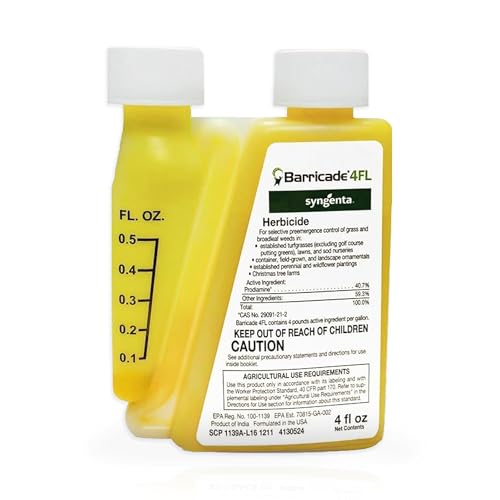
Prodiamine 4FL (Barricade)
16 wk residual · ~120 day half-life · Low water solubility
2. Dithiopyr (Best if You Are Running Late)
Common Brand Name: Dimension
Dithiopyr provides up to 12 weeks of control and has a shorter soil half-life (roughly 35-70 days depending on soil temperature). Its unique advantage is limited post-emergent activity: it can stop crabgrass even slightly after germination begins. NC State confirms it can provide postemergence control before crabgrass has tillered (generally before 2 tillers).
Best Used For: Late applications (if soil temps have already breached 60°F), or as the second step in a split application where its post-emergent catch complements an earlier Prodiamine barrier.
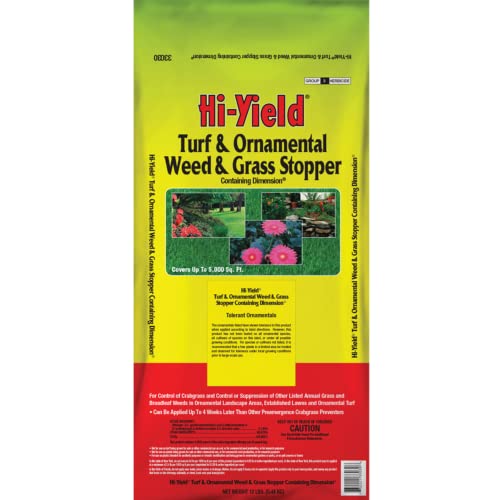
Dithiopyr (Hi-Yield Weed & Grass Stopper)
12 wk residual · Early post-emergent activity · 35-70 day half-life
3. Pendimethalin (Standard Consumer Option)
Common Brand Name: Halts, Pendulum
The most widely available active ingredient in consumer "weed and feed" products. It has a soil half-life of roughly 40-90 days (depending on soil conditions), but its effective residual as a weed barrier is shorter at roughly 6-8 weeks. Pendimethalin is also more susceptible to photodegradation than Prodiamine, making prompt watering-in especially important.
Best Used For: Standard lawns where a second application is planned for season-long control.

Pendimethalin (Scotts Halts)
6-8 wk residual · Split-program option · Water in promptly
Regional Timing and Natural Indicators
Because weather patterns fluctuate wildly from year to year, you cannot rely on a calendar date. The application window spans from early February in the Deep South to mid-May in the Upper Midwest.
Before soil temperature data was widely available, people relied on phenological indicators, like applying when forsythia bushes are in full bloom or beginning to drop petals.
While Ohio State University notes this is often a good visual cue, research shows it has limitations. Kansas State University found that forsythia can bloom at roughly 1–25 growing degree days (GDD), while crabgrass doesn't germinate until 150–200 GDD.
Treat blooming forsythia as your "get ready" signal. Better natural indicators include the early bloom of lilacs and the flowering of dogwood trees and redbuds, which correlate much closer to the 55°F soil mark.
None of these replace a thermometer in the ground, but they are useful secondary signals, especially for spotting microclimates in your yard.
Ready to Apply? Read the Application Guide
Once your soil temperatures hit the action window, you need to get the product down correctly. Our step-by-step companion guide covers sprayer calibration, flat-fan nozzle selection, proper mixing order, and the checkerboard spray technique used by professional turf managers:
How to Apply Liquid Pre-Emergent Herbicide: A Step-by-Step Guide for Homeowners
Track Your Local Soil Temperatures Today
Calendar dates and blooming flowers are just estimates. The most reliable way to time your pre-emergent herbicide is by using actual soil data.
At SoilTemps.com we track 2-inch soil temperatures from over 380 USDA SCAN and NOAA USCRN stations nationwide. Our pre-emergent recommendation system uses the exact 50–55°F action band with a 3-day trailing average, aligned perfectly with the university consensus described throughout this article.
Ready to check your timing?
Enter your city or ZIP code to instantly check your local soil temperature and find out if your pre-emergent window is approaching, active, or past.