
Quick Answer: When Do You Switch From Pre-Emergent to Post-Emergent?
The pre-emergent window is open while 2-4 inch soil is below 55°F and rising. Apply your barrier herbicide while soil sits in the 50-55°F range and climbing, before it holds 55°F for three to four consecutive days. Once soil sustains 55°F (crabgrass germination), the prevention window has closed and you switch to post-emergent products that kill the seedlings already up.
Quick Answer
Check your local soil temperature right now
Enter your city or ZIP code to see real-time 2-inch soil temperatures from the nearest USDA or NOAA monitoring station, and find out whether your pre-emergent window is still open or already closed.
Crabgrass does not read the calendar, and neither should you. The single mistake that wastes more herbicide money than any other is timing the application to a date instead of to the ground. A pre-emergent applied two weeks after germination is just expensive dye. A post-emergent sprayed before any weeds are up is wasted, because there is nothing for it to kill.
This guide draws the line precisely. It covers the soil-temperature trigger that opens and closes the pre-emergent window, the chemistry that separates a barrier herbicide from a post-emergent rescue spray, the product that bridges both worlds when your timing slips, and the four rescue scenarios for when you are already late. It also covers the split-application insurance policy that makes a missed window far less painful in the first place. Every threshold here is anchored to soil temperature, which you can monitor with a soil thermometer or by checking your nearest station on this site.
The Two Windows: What Actually Separates Pre From Post
Herbicide strategy divides into two phases keyed to weed life stage. Pre-emergent herbicides stop seeds before they sprout. Post-emergent herbicides kill weeds that have already emerged. The switch point between them is not a date. It is the moment crabgrass seed germinates, which soil temperature tells you with far more precision than any spring calendar.
How a Pre-Emergent Barrier Works
A pre-emergent herbicide does not prevent germination in the literal sense. The seed still tries to sprout. What the herbicide does is create a chemical zone in the top half-inch of soil that interrupts cell division in the emerging seedling, killing it as it pushes through. The active ingredients for crabgrass, prodiamine, pendimethalin, and dithiopyr, are all University of Wisconsin-Madison Turfgrass Science: Group 3 mitotic-inhibitor herbicides, meaning they all attack the same cell-division process.
The structural advantage of a pre-emergent is scale. One uniform application protects the entire lawn surface against thousands of germinating seeds at once. That barrier is also why timing is unforgiving: it has to be in place and activated by irrigation or rainfall before the seed sprouts. A barrier laid down after germination has nothing left to stop.
How a Post-Emergent Works
A post-emergent is absorbed through the leaf tissue of a weed that is already growing, then translocated through the plant to disrupt growth or photosynthesis. Because it targets a living, visible plant, it can be applied weed-by-weed or patch-by-patch. That precision is also its weakness: post-emergents work plant by plant rather than across the whole surface, and they get progressively less effective as the target weed matures and toughens.
A tiller is a new shoot the crabgrass plant sends up from its base. Post-emergent effectiveness drops sharply with each tiller a crabgrass plant produces. Michigan State University reports that control is generally far more effective when crabgrass is young, before it has tillered. This single biological fact is why "switch the moment soil hits 55°F" matters so much: every day you wait, the target plants add tillers and get harder to kill.
The Soil-Temperature Trigger That Closes the Window
There is one number that governs the switch, and it is 55°F at the 2-4 inch soil depth, sustained for three to four consecutive days. NC State Extension (TurfFiles, 2024): crabgrass germinates when 24-hour mean soil temperatures average approximately 55°F for three to four consecutive days, which is the practical deadline for the final pre-emergent application. Nebraska Extension in Lancaster County: crabgrass and foxtail germination requires 55°F at the 4-inch depth sustained for several days.
So the prevention window is the stretch while soil is climbing through the 50-55°F range. The deadline is the moment it holds 55°F. After that, you are in post-emergent territory.
The GDD Cross-Check
Soil temperature is the field-ready trigger, but turf scientists also model germination with growing degree days (GDD) on a base of 50°F. Purdue University Turfgrass Science (Patton): research suggests roughly 200 GDD on a 50°F base accumulate before crabgrass germinates, and very early spring pre-emergent applications still provide good control. The two models agree in practice: by the time you have banked ~200 GDD, soil has typically been sitting near or above 55°F for several days. Use soil temperature for the go/no-go decision and treat GDD as a regional confirmation.
Why Forsythia Bloom Is Not Enough
The old garden lore says to apply crabgrass preventer when the forsythia blooms. It is not wrong, but it is not reliable either. Fairway Green Inc.: forsythia bloom only correlates with crabgrass germination in years of normal, steadily rising temperatures, and most crabgrass germinates above 70°F, well after forsythia has finished. A warm February can push blooms weeks early; a cold snap can stall germination after the blooms fade. Soil temperature targeting the 55°F threshold is the authoritative trigger. Treat forsythia as a rough backup signal at best.
Soil temperature lags air temperature by one to three weeks in spring because soil acts as an insulator. A 70°F afternoon in March does not mean the soil 2 inches down has caught up; it may still be in the mid-40s. Measure at the 2-4 inch depth, mid-morning, for three to five consecutive days before you decide the window is open or closed. A single warm reading means nothing.
When the 55°F Trigger Arrives by Region
The window opens at the same soil temperature everywhere, but the calendar date that soil hits 55°F varies by hundreds of miles and several weeks. The table below maps the typical pre-emergent deadline by region, drawn from the cited extension programs. Confirm against your own ground temperature before acting.
| Region (USDA zones) | Example states | Typical pre-emergent window | Source |
|---|---|---|---|
| Southeast / Gulf (8-9) | GA, central FL, TX coast | Feb 15 – Mar 15 | NC State, regional |
| Eastern North Carolina | Coastal NC | ~Mid-February | NC State Extension |
| Central NC Piedmont | Raleigh, Greensboro | By end of February | NC State Extension |
| Western NC Piedmont / mountains | Asheville | Early March (higher elev. later) | NC State Extension |
| Mid-Atlantic / Transition (6-7) | VA, MD, KS, TN | Early-to-mid March | Regional extension |
| Lower Midwest (Indianapolis south) | IN, OH, MO | Mid-to-late March, split advised | Purdue University |
| Northeast (5-6) | PA, NY, NJ | Early-to-mid April | Penn State, regional |
| Upper Midwest / N. Plains (4-5) | MN, NE, WI, IA | Mid-April – mid-May | UMN, UNL |
For the colder regions, the extension programs are specific. University of Minnesota Turfgrass Science: crabgrass preventers should be applied from mid-April to mid-May in Minnesota. Nebraska Extension in Lancaster County: DIY applicators should make the first application between April 15 and the first week of May, once soils consistently reach 55°F at the 4-inch depth, with a second application around mid-June for season-long control. UNL notes the 130-year average last freeze for Lincoln is April 23.
NC State Extension (TurfFiles, 2024) anchors the warm end: the target is mid-February in eastern NC, by the end of February in the central Piedmont, and early March in the western Piedmont and mountains, with higher elevations later. They add a warning that applies everywhere: warming winters have pushed germination as early as February, so the date drifts earlier over time. The soil thermometer is the only timing tool that adjusts automatically. Our pre-emergent herbicide timing guide goes deeper on dialing in your specific date.
Sources cite the trigger at slightly different points: Purdue uses ~200 GDD base-50, NC State and UNL cite 55°F at the 4-inch depth, and Fairway Green notes most germination happens at 60-70°F. They are not in conflict. Treat 50-55°F as the application window (act before germination), 55°F sustained as the hard deadline, and 60-70°F as the period of majority germination when you have definitely switched to post-emergent thinking.
Pre-Emergent Product Selection for the 50-55°F Window
In the prevention window, you are choosing among three Group 3 actives. They differ mainly in how long the barrier lasts and how forgiving they are if your timing runs late.
Prodiamine: Longest Residual, Best for Split Applications
University of Wisconsin-Madison Turfgrass Science: prodiamine offers the longest residual barrier of the three. That makes it the workhorse for an early-season application and the natural choice for the first dose of a split program, because it holds the barrier intact while you wait to apply the second dose six to eight weeks later. A single concentrated jug treats a full season of split applications at low cost per thousand square feet.
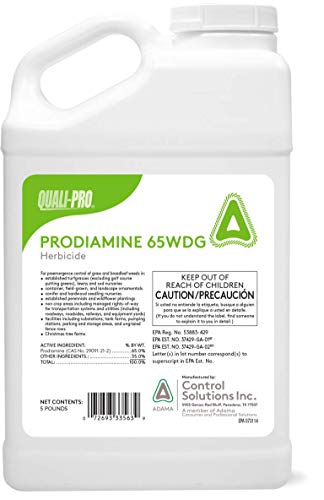
Quali-Pro Prodiamine 65 WDG Pre-Emergent Herbicide, 5 lbs
The longest-residual pre-emergent active for the early 50-55°F window, and the backbone of a split-application program. One 5 lb jug treats an entire season of low-rate applications, making it the lowest cost-per-acre way to buy timing insurance against a missed window.
Pendimethalin: Best Retail Value on Fertilizer Blends
University of Wisconsin-Madison Turfgrass Science: pendimethalin granular-on-fertilizer blends offer good retail value. This is the active in most big-box "crabgrass preventer plus lawn food" bags. The granular-on-fertilizer format is convenient and inexpensive for a single spring application, but the weed-and-feed format creates a timing conflict worth understanding, covered below.
Dithiopyr: The Late-Timing Rescue With Post-Emergent Activity
Dithiopyr is the one pre-emergent that doubles as a short-window rescue. Purdue University Turfgrass Science (Patton): dithiopyr (Dimension) controls crabgrass after germination until the plant reaches one tiller, making it usable as an early post-emergent and giving a wider late-application window than prodiamine or pendimethalin. University of Wisconsin-Madison Turfgrass Science: dithiopyr is the choice when timing runs late because of that early post-emergent activity.
This is the product to reach for when you realize you are a few days behind. It still lays a barrier for ungerminated seed and cleans up seedlings that are up but not yet tillered.
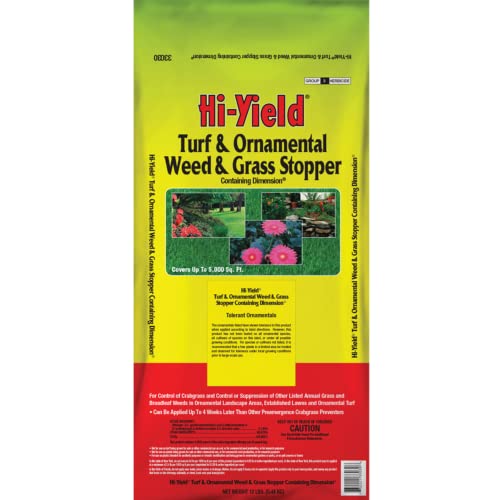
Hi-Yield Turf & Ornamental Weed & Grass Stopper (dithiopyr), 12 lb
The rescue pre-emergent. Dithiopyr lays a barrier for ungerminated seed and still controls crabgrass that has already emerged, up to the one-tiller stage. Reach for this when you discover soil already touched 55°F and you need a product that works in both directions at once.
For application technique, including water-in timing and how to avoid striping a liquid pass, see our liquid pre-emergent application guide.
The cheapest crabgrass preventer at the store is usually a pendimethalin-on-fertilizer "weed and feed" bag. The problem is that the pre-emergent and the fertilizer want different timing. The pre-emergent needs to go down before 55°F soil, but a heavy nitrogen feed that early can push soft, disease-prone growth before the lawn is ready. If you want to feed and prevent on separate, optimal schedules, see our spring lawn fertilization guide and apply the products independently.
Split Applications: The Insurance Policy Against Missed Timing
The most effective single change a homeowner can make is to stop thinking of pre-emergent as one application and start thinking of it as two. The research here is unusually clean.
Purdue University Turfgrass Science (Patton, sequential applications study): when the same total active ingredient per acre is applied, sequential (split) applications more effectively and consistently control crabgrass than a single application, and equivalent control is achieved regardless of whether prodiamine, pendimethalin, or dithiopyr is used for the first or second application. Purdue University Turfgrass Science (Patton): lawn-care operators running multiple rounds can split a single application into two and gain increased crabgrass control without additional product cost, and split applications are advised from Indianapolis south and anywhere with a crabgrass history.
Read that twice. You are not buying more herbicide. You are dividing the same total dose into two timed doses and getting better, more consistent control. The second dose also extends the residual barrier deeper into the germination season and catches any seed that slipped past the first.
The Practical Split Schedule
- First half at the 55°F trigger. Apply roughly half your season rate of prodiamine when 2-4 inch soil is in the 50-55°F range and climbing.
- Second half six to eight weeks later. Apply the remaining half (prodiamine again, or dithiopyr if you want the post-emergent insurance on any escapees). The Wisconsin and Nebraska programs both endorse a second dose for season-long coverage.
- Stay under the per-season label limit. The two doses combined must not exceed the product's maximum annual rate.
The two-dose split is exactly the kind of timing the lawn-care schedule on this site is built to track. Enter your city and it will surface the soil-temperature trigger for your first application and remind you when the second is due. The schedule keys off your nearest station's real readings, not a generic regional date.
Post-Emergent Product Selection After Germination
Once soil has sustained 55°F and crabgrass is up, the barrier herbicides are spent and you choose a post-emergent based on the crabgrass growth stage and your grass type. The two variables that matter most are how many tillers the crabgrass has and whether your turf tolerates the active ingredient.
Quinclorac (Drive XLR8): The Most Forgiving Choice
Quinclorac is the closest thing to a universal crabgrass post-emergent. Michigan State University Extension: quinclorac provides excellent control of crabgrass at almost any growth stage, seedling or mature, is very safe applied to new seedings, and works on most cool- and warm-season turfgrasses. Penn State Extension: quinclorac controls newly emerged crabgrass and mature plants with four or more tillers but is weaker on the 2-to-4-tiller stage; tall fescue may be treated seven days after emergence while Kentucky bluegrass requires 28 days, and it performs best with methylated seed oil.
The takeaways: quinclorac handles both very young and fully mature crabgrass, it is the only post-emergent safe on new seedings out of the gate, and it has a notable soft spot at the 2-to-4-tiller stage where you should lean on a different product. Always tank it with methylated seed oil for best uptake.
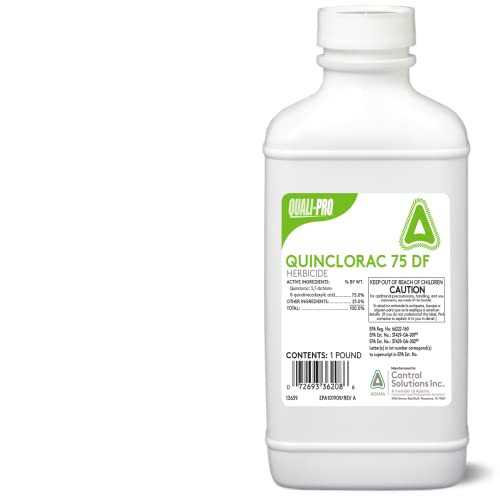
Quali-Pro Quinclorac 75 DF Selective Herbicide, 1 lb
The primary rescue spray after crabgrass emerges. Controls seedling through mature plants, is safe on cool- and warm-season turf, and is the only post-emergent here that is safe to use on new seedings. A generic equivalent to Drive XLR8 at a fraction of the per-acre cost. Tank with methylated seed oil.
Mesotrione (Tenacity): Works Both Pre and Post, Seeding-Safe
Mesotrione is the bridge product that blurs the pre/post line. Penn State Extension: mesotrione (Tenacity) gives best post-emergent crabgrass control on plants with fewer than four tillers, usually requires two applications at two-week intervals, and may be applied to new seedings only after the turf has been mowed twice or four weeks after emergence. It works as a pre-emergent and a post-emergent in the same product, which makes it the cleanest choice when you are both controlling young crabgrass and trying to establish new cool-season turf.
That dual nature is why Tenacity shows up in our fall overseeding cool-season guide: it is one of the only weed controls you can use at seeding time.

Syngenta Tenacity Herbicide (mesotrione), 8 oz
The pre-and-post bridge product. Mesotrione controls young crabgrass under four tillers, blocks new germination, and is seeding-safe, so it covers the scenario of killing crabgrass while establishing new cool-season turf. Expect two applications two weeks apart. Atticus Torocity is the cheaper generic equivalent.
Fenoxaprop (Acclaim Extra): Strong on Young Grass, Bluegrass Caution
Fenoxaprop is a targeted grass-weed killer with one important caveat. Penn State Extension: fenoxaprop-p-ethyl (Acclaim Extra) is relatively safe on most cool-season turfgrasses but may injure some Kentucky bluegrass cultivars, especially at high temperatures; rates increase for crabgrass up to four or five tillers, with a 28 fl oz per acre limit on Kentucky bluegrass. It excels on younger crabgrass and can be stepped up for larger plants, but if your lawn is Kentucky bluegrass, mind the cultivar sensitivity and the rate cap.
Topramezone (Pylex): The Professional Heavy Hitter
For the toughest, most mature crabgrass, topramezone is the professional-grade option. Michigan State University Extension lists Drive (quinclorac), Acclaim Extra (fenoxaprop-ethyl), Tenacity (mesotrione), and Pylex (topramezone) all as effective post-emergent options for crabgrass. Pylex is potent at very low rates and is typically reserved for situations where the others have struggled. Follow the label rate precisely, as cool-season turf can show temporary whitening.
Post-Emergent Matrix by Crabgrass Stage and Turf
| Active (product) | Best crabgrass stage | Cool-season turf | New seedings | Source |
|---|---|---|---|---|
| Quinclorac (Drive XLR8) | Seedling or 4+ tillers; weak at 2-4 | Safe on most | Safe | MSU, Penn State |
| Mesotrione (Tenacity) | Under 4 tillers; 2 apps | Safe | After 2 mowings / 4 wk | Penn State |
| Fenoxaprop (Acclaim Extra) | Young, up to 4-5 tillers | Safe; KBG cultivar caution | Check label | Penn State |
| Topramezone (Pylex) | Mature / escaped plants | Use low rate; possible whitening | Check label | MSU |
Post-emergents stress the turf along with the weed. Avoid spraying when air temperature exceeds 85°F, when turf is drought-stressed, or within 24 hours of mowing. Penn State specifically flags fenoxaprop injury to Kentucky bluegrass at high temperatures. Spray in the cooler, actively growing windows of late spring or early fall, and water normally after the 24-hour uptake period to help the lawn recover.
The Four Rescue Scenarios: You Missed the Window. Now What?
Missing the pre-emergent window is the most common reason people land on this page. Your move depends entirely on how far past the trigger you are, which soil temperature and a quick look at the lawn will tell you.
Scenario 1: Soil Just Hit 55°F, No Visible Crabgrass Yet
You are at the edge. Germination is beginning but nothing is up. Action: apply dithiopyr immediately. It still functions as a barrier for ungerminated seed and, per Purdue, controls the earliest seedlings up to the one-tiller stage. This is the single best use case for Dimension and the cheapest scenario to recover from.
Scenario 2: Soil Is 60°F+, Small Crabgrass Visible (Pre-Tiller)
Seedlings are up but young, with no tillers yet. Action: apply mesotrione (Tenacity), or tank dithiopyr plus quinclorac. Penn State puts mesotrione's sweet spot at under four tillers, and quinclorac is excellent on newly emerged plants. You are killing what is up while blocking the late germinators still to come. Plan on a second mesotrione pass two weeks later.
Scenario 3: Soil Is 65°F+, Crabgrass Has Multiple Tillers
This is the hard case. Action: post-emergent only, likely more than one application. Penn State notes quinclorac is weaker on the 2-to-4-tiller stage, so a mature stand may need quinclorac at the 4-plus-tiller rate (with methylated seed oil) or a step up to topramezone. Michigan State University Extension: mature plants may require multiple applications spaced two to three weeks apart. For isolated large plants, hand-pulling is often faster and more reliable than repeated spraying.
Scenario 4: It Is Already Midsummer
The plants are mature and the season is mostly gone. Action: stop chasing it and plan for next year. Crabgrass is a summer annual that dies at the first hard frost. Repeated midsummer spraying stresses your turf during its weakest season for little payoff. Instead, focus on the off-season fundamentals that crowd crabgrass out, then commit to an early split pre-emergent program next spring. A thick lawn is the most durable crabgrass control there is.
Crabgrass exploits thin, bare, compacted turf. The cultural practices that close those openings are the foundation under every herbicide program: mow tall (3+ inches for cool-season grass to shade soil), water deeply to drive deep roots, fertilize for density on the right schedule, and aerate to relieve compaction. See aeration timing and cool-season fertilization schedule to build the dense canopy that makes next spring's pre-emergent the last line of defense rather than the only one.
Coordinating Crabgrass Control With Broadleaf Weeds
Crabgrass is a grassy weed, but most lawns fight broadleaf weeds (dandelion, clover, plantain) in the same window. The actives differ: the crabgrass post-emergents here will not touch broadleaves, and broadleaf herbicides will not touch crabgrass. Sequence them rather than expecting one product to do both.
Mesotrione is the partial exception, with some broadleaf activity alongside its crabgrass control. For a dedicated broadleaf program timed to soil temperature, see spring broadleaf post-emergent for cool-season lawns and the warm-season version. If your "weeds" turn out to be a sedge rather than crabgrass (triangular stems, glossy leaves, faster vertical growth), none of these products are the right answer; see identifying nutsedge.
Verification: Confirming the Lever Before You Spray
Every decision in this guide turns on one measurement, so measure it correctly before you commit a single dollar of product.
How to Read the Trigger
Insert a soil thermometer 2-4 inches deep in a representative part of the lawn, away from pavement, foundations, and south-facing slopes that radiate extra heat. Read mid-morning between 8 and 10 AM, when soil temperature is closest to the daily mean. Track it for three to four consecutive days. You are watching for two things: whether soil has crossed 55°F (deadline for pre-emergent) and whether it is still rising (pre window) or holding (switch to post). Our soil thermometer guide covers probe selection and placement in detail.
Confirm Against Real Station Data
A single backyard probe can mislead if your spot runs warm or cold. Cross-check against the nearest USDA SCAN or NOAA USCRN station, which report 2-inch soil temperature continuously. When your probe and the station agree on the trend, you can act with confidence.
Verify the lever
Is your pre-emergent window open or closed?
Enter your city or ZIP code to see real-time 2-inch soil temperature from the nearest USDA or NOAA station. If it has held 55°F for three to four days, the window has closed and it is time to switch to post-emergent. If it is still climbing, you can still lay the barrier.
After spraying a post-emergent, verify the result the right way. Crabgrass killed by quinclorac browns slowly over one to three weeks, not overnight. Resist the urge to respray a plant that simply has not died yet. For mesotrione, expect the treated weeds to whiten before they collapse, and plan the second application at the two-week mark regardless of how the first looks.