
Quick Answer
Read soil temperature at 2 inches deep for germination and pre-emergent decisions, 4 inches deep for root-zone and warm-season green-up, take the reading mid-morning (8 to 10 AM) in 3 to 5 spots away from pavement, and track the trend over 3 to 5 days. One warm reading is never enough.
Thermometers covered below
Quick Answer
Check your local soil temperature right now
Enter your city or ZIP code to see today's 2-inch and 4-inch soil temperature from the nearest USDA SCAN or NOAA USCRN station, plus a multi-day trend to verify against your own probe.
Almost every other guide on this site hands you a number: apply pre-emergent at 50 to 55°F, prevent grubs at 65 to 70°F, stop mowing at 45 or 60°F. Those numbers are only as good as your ability to read soil temperature correctly. Get the depth wrong, read at the wrong time, probe next to a hot sidewalk, or act on a single warm afternoon, and every decision inherits the error.
This is the foundational tool guide: the two depths that matter, how to choose a dial or digital thermometer, where and when to probe, how to track a multi-day trend, and how to calibrate against an ice bath. It also covers the one thing a handheld probe cannot do, which is why pairing it with continuous station data is the most reliable approach.
Why Soil Temperature Beats the Calendar and the Air Thermometer
Biological processes respond to soil temperature, not air temperature and not the calendar. Seeds germinate, roots grow, weeds wake up, and grubs rise toward the surface based on how warm the ground is. A warm March afternoon does not mean the ground is warm: soil has thermal mass and lags air temperature by days to weeks in spring. That lag is why two neighbors can do the identical thing on the identical date and get opposite results.
The instantaneous-reading problem
There is a trap in handheld thermometers most homeowners never hear about. Purdue University Turfgrass Science makes the point plainly: a measurement gives you an instantaneous reading, not an average over time. Germination models run on accumulated heat and daily averages, not snapshots.
When a model says crabgrass germinates at 55°F sustained, it means the daily average, the midpoint between the day's high and low. Your 9 AM reading is a single point on that curve, not the average. The rest of this guide manages that gap: read at a consistent time, and track several days so noise averages out.
SoilTemps draws from 380-plus USDA SCAN and NOAA USCRN stations that log continuous soil temperature and report a true daily average at standard depths. That is the number a germination model wants. Use your handheld probe to verify your microclimate against that regional average, not to replace it. When they disagree, your probe just told you something about your soil type or exposure.
The Two Depths That Run Everything: 2-Inch vs 4-Inch
This is the load-bearing distinction in the guide. Soil temperature drops as you go deeper, and different decisions live at different depths.
2 inches is the germination and pre-emergent depth, where weed and grass seed sit, so you read it for crabgrass timing, cool-season seeding, and pre-emergent application. 4 inches is the root-zone depth, where established roots, rhizomes, and stolons live, so you read it for warm-season green-up, fertility, and aeration.
The depth conventions are not unanimous, and that is fine
Different programs cite different depths. Knowing this keeps one source from seeming to contradict another.
| Program | Cited depth | Used for |
|---|---|---|
| Purdue University | 1 inch | Crabgrass germination |
| Kansas State University | 1 inch | Crabgrass GDD model |
| Penn State Extension | Upper inch | Cool-season seed germination |
| University of Nebraska-Lincoln | 4 inches | Pre-emergent timing |
| SoilTemps / A.M. Leonard synthesis | 2 inches | Practical germination standard |
The A.M. Leonard Mastery Center, synthesizing ten land-grant programs including Penn State, NC State, Michigan State, and Purdue, settles on 2 inches because it splits the 1-inch and 4-inch conventions and sits where seeds are. That is the depth SoilTemps reports for germination decisions.
A soil temperature number is meaningless without a depth. The same lawn at the same moment might read 58°F at 2 inches and 53°F at 4 inches. If a source gives a threshold without naming a depth, assume 2 inches for germination and pre-emergent, 4 inches for root-zone and green-up, then confirm. Mismatched depths are a common reason two sources seem to disagree.
Which depth for which task
| Task | Read at | Threshold | Guide |
|---|---|---|---|
| Pre-emergent (crabgrass) | 2 in | 53-58°F, 4-5 days | pre-emergent vs post-emergent |
| Cool-season seeding | 2 in | 50-65°F | seed germination rates |
| Cool-season fertilization | 2-4 in | 55°F+ rising | cool-season fertilization schedule |
| Grub prevention | 4 in | 65-70°F | grub prevention timing |
| Warm-season green-up | 4 in | 60-65°F (full ~70°F) | warm-season fertilization schedule |
| Irrigation | 2-4 in | Track trend | irrigation timing |
| Stop mowing | 4 in | 45°F / 60°F | when to stop mowing |
Each guide explains the threshold for its task. This guide makes sure the number you feed them is correct.
Choosing a Soil Thermometer: Dial vs Digital
Two formats dominate, and both work. The choice comes down to how often you read and whether you want to recalibrate.
Dial (analog) thermometers
A stainless-steel dial thermometer with a 4-inch-plus stem is the classic, no-batteries choice: durable and cheap, but slower to stabilize (often a minute or more) and usually not recalibrated, so you note the offset and correct in your head. For a once-a-day spring read, that is fine. The Taylor 5976N is the budget benchmark, a 4-inch stainless stem that reaches past the 2-inch germination depth. Ice-bath test it, note whether it reads high or low, and apply that correction.
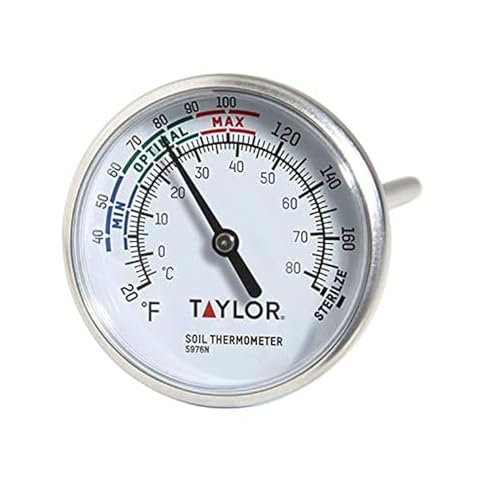
Taylor 5976N Soil Testing Dial Thermometer, 4-inch Stem
The budget pick. A no-battery analog dial with a 4-inch stainless stem that reaches the 2-inch germination depth. Slower to settle than a digital probe and not field-recalibrated, so ice-bath test it once and note its offset.
If you want a tool labeled for soil rather than a kitchen probe, the AcuRite 00661 is a dedicated dial soil thermometer with a weather-resistant stem built for ground use.

AcuRite 00661 Stainless Steel Soil Thermometer
A purpose-built dial soil thermometer with a weather-resistant stainless stem made for repeated ground insertion. The pick if you want a tool labeled for soil rather than a kitchen meat thermometer pressed into garden duty.
Digital instant-read probes
A digital instant-read probe is the better everyday tool if you read daily through the spring window. It settles in seconds rather than the minute-plus a dial needs, which is what makes a daily read practical. The Luster Leaf 1625 is the value benchmark: a dedicated digital soil thermometer rather than a kitchen probe repurposed for the garden. Ice-bath verify at 32°F when it arrives.

Luster Leaf 1625 Digital Soil Thermometer
The everyday workhorse. A digital soil thermometer that settles in seconds instead of the minute-plus a dial needs, which is what makes a daily 2-inch read practical through the spring window. Ice-bath verify at 32°F when it arrives.
If you read most days across a large property, a professional turf probe earns its higher price. The Turf-Tec Spot On DT3-S is the digital soil probe turf managers carry: faster and more durable than a consumer probe under repeated daily use. Turf-Tec sells it direct rather than through Amazon, so buy it from the manufacturer.
When a long-stem compost thermometer makes sense
If you also manage a compost pile or want deep root-zone readings, a long-stem dial covers both. The REOTEMP FG20P has a 20-inch hermetically sealed stem: overkill for a 2-inch lawn read, but the reference tool for compost monitoring and deep checks.
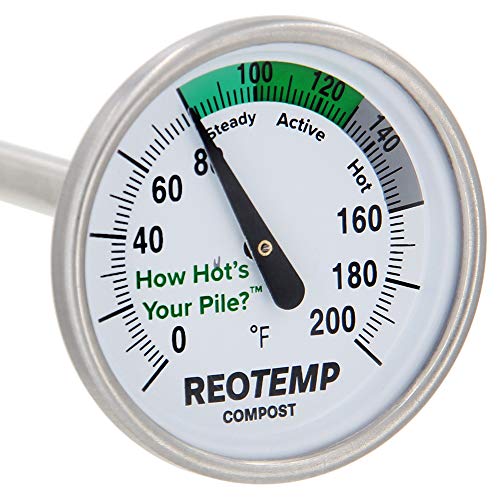
REOTEMP 20-Inch Backyard Compost/Soil Thermometer (model FG20P)
The deep-reach specialist. A 20-inch hermetically sealed dial stem that overshoots a 2-inch lawn read but is the right tool for compost piles and deep root-zone checks. Buy this only if you compost or want readings below normal turf depth.
What to avoid
- Infrared surface guns. They read only the top fraction of an inch, not the 2-inch depth where seeds sit. They mislead badly in spring.
- Glass thermometers. They break in hard or rocky soil.
- Short probes under 3 inches. They cannot reach the 4-inch root-zone depth, locking you out of green-up and fertility decisions.
How to Take the Reading Correctly
Owning the right thermometer is half of it. Technique is the other half, where most homeowners introduce error.
Step 1: Probe mid-morning
Take your reading between 8 and 10 AM. Industry synthesis of extension guidance points to mid-morning as the most stable window, closest to the daily average. Early-morning readings run colder; afternoon readings run warmer. Pick a time and keep it.
Step 2: Choose 3 to 5 representative spots away from heat sources
Walk the area you plan to treat and pick 3 to 5 spots that represent it. Stay away from:
- Pavement, driveways, and foundations, which act as heat sinks and read warm
- South-facing slopes, which run hotter than the rest of the yard
- Deep shade under tree canopies, which lags colder than open turf
- Low spots where cold air pools overnight
Sample the lawn you will treat, not its warmest or coolest corner.
Step 3: Insert straight down to the target depth
Push the probe straight down to 2 inches for germination reads, or 4 inches for root-zone and green-up reads. Do not angle it; an angled insertion samples a shallower depth than the stem suggests, biasing the reading warm in spring.
Step 4: Stabilize, then read
Wait 3 to 4 seconds for a digital, or a minute or more for a dial. Pulling a dial too early gives a reading closer to the surface than the tip depth. If your probe has HOLD, lock the value, then pull and read at eye level.
Step 5: Average the spots
Average your spots. If one is more than 5°F off the others, note why (shade, compaction, slope, a buried sprinkler line) and decide whether to treat that zone separately.
Drop small flags or stakes at your measurement spots so you return to the exact same locations every day. Consistent placement removes spot-to-spot noise from your trend and turns the daily reading into a 30-second routine instead of a hunt.
Track the Trend, Not a Single Day
This is the rule every source agrees on, the direct consequence of the instantaneous-reading problem. One reading is data. Five readings are a decision.
Michigan State University Extension ties crabgrass germination to 2-inch soil reaching 55°F for at least 3 consecutive days. Kansas State University Turf (Jared Hoyle) frames the trigger as a daily average of 55°F for about 5 days at 1 inch, using daily max and min to estimate that average because single point-in-time readings are impractical. The A.M. Leonard synthesis lands on 53 to 58°F at 2 inches held for 4 to 5 days. Penn State Extension puts cool-season germination at roughly 55 to 58°F in the upper inch for 4 to 5 days.
The common thread: a sustained multi-day window, not a single warm afternoon. A heat spike can push your 9 AM reading up 8°F for one day and fall right back. Acting on that single day is how people apply pre-emergent two weeks early and watch crabgrass break through anyway.
Growing degree days, briefly
The rigorous version of trend tracking is growing degree days (GDD). Under a base-50°F model, Kansas State University reports crabgrass germinates around 200 accumulated GDD. It is the formal expression of the idea your 3-to-5-day trend approximates: germination responds to accumulated heat over time, not one moment.
Plant blooms as a free backup signal
Phenology is a useful no-cost backup. Kansas State and Ohio State research show forsythia blooms at roughly 1 to 25 GDD while crabgrass does not germinate until about 150 to 200 GDD, so a forsythia bloom is a prompt to start watching your probe, not a signal to apply. Lilac and redbud bloom correlate much more closely with germination. Use blooms to know when to pay attention; use the 2-inch trend to decide when to act.
Why Your Yard Differs From the Station: Soil Type and Microclimate
If station data is so good, why own a probe? Because your yard can hit a threshold days before or after the regional station, and only your probe knows by how much.
Soil type sets the pace
According to soil-physics guidance from the Royal Horticultural Society (via Horticulture Magazine), sandy soils drain and warm fast, while clay soils hold water, change temperature slowly, and stay too cold in spring. A clay lawn reaches a germination threshold noticeably later than a sandy lawn in the same ZIP code. Heavy clay lags the regional station; sandy soil leads it.
Slope and exposure shift the number
Exposure matters as much as soil. Peer-reviewed slope-aspect research consistently finds south-facing ground runs measurably warmer than shaded north-facing ground in spring, because it takes more direct sun. The gap is large enough to move green-up and germination by a week or more across a single property.
Spend one spring mapping your yard. Probe a sunny south slope, an open flat, and a shaded north side on the same morning and note the spread. Once you know your sunny zone runs, say, 6°F ahead of your shaded zone, you can stagger their schedules and read the regional station number against your own offset. That one-time mapping pays off every season after.
This variation is the case for pairing tools. The station gives a continuous daily average for the region; your probe tells you how far your soil and exposure deviate from it. Together they beat either alone.
Calibration: The Ice-Bath Check
A thermometer that reads 3°F off is worse than none: it gives you false confidence. Calibrate before the season. The standard method is the ice bath, the same procedure used in food safety. Per the method documented by Operandio / IERE:
- Fill a container with mostly crushed ice and a little cold water. Crushed ice with minimal water holds a true 32°F at equilibrium.
- Stir, then insert about 2 inches of the probe, keeping the tip off the container walls.
- Wait about 10 seconds for the reading to stabilize.
- It should read 32°F (0°C).
If your digital probe has a calibration function, adjust it to 32°F per its manual. Many dial thermometers cannot be adjusted at all; for those, write the offset on tape on the stem ("reads +2," meaning subtract 2°F from every field reading) and correct in your head.
Pre-emergent windows are narrow. A probe reading 3°F warm makes you apply a week too early, so the residual can run out before peak germination. A probe reading 3°F cold makes you apply late, after crabgrass has broken. Both look like the product failing. Neither is. The thermometer was lying. Ice-bath check it.
Cool-Season vs Warm-Season vs Transition Zone
The depth and threshold you watch depend on your grass type, which tracks roughly with region.
Cool-season lawns (Northern US)
You care most about the 2-inch germination read and the 4-inch fertility read. Spring pre-emergent goes down when 2-inch soil holds 53 to 58°F for 4 to 5 days. Fall is the better window for overseeding, and fertility follows the cool-season fertilization schedule. In late fall, when to stop mowing keys off soil dropping below about 45°F.
Warm-season lawns (Southern US)
Your signature read is 4-inch green-up. Per green-up guidance, Bermuda and zoysia begin greening up around 60 to 65°F at 4 inches, but consistent averages near 70°F are needed for full green-up, and soil above 65°F is required for significant rhizome, root, and stolon growth. Zoysia greens up later, in the 65 to 70°F range. That reading drives your warm-season fertilization schedule; fertilizing before the root zone is active wastes nitrogen on dormant turf.
Transition zone (Midwest, mid-Atlantic, upper South)
The transition zone is the hardest place to time because the 2-inch pre-emergent window and the 4-inch warm-season green-up window overlap. You may be applying crabgrass pre-emergent at 2 inches while watching the 4-inch reading for Bermuda green-up. Reading both depths on the same morning pays off here, because one regional number cannot tell both stories at once.
Regional Timing: When Soil Crosses the Pre-Emergent Threshold
The most common reason to read soil temperature is timing crabgrass pre-emergent. Here is roughly when 2-inch soil reaches the 53 to 58°F sustained-4-to-5-day trigger by region. Treat these as starting points for when to begin probing, not dates to act on. Your probe and microclimate decide the actual day.
| Region (USDA zones) | Approximate window | Soil-temp / phenology notes |
|---|---|---|
| Southern / Gulf Coast (8-10) | Late Jan - early March | Year-round weed pressure; soil crosses 55°F at 2 inches earliest in the country |
| Southeast (7-9) | Late Feb - mid March | NC State documents February emergence; apply about 2 weeks earlier than older guidance |
| Transition Zone (6-7) | Late Feb - mid March | Hardest to time; warm-season green-up (Bermuda 60-65°F, zoysia 65-70°F) overlaps the window |
| Midwest / Great Lakes (4-6) | Late March - early May | Best phenology correlation (redbud/lilac); MSU and K-State: ~55°F at 2 inches for 3-5 days, ~200 GDD base-50 |
| Northeast (5-7) | Mid March - mid May | Short windows; Penn State germination ~55-58°F upper inch for 4-5 days |
| Nebraska / Plains | First app April 15 - first week of May | UNL: ~55°F at 4-inch depth for several days; Lincoln 130-yr avg last freeze April 23 |
For the full decision logic, see pre-emergent vs post-emergent and pre-emergent herbicide timing.
Common Mistakes That Corrupt Your Reading
Most timing failures trace back to one of these, not to a bad product.
Reading the wrong depth. A 2-inch number used for a 4-inch decision is off by several degrees the wrong way. State the depth, match it to the task.
Probing next to pavement or a foundation. Heat sinks read warm and pull your average up, sending you out a week early.
Acting on a single warm day. One spike is not a trend. Wait for 3 to 5 consecutive days.
Reading at noon or in late afternoon. Afternoon soil runs warmer than the daily average. Read mid-morning, same time daily.
Skipping the ice-bath check. An uncalibrated probe quietly biases every decision all season.
Ignoring your soil type. Heavy clay lags the regional station; sandy soil leads it. Account for it.
Angling the probe. An angled stem samples shallower than its length, biasing spring readings warm.
Verify the Lever: Pairing Your Probe With Station Data
The most reliable setup combines two things one tool cannot provide alone. Continuous station data gives the true daily-average trend germination models need, which a handheld snapshot cannot replicate. Your probe gives your yard's offset from that average, which a distant station cannot know about your clay soil or south-facing slope.
The workflow is simple. Watch the station trend here to know when regional soil approaches a threshold. Once it is within a few degrees, take your own 3-to-5-day probe trend to confirm your microclimate has arrived, then act. That paired approach drives your irrigation timing, your grub prevention timing at 65 to 70°F, and every other threshold on this site.
Verify the lever
See your station's daily-average trend
Enter your city or ZIP code for the continuous 2-inch and 4-inch soil temperature trend from your nearest USDA SCAN or NOAA USCRN station, then confirm it against your own probe before applying anything.