
Quick Answer: When Is the Best Time to Spray Broadleaf Weed Killer?
The best time to apply broadleaf weed killer on a cool-season lawn is when air temperatures hold between 60 and 85°F for several days running and the weeds are actively growing: flowering or visibly leafing out, not wilted from drought, not stressed by frost. For most cool-season lawns, this falls after dandelion bloom but before summer heat. Mowing the lawn 1-2 days before and after spraying, and checking the 24-hour rain forecast, are the other two non-negotiables. The 60-85°F band follows university extension guidance (Penn State, Iowa State, Ohio State).
What you need
- Dandelions and plantain: Southern Ag 2,4-D amine (32 oz)
- Clover, ground ivy, tougher weeds: SpeedZone EW (128 oz)
- Mixes and sprays either one: Chapin 1-gallon pump sprayer
Get Personalized Timing
See your local soil and forecast
Enter your city or ZIP code to check soil temperatures from the nearest USDA monitoring station and see when your spring broadleaf window opens.
This guide is built from 18 publications across 14 university turfgrass extension programs, plus the major manufacturer labels. It's specifically for cool-season lawns like Kentucky bluegrass, fescue, perennial ryegrass, and the cool-season blends common across the Northeast, Upper Midwest, and transition zone. If you have St. Augustine, centipede, bahia, or carpetgrass, stop here and check the warm-season warning section below before reading further. The chemistry recommended in this guide can damage or kill warm-season turf.
The Three Levers: Air Temp, Active Growth, Weed Phenology
One finding surprised our research: extension publications don't publish a clean soil-temperature trigger for spring broadleaf the way they do for crabgrass pre-emergent. For pre-emergent crabgrass control, every extension agrees on roughly 50-55°F at 2 inches as the action threshold. For spring broadleaf post-emergent, the trigger is fuzzier. The actual driver is air temperature (which controls how the herbicide translocates inside the plant) plus whether the weeds are actively growing, with weed phenology (especially dandelion bloom) as the practical visual cue.
The soil-temperature data we publish at SoilTemps is still useful here. It tells you whether the ground has thawed, whether your cool-season turf canopy is actively growing, and whether the broadleaves rooted in that soil are likely to translocate a systemic herbicide. But it's a secondary check, not a hard threshold.
Air-temperature window: 60-85°F
The 60°F floor and 85°F ceiling are the most consistently cited bounds across extensions:
University of Maryland Extension: "daily air temperatures will be between 65° and 85°F. When the temperature is too hot, the herbicide will be more likely to volatilize and damage sensitive plants."
Iowa State Extension: "Apply liquid broadleaf herbicides when the winds are light and temperatures are forecast to remain below 85 degrees Fahrenheit for 24 hours."
Rutgers Cooperative Extension (FS385): "Avoid applying herbicides when plants are wilting from drought or when high temperatures are expected. Consult the label as most products suggest avoiding applications when temperatures are higher than 85°F."
Kansas State University: "When treating spring weeds such as dandelions, treat on a day that is 50 degrees or warmer."
University of Illinois Extension: "Avoid hot days (over 85 degrees F). These chemicals can volatilize (turn into vapor) in hot weather."
Michigan State University is slightly more conservative on the ceiling: "Don't spray when temperatures are above 80°F as you might burn the turf at high temperatures." The 80°F MSU number is a turf-injury margin of safety; the 85°F number elsewhere is a volatilization ceiling. Neither is wrong. If your lawn is already heat-stressed, treat MSU's 80°F as the working ceiling.
What "actively growing" actually means
Extensions consistently require "actively growing" weeds for spring broadleaf applications, but none of them define the term operationally. The University of Maryland Extension warns against treating "drought-stressed lawns." The University of Illinois says: "Only apply to actively growing weeds. After all, if a weed is dormant, it will not take up the poison." Cornell Cooperative Extension: postemergence herbicides "should be applied to actively growing weeds that are not under stressful conditions such as high temperatures and droughty conditions."
The defensible homeowner test:
- The lawn has been mowed at least once or twice this spring (turf is growing, weeds are growing).
- No drought wilt. Leaves are turgid, not curled.
- No frost in the next 48 hours.
- Weeds are visibly leafed-out, in rosette stage, or flowering.
Weed phenology: dandelion bloom is the indicator
The most commonly cited phenological cue for spring broadleaf timing is dandelion flowering itself. Rutgers FS385: "By around mid-April in New Jersey, dandelions begin to flower." Purdue Turfgrass Science: in Indiana, dandelions flower "late April to mid-May." Michigan State Extension goes further and identifies the puff-ball stage as a strong window: "the puff-ball stage can be very effective, as this is the time the dandelion is at its weakest because it has just spent all that energy pushing out flowers."
A common conflation worth correcting: forsythia bloom is a crabgrass pre-emergent cue, not a broadleaf cue. Forsythia is the standard indicator for getting your prodiamine or dithiopyr down before crabgrass germinates. Redbud and lilac don't appear in tier-1 broadleaf timing literature at all. Dandelion bloom is the indicator that matters here, and it has a reliability advantage that other phenological cues lack: when the target weed itself is flowering, it is by definition actively growing.
Where Soil Temperature Still Helps
When the soil at 2 inches reaches 50-65°F, the cool-season turfgrass active-growth band per Michigan State, your turf is growing and the broadleaves rooted in it are translocating. Penn State sets a higher bar at "70°F or higher" for peak broadleaf herbicide activity, but that's an outlier number; most extensions don't publish a soil-temp trigger at all.
Use the soil-temp data as a sanity check before spraying. If your local 2-inch soil temperature is still in the 40s, the ground hasn't really warmed up yet, the cool-season turf is barely growing, and a post-emergent application will sit on dormant or barely-translocating tissue. Wait a week.
Check the lever
Look up your local 2-inch soil temperature
See real-time soil temperature data from the nearest USDA or NOAA monitoring station for your ZIP.
Spring Is the Second-Best Window. Fall Wins.
Most lawn-care content treats spring as the season to spray. Fall is more effective than spring for perennial broadleaves, and this is consensus, not controversy. Iowa State, Wisconsin, Minnesota, Cornell, Ohio State, Michigan State, Kansas State, Virginia Tech, NC State, and Maryland all converge on this point.
The reason is plant biology. In fall, perennial broadleaves like dandelion, ground ivy, and wild violet translocate carbohydrates from leaves down to roots in preparation for winter. A systemic auxin herbicide (2,4-D, MCPP, dicamba, triclopyr) moves with that flow into the meristem (the growing point in the root crown) and kills the plant from below. Single fall application can give "up to a year" of control, per Ohio State Buckeye Turf, versus as few as 8 weeks for spring control.
So when is spring the right call?
- You have visible, flowering weed populations that need to be hit before they go to seed and broadcast more weeds across the lawn.
- You missed the fall window last year and don't want to wait until October.
- You're managing a known patch of a perennial like wild violet or ground ivy and you want to treat it twice: once in spring at bloom, again in fall.
Spring is appropriate. It's just not optimal for establishing broadleaf control. If you're starting from a heavily weedy lawn, plan a fall renovation pass and use spring as cleanup.
Common Spring Broadleaf Weeds: Identification Table
Identify before you spray. The chemistry that wipes out dandelion is the wrong tool for wild violet; the chemistry that finally kills creeping Charlie is overkill for chickweed. Each row below shows the visible ID points, the germination season, and the chemistry that actually works on it, all sourced from university extension publications.
| Common name | Scientific | ID points | Germination season | Chemistry that works |
|---|---|---|---|---|
| Dandelion | Taraxacum officinale | Deeply lobed basal rosette; hollow stem with milky sap; single yellow flower per stem; deep taproot | Perennial; new germination spring + fall | 2,4-D, MCPP, dicamba (three-way); triclopyr+clopyralid; florasulam |
| White clover | Trifolium repens | Three-leaflet leaves with white "V" mark; creeping stolons; round white-pink flower heads | Perennial; cool-season grower, peak bloom late spring | Clopyralid, fluroxypyr, quinclorac (best); also dicamba, triclopyr |
| Common chickweed | Stellaria media | Small oval opposite leaves; trailing stems with single line of hairs; tiny 5-petal white flowers (look like 10 petals) | Winter annual; germinates fall, blooms early spring | Dicamba, MCPP, fluroxypyr particularly effective; carfentrazone for fast burndown |
| Henbit | Lamium amplexicaule | Square stems; rounded scalloped leaves clasping the stem (sessile upper leaves); pink-purple tubular flowers in whorls | Winter annual; germinates fall, blooms Mar-Apr | 2,4-D + dicamba combinations |
| Purple deadnettle | Lamium purpureum | Square stems; petioled triangular upper leaves (vs. henbit's clasping leaves); top leaves tinged purple | Winter annual; germinates fall, blooms early spring | 2,4-D + dicamba combinations |
| Broadleaf plantain | Plantago major | Wide, smooth oval leaves with parallel veins in basal rosette; leafless flowering spike with seeds along the entire length | Perennial; thrives in compacted soil | 2,4-D or triclopyr; pre-mixed three-way products |
| Buckhorn plantain | Plantago lanceolata | Narrow lance-shaped leaves with prominent parallel veins; dense seed head only at the tip of a long leafless stalk | Perennial | 2,4-D + MCPP/MCPA combinations; triclopyr alone or combined |
| Wild violet | Viola spp. | Heart-shaped leaves on long petioles emerging from underground rhizomes; purple (or white) 5-petal spring flowers | Perennial; thick waxy cuticle and rhizomes | Triclopyr is the standard answer; multiple seasons typically required. Pre-emergents do NOT work. |
| Ground ivy / creeping Charlie | Glechoma hederacea | Square stems creeping along the ground; rounded scalloped leaves opposite on stem; small purple tubular spring flowers; minty smell when crushed | Perennial; spreads by stolons | Triclopyr alone OR triclopyr + fluroxypyr; spring application at/just after flowering plus a fall follow-up |
| Mock strawberry | Potentilla indica | Three-leaflet leaves with rounded tooth edges (true strawberry has sharp teeth); yellow flowers (true strawberry is white); upward-pointing red berries that are dry and tasteless | Perennial; spreads via stolons | 2,4-D + MCPP + dicamba three-way; triclopyr improves control on persistent stands |
A few weeds that homeowners ask about in spring but actually act later:
Spotted spurge (Euphorbia maculata) is a summer annual that germinates at 60-100°F soil. The right time to act on spurge is now in spring, with a crabgrass pre-emergent (prodiamine, dithiopyr, pendimethalin) before soil hits 60°F. Trying to spray emerged spurge in June with a broadleaf product is a much harder fight.
The henbit-versus-purple-deadnettle distinction is the most-confused ID in the table. Same chemistry sensitivity, different leaves: henbit has clasping leaves (no stem between leaf and stalk), deadnettle has petioled triangular leaves (a short stem connects each leaf to the stalk). The visual difference is the field test.
For most homeowners, scattered broadleaf populations call for spot-spraying rather than blanket broadcast. You treat the visible weeds, not the whole lawn. Two sprayer formats cover most yard sizes:
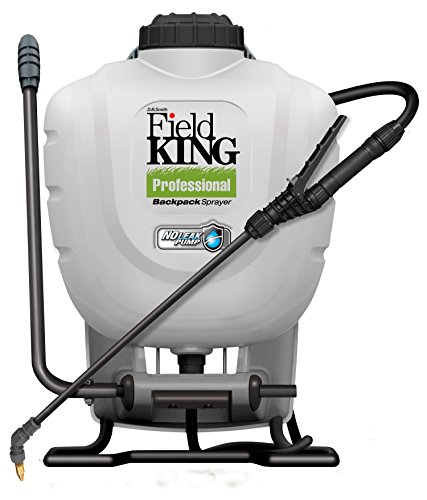
Field King 4-Gallon Backpack Sprayer
Pro-grade backpack sprayer with internal no-leak pump and an included pressure regulator that holds 25 psi, the right pressure range for selective broadleaf herbicides. The right tool for lawns over ~5,000 sq ft.

Chapin 20004 SureSpray 1-Gallon Pump Sprayer
Hand-pump tank sprayer with adjustable cone nozzle, 34-inch hose, and easy-fill funnel-top opening. Translucent tank lets you see what's left. The right size for spot-treating scattered weeds in lawns under ~5,000 sq ft.
Chemistry: What's in That Bottle (And Why)
The selective broadleaf herbicide aisle looks crowded, but the active-ingredient list is short. Five families do almost all the work, and they're combined in pre-mixed products because no single active covers the full broadleaf weed spectrum. Here's what each one actually does.
Phenoxies: 2,4-D, MCPP, MCPA (the workhorses)
The phenoxy family is the foundation of selective broadleaf weed control. These are synthetic auxins that mimic the plant hormone IAA and cause uncontrolled growth that kills the weed. 2,4-D is the most-used and the broadest-spectrum: dandelion, plantain, and other tap-rooted weeds are its specialty. Kansas State Extension is direct about its limitations: "by itself, 2,4-D does not control white clover, chickweed, purslane, ground ivy, or violets very well."
That's why MCPP (also called mecoprop) is added to almost every 2,4-D product on the residential shelf. Per Rutgers FS385, MCPP is "most effective in the control of several perennial or winter annual weeds such as chickweed and clovers," the things 2,4-D misses.
MCPA is a chemical cousin of 2,4-D used in seedling-turf or warm-season-tolerant mixes (Tri-Power swaps MCPA in for 2,4-D). It's slightly less injurious to sensitive turf species but K-State notes it "will not control the broad spectrum of weeds that 2,4-D controls."
A volatility note for warm spring weather: the ester formulations of 2,4-D evaporate and drift in heat. Penn State Extension recommends esters in cooler April weather for better uptake, then switching to amine formulations as temperatures rise. Most consumer products are amines for exactly this reason.
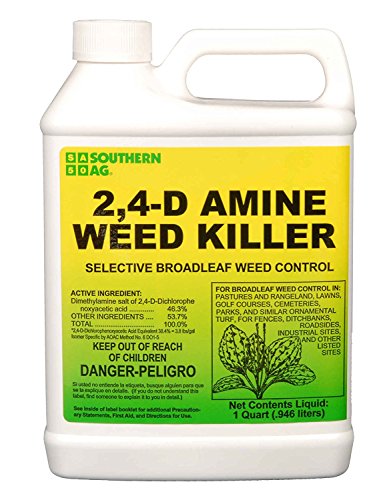
Southern Ag Amine 2,4-D Weed Killer (32 oz)
3.8 lbs/gal 2,4-D acid equivalent in low-volatility amine form. The most economical way to put down a 2,4-D base. Mix with MCPP or use as a tank-mix partner for dicamba. Generic equivalent of Trimec's 2,4-D component.
Dicamba (picks up what 2,4-D misses)
Dicamba is in the benzoic acid family but acts like a synthetic auxin, same as the phenoxies. Per Rutgers FS385, it "controls many different weeds, several of them are not easily controlled by 2,4-D, MCPP, and MCPA. Of particular importance are the summer annual weeds that have a prostrate growth habit, including knotweed, purslane, and spurge as well as winter annual henbit and chickweeds." Dicamba "does not control plantains or dandelion," which is why it pairs with 2,4-D.
Tree-root caution. Dicamba is the chemistry homeowners use to accidentally damage shade trees. Per the Pacific Northwest Pest Management Handbook, dicamba "persists in soil longer than other common broadleaf herbicides and can move with the wetting front of soil water." Tree roots in the lawn (especially silver maple) pick it up. Don't apply within the drip line of shallow-rooted trees. The University of Wisconsin Extension publication on broadleaf herbicide injury notes that dicamba damage "may show up a year or so after application," which makes the cause hard to trace if you weren't the one who sprayed.
Pyridines: triclopyr, fluroxypyr, clopyralid (the tough-weed specialists)
When the three-way bottle isn't enough, when wild violet or creeping Charlie is winning despite multiple seasons of treatment, the answer is a pyridine. Per Rutgers FS385, triclopyr controls "speedwells, lespedezas, woodsorrel (oxalis), ground ivy, violets, and clovers." This is the chemistry for the weeds that mock 2,4-D.
Triclopyr can injure bentgrass and roughstalk bluegrass, so watch the turf type before applying. A small-area test on an unobtrusive corner is cheap insurance.
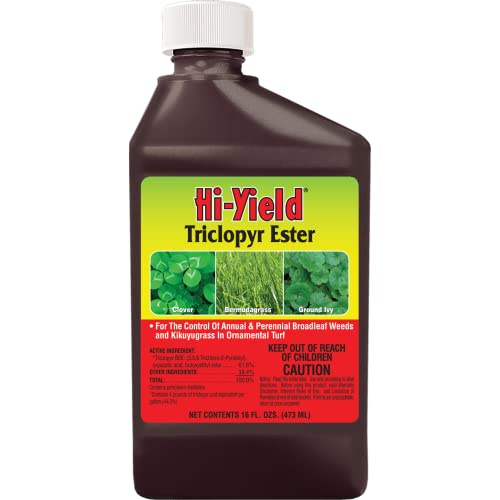
Hi-Yield Triclopyr Ester (8 oz)
Concentrated triclopyr, the standard answer for wild violet and ground ivy / creeping Charlie. The chemistry that works when 2,4-D + MCPP + dicamba doesn't. Multiple seasons of application typically required for established perennial patches.
Fluroxypyr appears in newer 4-way mixes (Escalade 2). It complements triclopyr on ground ivy and clover and is rainfast in about an hour. Clopyralid is restricted-use in some states (Washington and Oregon limit it to golf-course use); check your state before sourcing.
PPO inhibitors: carfentrazone, sulfentrazone (speed and breadth)
Both are protoporphyrinogen oxidase inhibitors that disrupt chlorophyll production at the cellular level and produce visible weed death within hours rather than days. Carfentrazone is the contact partner that gives SpeedZone its visible-burndown speed advantage over plain Trimec. Per the SpeedZone label: "Fast acting with evidence of injury within hours… Generally, the injury symptoms can be noticed within hours of the application and plant death can occur within 7-14 days."
It's rainfast in 1 hour per the QuickSilver T&O label and works well in cool weather when the auxin chemistries slow down.

QuickSilver T&O Herbicide (8 oz)
Carfentrazone-ethyl 21.3%. EPA Reduced Risk classification. Rainfast in 1 hour. Visible weed injury within 24 hours, the fastest-acting selective broadleaf chemistry available to homeowners. Best as a tank-mix partner with a three-way for cool-spring speed.
Sulfentrazone is a related PPO inhibitor with a key extra: it picks up sedges (yellow nutsedge, kyllinga) along with broadleaves like spurge and chickweed. NC State Extension's Dismiss publication notes its spectrum: "spotted spurge, chickweed, eclipta, bittercress" plus "yellow nutsedge, globe sedge, and kyllinga." One note from NC State: do not add a non-ionic surfactant. "Use of surfactants is not recommended" because extra adjuvant on sulfentrazone causes turf discoloration.

FMC Dismiss Turf Herbicide (6 fl oz)
Sulfentrazone-based. Adds yellow nutsedge, kyllinga, and sedge control on top of broadleaf activity. Useful when you have mixed weed pressure. Visible injury within 24-48 hours. Do NOT add NIS surfactant; the formulation is complete.
Mesotrione / Tenacity (the seed-safe selective)
Mesotrione is the odd one out: it's an HPPD inhibitor, not an auxin or PPO. It blocks the carotenoid pathway in target weeds, which is why treated weeds turn white before they die. Per the Pacific Northwest Pest Management Handbook, "Tenacity may temporarily whiten turfgrass foliage" too. That's not damage; it's the carotenoid-biosynthesis tell.
The reason mesotrione gets its own callout: it's the only common selective post-emergent that's safe to apply at seeding for cool-season turf. Renovating a lawn with herbicide-and-seed in the same season? Mesotrione is the chemistry. It also has both pre-emergent and post-emergent activity, which makes it useful as a residual barrier under freshly seeded turf. A nonionic surfactant (NIS) at 0.25% v/v is required for post-emergent applications.

Syngenta Tenacity Herbicide (8 oz)
Mesotrione: pre-emergent AND post-emergent activity in one product. The standard 'safe at seeding' selective for cool-season renovation. Treats 46+ broadleaf and grassy weeds. Whitens treated weeds (the chlorophyll-blocking tell) before kill within 1-3 weeks.
Quinclorac (the clover-and-crabgrass dual)
Quinclorac is the unicorn: it's both a synthetic auxin (broadleaf activity) AND a cellulose biosynthesis inhibitor (grass activity). One product, two jobs. Per Rutgers FS385: "Effectively controls…white clover and speedwells" plus crabgrass.
The single most common DIY failure with quinclorac: methylated seed oil (MSO) is required, not optional. Without MSO the product underperforms badly on crabgrass. NIS works as a substitute but loses meaningful efficacy. If you're spraying Drive XLR8 or generic quinclorac without MSO in the tank, you're wasting product.

BASF Drive XLR8 (Quinclorac), 64 oz
Liquid quinclorac. Kills crabgrass post-emergence AND white clover in the same application. Rainfast in 30 minutes. Mix at 3 tablespoons per gallon plus MSO. Do NOT mow 2 days before or after; mulch clippings on-site for the first 3 mowings.

Southern Ag Methylated Seed Oil (MSO), 32 oz
Required adjuvant for quinclorac. Mix 1.5 tablespoons MSO per gallon of water alongside Drive XLR8. The single most-skipped step in DIY quinclorac use. Without it, the herbicide barely works on crabgrass.
Why 3-Way and 4-Way Mixes Dominate
No single auxin covers the full broadleaf weed spectrum. 2,4-D is great on dandelion and plantain but weak on clover and ground ivy. MCPP kills clover and chickweed but not dandelion. Dicamba picks up knotweed, henbit, chickweed, and the things 2,4-D misses but doesn't touch dandelion or plantain. The math forces you toward combinations.
The canonical mix is the Trimec 3-way: 2,4-D + MCPP + dicamba. Trimec Classic is roughly 25.93% 2,4-D, 6.93% MCPP-P, and 2.76% dicamba. Generic "three-way" products from Southern Ag, Hi-Yield, and others use the same triplet at varying ratios.
The 4-way upgrade adds either carfentrazone (for cool-weather speed) or triclopyr (for tough perennials):
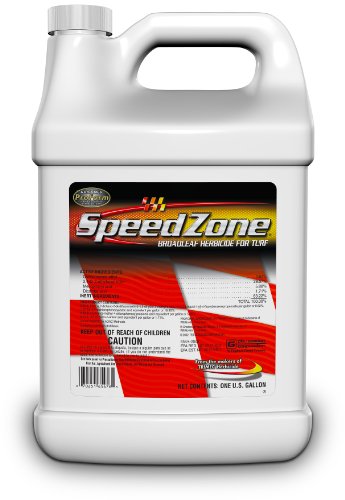
PBI Gordon SpeedZone EW Broadleaf Herbicide (128 oz)
4-way mix: 2,4-D ester + MCPP + dicamba + carfentrazone. The carfentrazone delivers visible weed injury within hours, the cool-weather speed advantage over plain Trimec. Marketed for cool-spring conditions where the auxin chemistries slow down.
For higher-temperature spring and early-summer applications when you'd rather not push a phenoxy ester:
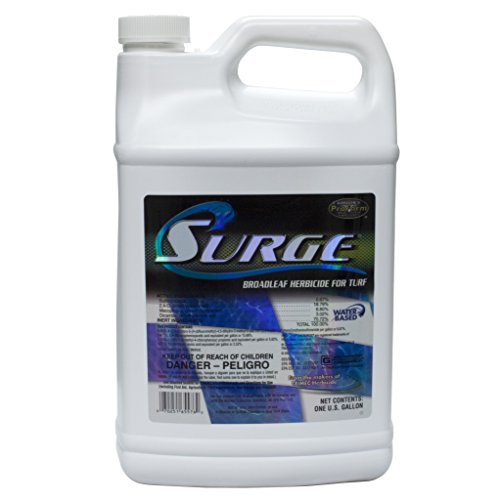
Surge Broadleaf Herbicide (1 Gallon)
4-way: 2,4-D + MCPP + dicamba + sulfentrazone. The sulfentrazone broadens activity onto sedges and adds soil residual. Labeled for application at temperatures up to 90°F, a practical fit when temps push past the 85°F SpeedZone ceiling. Note: not available in CA or NY.
Application Mechanics: Six Things You Have to Get Right
University extensions and product labels converge on a tight checklist. Skip any one and the application fails or causes collateral damage.
1. Mow timing: 1 to 2 days before AND after
The SpeedZone label says it directly: "Delay mowing 1 to 2 days before and after the application of this product." Why before? The herbicide is absorbed through leaf surface area, and freshly mowed weeds have less leaf to intercept the spray. Why after? Systemic auxins (and quinclorac) need time to translocate down to roots. Cutting the leaves shortly after spraying removes the herbicide before it gets to the meristem, and perennial weeds regrow from the surviving root system.
2. Rainfast window: at least 6 hours, ideally 24
This depends on the chemistry, and there's a real divergence between extension guidance and label minimums.
| What | Window |
|---|---|
| Quinclorac (Drive) liquid | 30 minutes |
| Carfentrazone (QuickSilver) | 1 hour |
| Mesotrione (Tenacity) | 1 hour rainfast; 6 hours preferred |
| Fluroxypyr | 1 hour |
| SpeedZone (3-way + carfentrazone) | 3-4 hours per label |
| 2,4-D amine | 6-8 hours |
| Classic 3-ways (Trimec, no carfentrazone) | 6 hours per label |
| Extension default rule of thumb | 24 hours |
Why do extensions still publish "24 hours" when the label says less? Because rainfast (when product can survive a rain shower) isn't the same as maximum efficacy (when the plant has fully translocated the herbicide). Translocation continues for many hours past the rainfast window. Penn State and Purdue prefer to publish 24 hours because longer dry periods produce noticeably better control under cool spring conditions with slow weed growth. The label is the legal minimum; the extension number is the efficacy optimum.
The practical homeowner rule: aim for at least 6 hours, ideally 24 hours, of dry weather after application.
3. Wind speed: 3 to 10 mph
Below 3 mph (calm) risks temperature inversion drift; the chemical can sit in a warm air layer and move sideways for hundreds of feet. Above 10 mph, particle drift carries the spray off-target. The Iowa State Integrated Crop Management page on wind speed is direct on this. For 2,4-D and dicamba specifically, Purdue narrows the window slightly to 2-12 mph.
Two reasons to be especially careful with 2,4-D and dicamba:
- Volatility. The ester formulations of 2,4-D, and the older formulations of dicamba, can volatilize after application, turning into a gas as temperatures rise. They drift hours or days after the spray dried. Amine salts are less volatile but still drift as droplets.
- Sensitivity of nearby plants. Tomato, grape, redbud, sycamore, and most legume foliage will deform from drift at parts-per-billion levels. The most common drift complaint extensions field is "the broadleaf application killed my neighbor's tomatoes."
Drift-reduction nozzles operating at 15-30 psi produce larger droplets that resist drift without sacrificing coverage:

TeeJet AIXR Air Induction Flat Spray Nozzles (12-pack)
Air induction flat-fan tips that produce large air-filled droplets. Drift management without losing coverage. The right upgrade if you're spraying anywhere near vegetable gardens or neighbor property. Yellow tips = 0.2 GPM at 40 psi (the typical homeowner range).
4. Air temp: 60 to 85°F
Below 60°F broadleaves aren't translocating much. Above 85°F volatilization risk spikes (especially for ester formulations) and turf injury becomes a concern. As temperatures rise toward summer, switch from ester to amine formulations of 2,4-D. Penn State and Kansas State both make this point explicitly.
5. Time of day: mid-morning, after dew dries (for liquids)
For liquid applications, wait for dew to dry off the lawn so the herbicide can adhere directly to leaf surfaces without dilution. Iowa State Extension makes the inverse point for granular products: "Apply granular products in the early morning when the foliage is wet with dew." Granules require dew adhesion to stick to weed leaves.
For both, avoid midday peak heat once temps run past 80°F.
6. Active-growth check: no wilt, no frost, lawn mowed
Quick visual sweep before you mix anything: leaves turgid (no wilt), no frost in the next 48 hours, lawn has been mowed at least once or twice this spring. If any of these is off, wait.
The Pollinator Question (and Why Mowing First Matters)
Broadleaf herbicides aren't acutely toxic to bees the way neonicotinoid insecticides are. But two things still matter: the herbicide removes the dandelion and clover flowers that early-spring pollinators visit, and drift can land on adjacent flowering plants.
University of Maryland Extension is direct: "if they do flower, mow the yellow flowers off 1-2 days before application to help avoid harming pollinators." UMD also flags that white clover is "a high-quality forage plant for pollinators, particularly early in the season," which complicates the choice between an immaculate lawn and a pollinator-friendly one.
Some states have codified rules. Vermont requires applicators of pollinator-toxic products to apply only when winds are below 9 mph and to maintain a 50-foot buffer from pollinator foraging sites. Minnesota's 2023 statute prohibits "pollinator-lethal pesticide" use within city boundaries, with exemptions defined in law. Always check your state's pesticide regulations.
The "No Mow May" movement and a chemical broadleaf application are different choices for different goals. If you're keeping turf as bee habitat, don't spray it. If you're applying a herbicide, mow the dandelion and clover blooms off 1-2 days before, then spray.
Reseeding Restrictions
If you're using a typical 3-way broadleaf product, the 4-week rule applies in both directions:
- Wait 4 weeks after spraying before seeding. Per Penn State Extension's lawn renovation guidance, "a waiting period of about four weeks will be required following use of this herbicide combination before seeding can begin."
- Wait until newly seeded turf has been mowed at least twice before applying broadleaf herbicide. Per Purdue Turf: "Most broadleaf herbicide labels suggest delaying application until newly seeded areas have been mown twice." This typically means 4-8 weeks depending on growth rate.
Mesotrione (Tenacity) is the standard exception for cool-season turf, safe to apply at seeding and one of the few selectives that can be sprayed alongside germinating grass. For everything else, plan around the 4-week buffer in both directions.
Warm-Season Turf Warning
The cool-season chemistry described in this guide can severely injure or kill warm-season turfgrasses. The SpeedZone label is explicit: "Do not apply this product to bentgrass greens, carpetgrass, dichondra, legumes, and lawns where desirable clovers are present."
Standard cool-season 2,4-D rates injure St. Augustine (especially Floratam), centipedegrass, and bahiagrass. If you have warm-season turf, you need a "Southern" formulation (Trimec Southern, Atrazine + 2,4-D combos like Bonus S, or a specialty product like Celsius WG with thiencarbazone + iodosulfuron + dicamba). Cool-season product formulations are not safe substitutes; even Trimec Southern is not safe at the same temperatures as cool-season Trimec. A warm-season-specific guide is on our roadmap.
Regional Timing Snapshot
| Region | Spring window | Notes |
|---|---|---|
| Upper Midwest (MN, WI, N. MI) | Late April to early June | Fall preferred; spring opportunity is dandelion-flowering through mid-May |
| Northeast (NY, NJ, PA, MD, MA) | May | 65-85°F window per UMD; Penn State anchors to soil ≥ 70°F for peak growth |
| Transition zone (KS, MO, S. IL/IN/OH, VA, NC) | April to May | Caution: avoid early spring on lawns with warm-season grass coming out of dormancy |
| Pacific Northwest (W. OR/WA) | May to June | Cool, wet spring extends the in-spec window; defer to product label |
Pacific Northwest extension publications focus on culture and product selection rather than spring temperature thresholds. The cool, wet PNW spring tends to extend the in-spec application window into June, but defer to your product label for specifics.
A soil thermometer pays for itself the first season:

Soil Thermometer (instant-read probe)
Instant-read probe thermometer for measuring soil temperature at a 2-3 inch depth. The single most useful tool for getting timing right across pre-emergent, post-emergent, fertilization, and overseeding. Pairs with the SoilTemps station data for your local trend.
Get Your Local Timing
Timing is local. The "when to apply broadleaf weed killer" answer depends on your specific climate, your nearest USDA monitoring station's current readings, and whether your lawn is at the edge of cool-season range. We track this for every city in the country:
Personalized Timing
Get your city's lawn-care schedule
See your full 12-month lawn-care timeline: when each task opens, what to apply, and how it tracks against your local soil temperature data.