
Quick Answer: When Should You Overseed in Spring?
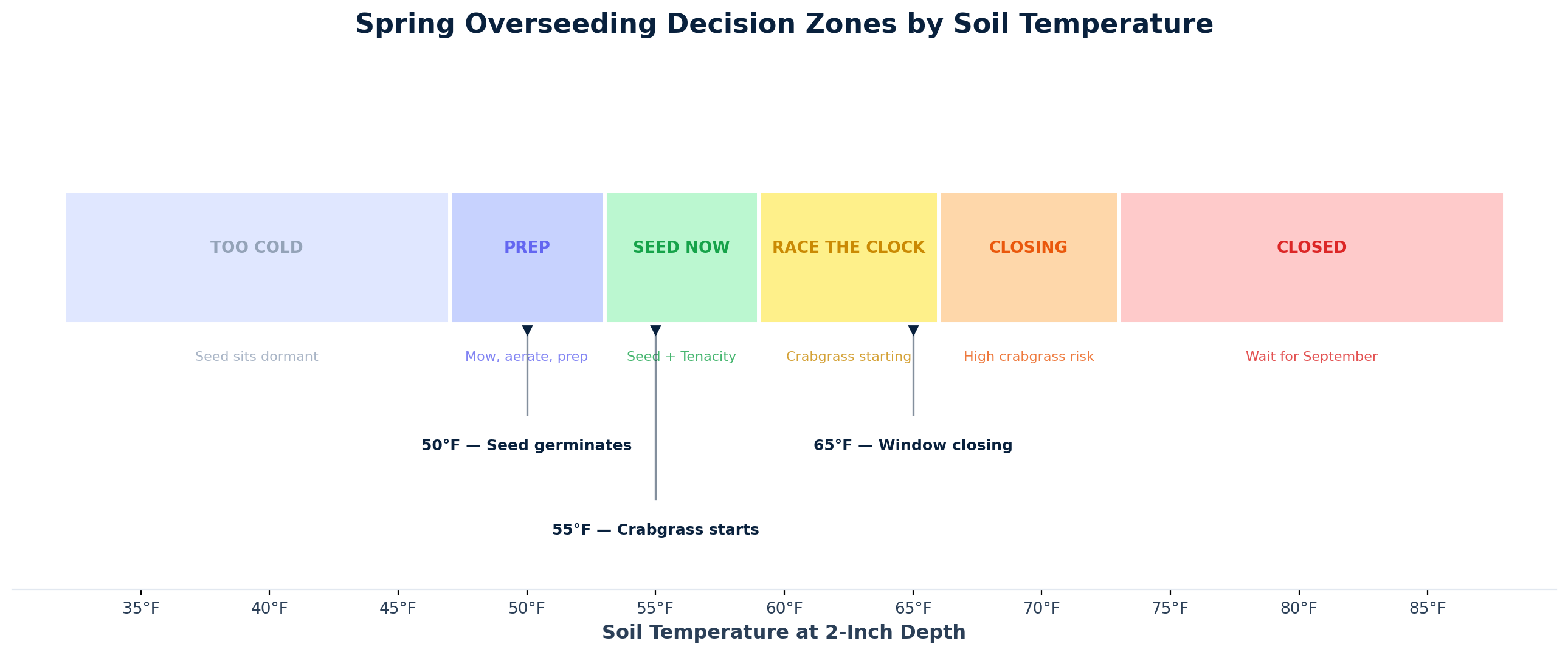
Begin spring overseeding when your local soil temperature at a 2-inch depth is consistently between 50°F and 65°F. For most cool-season regions, this window opens in mid-to-late spring and closes as soil approaches 70°F. Use fast-germinating species (perennial ryegrass or tall fescue), apply a seeding-safe pre-emergent like Tenacity, and commit to daily watering for the first month. The 50-65°F window follows university turfgrass extension guidance (Purdue, Michigan State); the local readings on this site come from USDA SCAN and NOAA USCRN in-ground stations.
What you need
- Seed for thin spots: Twin City turf-type tall fescue
- Feed at seeding: Starter fertilizer 18-24-12
- The one weed barrier new seed tolerates: Tenacity (mesotrione)
Quick Answer
Check your local soil temperature right now
Enter your city or ZIP code to see real-time 2-inch soil temperatures from the nearest USDA or NOAA monitoring station, and find out if your spring overseeding window is open.
Fall is better than spring for overseeding cool-season grass. University extension programs converge on this point and the rest of this guide will say so several times. If you can wait until September, you should.
You are reading this because your lawn cannot wait. Maybe a brutal winter left bare patches across the front yard. Maybe you moved into a new construction home with compacted builder-grade soil and thinning turf. Maybe the dog has turned a section of the backyard into a dirt lot. The question is not whether to overseed in spring but how to do it without wasting your time and money.
The answer comes down to soil temperature, and the chemistry of pre-emergents that interact with germinating seed. This guide pulls species-specific germination data from Purdue University, soil-temperature thresholds from a dozen university extension programs, and a step-by-step process anchored to actual ground conditions rather than calendar dates. Spring overseeding is a patch job. Done correctly, it works.
Can You Really Overseed in Spring?
Yes, with three non-negotiable conditions.
Why Fall Is Better (And Why You Are Doing It Anyway)
University extension sources do not mince words. NC State Extension warns that "spring-established tall fescue is more susceptible to drought, heat, fungal diseases, and weed encroachment." Kansas State Extension goes further: "My recommendation is not to even attempt spring seeding unless you are committed to watering during the summer." UMass Extension puts the ideal window at August 15 through September 15, adding that spring renovation "may be attempted if absolutely necessary."
The reasons are straightforward. In fall, soil is warm from summer, weed germination is declining, rainfall is typically more consistent, and new grass has an entire cool season to establish deep roots before the following summer. In spring, you are racing against a closing window: the soil is still warming, crabgrass is germinating alongside your seed, and summer heat arrives before roots have time to develop.
Industry estimates suggest that 50 to 70 percent of spring-seeded fescue thins or dies in the first summer. That figure is not from a single study but reflects the broad experience of lawn care professionals and turf researchers.
The Three Conditions for Success
Spring overseeding can work, but only if you meet all three of these conditions:
Irrigation access. You must be able to water 2-3 times daily for the first two weeks and at least daily for weeks 3-4. Without an irrigation system or at minimum a hose-end sprinkler on a timer, spring overseeding is a losing bet.
Fast-germinating species. Perennial ryegrass (5-10 days to germinate) and tall fescue (7-14 days) give you the best chance. Kentucky bluegrass, at 14-30 days, takes too long for the spring window.
Seeding-safe weed control. Tenacity (mesotrione) is the only widely available pre-emergent that allows cool-season grass seed to germinate while blocking crabgrass. Without it, you are choosing between crabgrass prevention and new grass, and either choice has consequences.
When Spring Overseeding Makes Sense
The practical scenarios where spring overseeding is the right call include bare spots after a harsh winter (especially cold winters without snow cover that desiccate crowns), new construction yards where the builder left compacted subsoil with a thin layer of sod or seed, dog damage from urine burns and traffic patterns, and shade areas where grass thins every summer and needs annual renovation.
For all of these situations, think of spring overseeding as a patch job, not a permanent solution. Plan to overseed again in September for long-term establishment.
The Soil Temperature Window Every Spring Overseeder Needs to Know
The general 50-65°F range is the right answer for casual reference, but the species-specific numbers, the air-to-soil temperature lag, and the precise overlap with crabgrass germination are what determine whether your particular seeding succeeds.
Germination Temperatures by Grass Species
Seed to the soil band below. Every cool-season species seeds into the same 50-65°F band at a 2-inch depth: extension guidance from Michigan State, Rutgers and Iowa State treats the four the same way, with 50°F as the floor below which germination crawls. What separates them in spring is speed, not temperature, and speed is what decides whether a spring seeding beats the heat.
| Species | Seeding soil temp (2 in) | Days to Germinate | Spring Viability |
|---|---|---|---|
| Perennial ryegrass | 50–65°F | 5–10 | Excellent |
| Tall fescue | 50–65°F | 7–14 | Good |
| Fine fescue | 50–65°F | 7–14 | Good (shade) |
| Kentucky bluegrass | 50–65°F | 14–30 | Poor |
Those viability ratings are about establishment speed against summer, not germination temperature. Perennial ryegrass is up in 5-10 days and tall fescue is both quick and the most heat-tolerant of the four, so both have time to root. Kentucky bluegrass needs 14-30 days, which in a spring seeding often means meeting summer with almost no root system.
You will also see a different set of figures widely republished for these species (perennial ryegrass and tall fescue 68-86°F, Kentucky bluegrass 59-86°F, fine fescue 59-77°F), sourced to Purdue and Beard's Turfgrass Science and Culture. Those are laboratory alternating-temperature cycles: 16 hours at the first number, 8 hours at the second, measured in air. They describe a germination test, not soil you should seed into, and reading them as a soil range makes hot summer soil look acceptable for cool-season seed. Our germination guide explains the distinction in full.
Penn State Extension confirms that optimal leaf growth for cool-season grasses occurs at air temperatures of 60-75°F, while the University of Minnesota reports that germination begins at soil temperatures above 40°F, though at a very slow rate. The practical consensus across extension programs places the usable spring overseeding window between 50°F and 65°F soil temperature.
What these numbers mean in practice: at 50°F, germination begins but is painfully slow. At 55-60°F, germination accelerates noticeably. By 65°F, you are in the sweet spot, but you are also running out of time before crabgrass takes over and summer heat arrives.
Because they are not soil temperatures. Purdue's figures come from a laboratory germination test that alternates two air temperatures on a daily cycle, 16 hours at the lower number and 8 hours at the higher one. The pair describes that cycle, not a range your ground sits in, and Purdue notes the true minimums and maximums "are poorly defined." The 50-65°F window is the soil band to seed into: warm enough for germination to proceed at a useful rate, cool enough that you are not yet fighting crabgrass and heat stress simultaneously.
Why Air Temperature Lies to You
One of the most common mistakes in spring overseeding is using air temperature as a proxy for soil temperature. As Green Meadow Lawn Care explains in a frequently shared post: "What most people don't realize is that just because the air is 75 degrees, it doesn't mean the soil is 75 degrees. Soil acts as an insulator."
Soil temperature lags air temperature by roughly 1-3 weeks in spring. A warm spell in early April may push afternoon air temperatures into the 70s, but the soil 2 inches down may still be in the mid-40s. Conversely, a cold snap may drop air temperatures back into the 30s overnight without significantly affecting soil temperature.
As a rough guide, you need sustained air temperatures approximately 10°F above your target soil temperature before the soil catches up. If you want 55°F soil, you need daytime air temperatures consistently in the 65°F range for at least a week.
How to Measure Soil Temperature Correctly
Use a soil thermometer inserted 2-3 inches deep in a representative area of your lawn, away from pavement, buildings, or south-facing slopes that radiate extra heat. Take readings mid-morning between 8 and 10 AM, when soil temperature is most stable and closest to the daily average. Monitor for 3-5 consecutive days before making seeding decisions. A single warm reading means nothing; you need a consistent upward trend.

Soil Thermometer
Instant-read probe thermometer for measuring soil temperature at a 2-3 inch depth. An essential tool for timing overseeding, pre-emergent, and fertilizer applications.
For continuous monitoring without daily trips to the yard, SoilTemps.com provides real-time 2-inch soil temperature data from over 380 USDA SCAN and NOAA USCRN stations across the country. Enter your city or ZIP code at the top of this page to check your nearest station.
The Crabgrass Collision: Where Overseeding and Weed Germination Overlap
This is the structural challenge that makes spring overseeding harder than fall. The soil temperature windows for cool-season grass germination and crabgrass germination overlap significantly.
Cool-season grass germinates in the 50-65°F range. Crabgrass begins germinating at approximately 55°F and reaches peak germination between 60-70°F. Michigan State University research confirms that 80 percent of crabgrass germination occurs when soil temperatures at the 0-2 inch depth are consistently between 60 and 70°F.
That gives you a narrow gap. At 50-55°F soil temperature, your grass seed is germinating but crabgrass mostly is not yet. By 55-60°F, you are in the overlap zone where both are trying to establish. Above 65°F, crabgrass has the advantage, and your overseeding window is effectively closed.
This is why starting early matters so much in spring overseeding. Every day you gain at the front end of the window, before crabgrass pressure intensifies, improves your odds. And it is why Tenacity is not optional: it buys you 28-30 days of weed suppression that extends your effective window past the point where unprotected seed would be overwhelmed.
When soil temperatures exceed 65°F consistently, the spring overseeding window is closing. When they reach 70°F, it is closed. Seed planted into warm soil faces intense crabgrass competition and has less time to develop roots before summer heat stress. If you have missed the window, save your seed and money for September.
Choosing the Right Grass Seed for Spring Overseeding
Species selection is not a preference in spring. It is a strategic decision driven by germination speed.
Perennial Ryegrass: The Spring Overseeding MVP
Perennial ryegrass germinates in 5-10 days under ideal conditions, making it the fastest-establishing cool-season grass. Penn State Extension confirms this rapid germination rate. Its quick establishment means seedlings can get a foothold before crabgrass pressure peaks.
The tradeoff is durability. Perennial ryegrass is less heat and drought tolerant than tall fescue and may thin in hot summers, particularly in the transition zone. It works best as a fast-cover companion in blends or for patching small bare spots that need quick results.

Outsidepride Perennial Ryegrass Blend, 5 lb
Fast-germinating (5-10 days) cool-season grass for spring patching and overseeding. Pure seed with no other crop or weed seed listed.
Tall Fescue: The Durable All-Rounder
Tall fescue germinates in 7-14 days, which is fast enough for spring if you start early in the soil temperature window. Its deep root system and superior heat and drought tolerance make it the better choice for full-lawn overseeding where summer survival is the primary concern. NC State Extension recommends a seeding rate of 5-6 pounds per 1,000 square feet for overseeding.
Turf-type tall fescue (TTTF) varieties from specialty suppliers are significantly finer-bladed and denser than the old-style pasture fescues found in big-box blends. Named cultivars like those in GCI TTTF blends, Barenbrug RTF, and Jonathan Green Black Beauty undergo NTEP (National Turfgrass Evaluation Program) testing for performance characteristics. The improvement in quality over generic seed is substantial.
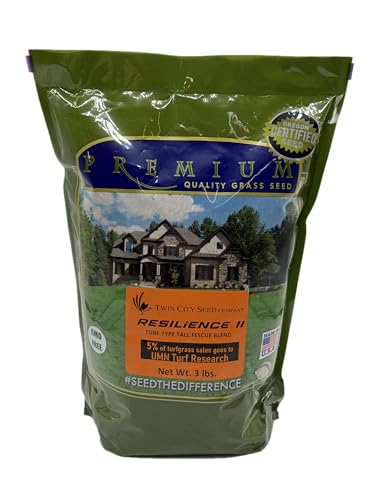
Turf-Type Tall Fescue Blend
Heat and drought tolerant with deep roots for summer survival. The best all-around choice for spring overseeding when you need grass that lasts.
Why Kentucky Bluegrass Is a Bad Spring Bet
Kentucky bluegrass takes 14-30 days to germinate and then requires weeks of additional establishment time. In spring, that timeline runs directly into rising temperatures and crabgrass pressure. Forum consensus across The Lawn Forum, LawnSite, and Reddit's r/lawncare is effectively unanimous: one experienced user summarized it as "I tried KBG overseeding in the spring and it was a complete waste of time and money."
Save Kentucky bluegrass for fall, when it has months of cool weather to establish its signature spreading root system.
How to Read a Seed Label
Cheap seed is one of the most common spring overseeding mistakes. Before buying, check the label for three things: weed seed content should be 0.00%, other crop content should be under 1%, and the germination rate should be above 85%. Named cultivars (rather than generic "tall fescue" or "perennial ryegrass") indicate that the seed has been bred and tested for specific performance characteristics. Specialty suppliers like Jonathan Green, GCI Turf, Barenbrug, and Hogan Seed consistently produce higher-quality seed than mass-market blends.
If the label says "VNS" (Variety Not Stated), you are getting generic, untested seed. Look for specific cultivar names. They cost a bit more per bag but germinate faster, establish denser turf, and contain far less weed contamination.
The Pre-Emergent Dilemma, and How to Solve It
This is the single most debated aspect of spring overseeding. Apply standard pre-emergent and you cannot seed for 60 or more days. Skip it entirely and crabgrass will invade every square inch of bare soil. There is a narrow path between these two outcomes.
Why Most Pre-Emergents Kill Your New Grass Seed
Pre-emergent herbicides create a chemical barrier in the top layer of soil that prevents cell division in germinating seeds. They do not distinguish between crabgrass and grass seed. Per Nebraska Extension, standard pre-emergents (prodiamine, benefin, balan, dithiopyr) will kill germinating grass seed alongside weed seed. The University of Maryland Extension is equally direct: "A preemergent herbicide cannot be applied if you plan on reseeding in the spring."
Tenacity (Mesotrione): The Only Real Workaround
Tenacity is a Group 27 herbicide (HPPD inhibitor) that works through a completely different mechanism than the cell-division-inhibiting Group 3 pre-emergents. Nebraska Extension confirms that mesotrione is one of only two pre-emergent chemicals that can be used at seeding time without killing cool-season grass seed. The other is siduron (Tupersan), which is harder to find and more expensive.
Apply Tenacity at seeding at a rate of 5-8 oz per acre (refer to the label for your specific situation). It provides approximately 28-30 days of pre-emergent residual control against crabgrass and certain broadleaf weeds. After the initial application wears off, a second application is label-approved, extending coverage to roughly 60 days total. The annual maximum is 16 oz per acre.
The Tenacity label specifies: do not use on seed mixtures containing more than 20% fine fescue by weight. Fine fescue is more sensitive to mesotrione and may experience temporary bleaching or stand reduction. If your seed blend is primarily fine fescue, Tenacity is not an option.
For homeowners who prefer a granular option, Scotts Starter Fertilizer with Weed Prevention contains mesotrione as the active ingredient combined with starter-grade fertilizer. It simplifies the process to a single product applied with a broadcast spreader at seeding time.

Tenacity Herbicide (Mesotrione)
The only widely available pre-emergent safe to apply when seeding cool-season grass. Provides ~28 days of crabgrass suppression without killing your new seed.

Scotts Starter Fertilizer with Weed Prevention
Combines starter fertilizer with mesotrione pre-emergent in a single granular product. Simplifies the spring overseeding process for homeowners.
A Soil-Temperature-Based Tenacity Timeline
Here is how to time Tenacity applications around the soil temperature window:
When soil reaches 50°F: Seed and apply Tenacity simultaneously. Your grass seed begins germinating while Tenacity suppresses early crabgrass seedlings.
At 55°F: Crabgrass is starting to germinate, but Tenacity is already active in the soil. Your grass seed has a head start.
At 28-30 days after first application: Reapply Tenacity if soil temperatures have risen into the 60-70°F range and crabgrass pressure is increasing. This second application extends your protection window.
At 60 days post-germination: Your new grass should be established enough (2-3 mowings) to transition to a standard herbicide program. If desired, apply a low rate of Prodiamine for late-season crabgrass control, though this is optional if your stand is thick.
What If You Already Applied Pre-Emergent?
If you already applied Prodiamine, Dithiopyr, or another standard pre-emergent this spring, you cannot successfully overseed for 60-90 days depending on the product and application rate. The barrier that prevents crabgrass germination will prevent your grass seed from germinating too.
Two options remain: wait until fall (the better choice) or, for small spot repairs, use a hand cultivator or Garden Weasel to physically disrupt the chemical barrier in the top layer of soil at the specific spots you want to seed. This is not practical for full-lawn overseeding but can work for isolated bare patches.
Step-by-Step Spring Overseeding Guide
This process is organized around soil temperature milestones rather than calendar dates, because the right timing depends on your local conditions, not the month.
Step 1: Start Monitoring Soil Temperature
When to begin: As soon as daytime air temperatures are consistently above 50°F.
Check your soil temperature at 2 inches deep using either a probe thermometer or SoilTemps.com real-time data. You are watching for the soil to reach 50°F and trend upward over 3-5 consecutive days. Do not seed based on a single warm reading.
Step 2: Mow Low and Clean Up
At 48-50°F soil temperature: Cut your existing grass to about 2 inches, which is lower than the typical 3-3.5 inch maintenance height for cool-season lawns. Bag the clippings rather than mulching to remove debris and expose the soil surface. Rake up any leaves, sticks, or dead grass.
Step 3: Core Aerate (or Dethatch)
At 48-50°F soil temperature: This is the most important soil preparation step. Penn State Extension recommends six to eight passes over the lawn with a core aerator before overseeding. Core aeration pulls 2-3 inch soil plugs that break up compaction, improve seed-to-soil contact, and create openings where seed can germinate directly in soil rather than sitting on top of thatch.
If your thatch layer is thicker than 1 inch, UMass Extension recommends dethatching to a depth of approximately 1/4 inch to expose enough soil for a good seedbed.
Rent a core aerator from a local equipment rental shop. For smaller areas, a Garden Weasel or manual core aerator can work for spot repairs.
Most homeowners rent a core aerator for a few hours rather than buy one. Equipment rental centers carry walk-behind and tow-behind machines, and six to eight passes give new seed direct access to soil.
Step 4: Spread Seed at the Right Rate
When soil reaches 50-55°F consistently: This is your seeding day. Nebraska Extension provides overseeding-specific rates (reduced from full establishment rates because you are seeding into existing turf):
| Species | Overseeding Rate | Full Establishment Rate |
|---|---|---|
| Perennial ryegrass | 3–4 lbs / 1,000 sq ft | 6–8 lbs / 1,000 sq ft |
| Tall fescue | 4–5 lbs / 1,000 sq ft | 8–10 lbs / 1,000 sq ft |
| Kentucky bluegrass | 1–2 lbs / 1,000 sq ft | 3–4 lbs / 1,000 sq ft |
Use a broadcast spreader for even coverage. Make two perpendicular passes at half the target rate (e.g., two passes at 2.5 lbs each for tall fescue at 5 lbs total) to avoid striping. Iowa State Extension notes that seed depth should be 1/8 to 1/4 inch for optimal germination.

Broadcast Spreader
Even seed distribution with adjustable rate settings. Two perpendicular passes at half-rate ensure uniform coverage without striping.
Step 5: Apply Starter Fertilizer
Apply a high-phosphorus starter fertilizer such as an 18-24-12 or similar formulation at seeding time. Iowa State Extension recommends 5 pounds of a 20-5-10 or similar analysis per 1,000 square feet. Phosphorus supports root development, which is critical for spring-seeded grass that needs to establish quickly before summer.
For homeowners who prefer an organic option, Milorganite is a popular slow-release fertilizer that will not burn seedlings. It releases nutrients gradually as soil temperatures rise, which aligns well with the seedling growth curve.
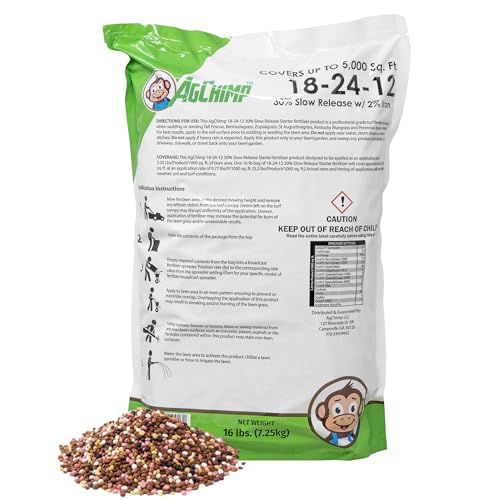
Starter Fertilizer (18-24-12)
High-phosphorus formulation to fuel root development in new seedlings. Apply at seeding time at 5 lbs per 1,000 sq ft.
Step 6: Apply Tenacity
If you are using Tenacity as your seeding-safe pre-emergent, apply it on the same day you seed. Mix according to label rates with a non-ionic surfactant and spray evenly over the seeded area. If you opted for Scotts Starter Fertilizer with Weed Prevention, you have already applied mesotrione in the previous step and can skip this one.
Step 7: Ensure Seed-to-Soil Contact
After spreading seed, use one or more of these methods to press seed into the soil:
Topdress with compost or peat moss at a thin layer (1/4 inch) over the seeded area. This holds moisture around the seed and improves germination rates. Iowa State Extension recommends that if using straw mulch, one bale per 1,000 square feet should leave approximately 50 percent of soil visible through the straw.
Roll the lawn with a lawn roller filled halfway with water. This presses seed into aeration holes and ensures contact with the soil surface.
NC State Extension states it plainly: "Getting good soil-to-seed contact is paramount."
Step 8: Begin the Watering Schedule
Start watering immediately after seeding. This is the phase where most spring overseeding projects succeed or fail, and the margin for error is thinner in spring than in fall because rising temperatures increase evaporation.
The Watering Schedule That Keeps Spring Seed Alive
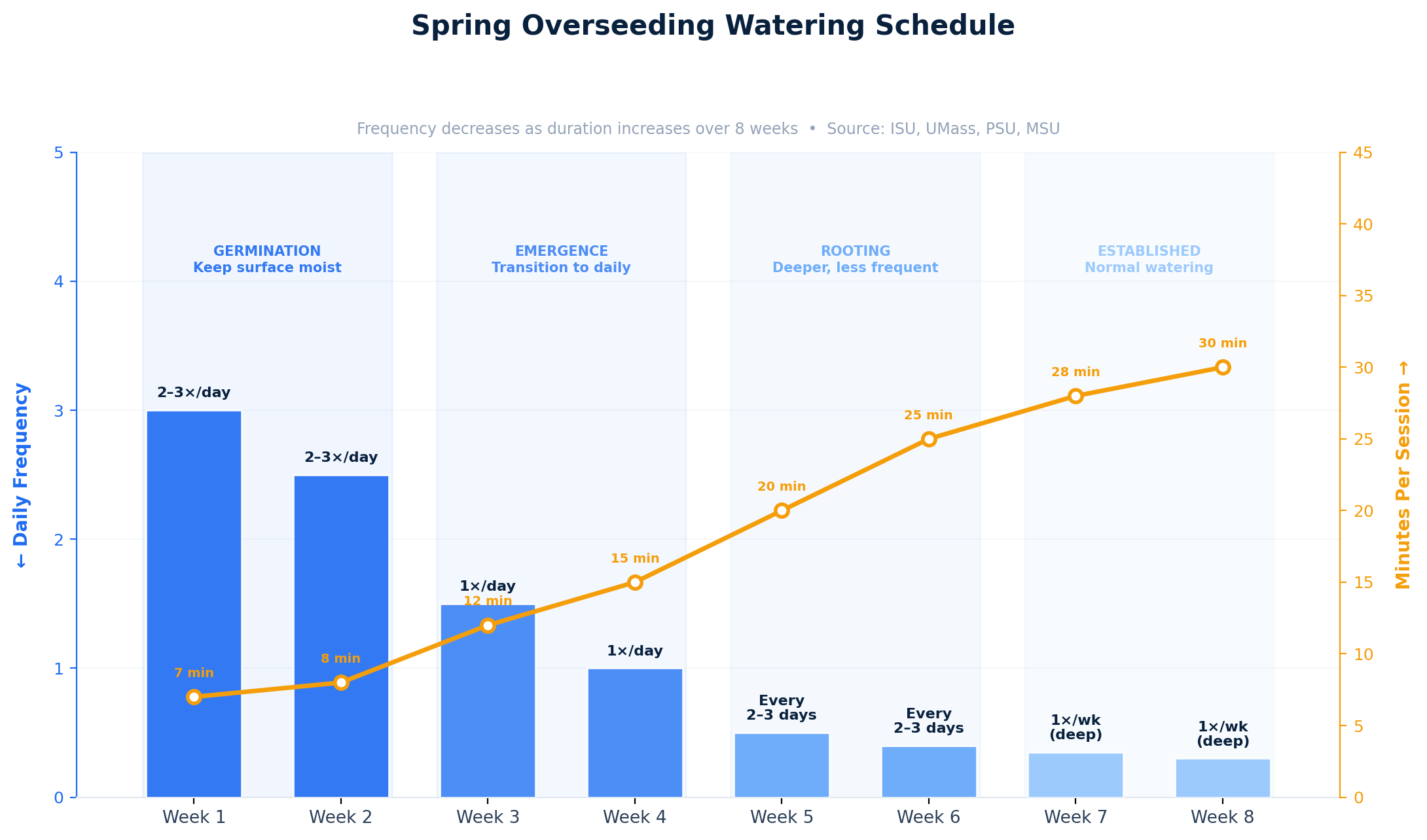
The extension consensus on watering new seed is remarkably consistent across Iowa State, UMass, Penn State, and Michigan State. The schedule progresses from frequent and light to deep and infrequent over about eight weeks.
Weeks 1-2: Light and Frequent
Water 2-3 times daily with light applications. The goal is to keep the top 1 inch of soil continuously moist without creating puddles or runoff. Each session should be 5-10 minutes depending on your sprinkler output. If the soil surface dries out and develops a crust, seed germination drops dramatically.
Weeks 3-4: Transition to Daily
As seedlings emerge and begin rooting, reduce to once daily. Increase the duration of each watering session to encourage roots to grow deeper.
Weeks 5-8: Deeper, Less Frequent
Water every 2-3 days with longer sessions. You are now training the root system to seek water at depth rather than depending on surface moisture.
After 8 Weeks: Established Lawn Watering
Michigan State University notes that a 2-month-old turf may be watered the same as an established lawn: approximately 1 inch per week, applied in one or two deep sessions rather than daily light watering.
If you do not have in-ground irrigation, use an oscillating sprinkler connected to a hose-end timer. Set it to run for short cycles (5-10 minutes) two to three times per day during the critical first two weeks. Focus on smaller zones rather than trying to cover the entire lawn in one session. Prioritize morning watering to minimize evaporation and disease risk.

Orbit Programmable Digital Hose Timer, 1 Outlet
Programmable timer for automated watering cycles. Set multiple daily sessions during the critical germination period without being home.
When to Mow, Fertilize, and Resume Normal Lawn Care
First Mow: The One-Third Rule at 4-6 Weeks
University of Maryland Extension provides the clearest guidance: begin mowing when the new grass reaches a height one-third taller than your target mowing height. For tall fescue at a 3-inch mowing height, that means the first cut happens when grass reaches 4 inches. Typically this is 4-6 weeks after seeding.
Use a sharp blade. A dull mower blade tears rather than cuts, which stresses seedlings and increases disease vulnerability. Avoid sharp turns on new grass, as the wheels can uproot young plants that have not yet anchored firmly.
Second Fertilizer Application: 3-4 Weeks After Germination
Kansas State Extension recommends a follow-up fertilizer application about four weeks after germination, using a high-nitrogen source such as 30-0-0, preferably with slow-release nutrients. This feeds the establishing grass without the burning risk of a fast-release product. The University of Minnesota applied starter fertilizer at 0.75 lbs nitrogen per 1,000 square feet a few weeks after germination in their overseeding success trial.
Summer Survival Plan for Spring-Seeded Grass
This is where honesty matters. Spring-seeded grass has shallow roots heading into its first summer. NC State Extension warns it is more susceptible to drought, heat, fungal diseases, and weed encroachment than fall-seeded grass.
To give it the best chance: raise your mowing height to 3.5-4 inches as summer approaches (taller grass shades roots and retains soil moisture), water deeply and infrequently rather than with daily light sessions, reduce nitrogen fertilizer during the hottest months to avoid pushing top growth at the expense of roots, and accept that some thinning is likely.
Plan to overseed again in September. Think of spring overseeding as round one of a two-round process, not a one-and-done project.
The 7 Mistakes That Kill Spring Overseeding Projects
These are the errors that show up most frequently in forum post-mortems and extension warnings. Avoiding all seven will put you ahead of most spring overseeders.
Seeding Kentucky bluegrass in spring. At 14-30 days to germinate plus weeks of additional establishment, KBG simply cannot beat the closing window. Stick to perennial ryegrass or tall fescue.
Applying standard pre-emergent, then trying to seed. Prodiamine, Dithiopyr, and Pendimethalin all create a barrier that kills grass seed just as effectively as it kills crabgrass. If you want to seed, use Tenacity or nothing.
Inconsistent watering. Both under-watering (letting the soil crust) and over-watering (creating standing water and moss) kill seedlings. The first two weeks require 2-3 light daily sessions, not one heavy soak and then neglect.
Relying on air temperature instead of soil temperature. A 75°F afternoon in early spring does not mean the soil is 75°F. Soil lags air by 1-3 weeks. Measure at 2 inches deep, mid-morning, for 3-5 consecutive days.
Applying high-nitrogen fertilizer at seeding. Nitrogen fuels the growth of your existing grass, which then shades out new seedlings competing for light. Use a high-phosphorus starter fertilizer instead, and save the nitrogen application for 3-4 weeks after germination.
Buying cheap, generic seed. Big-box seed mixes often contain weed seed, filler species, and untested generic varieties. Check the label for 0.00% weed seed and named cultivars from a specialty supplier.
Skipping soil preparation. Broadcasting seed onto compacted, thatchy soil is the most common shortcut that leads to failure. Without aeration or dethatching, seed sits on top of the thatch layer and never makes contact with soil. No soil contact means no germination.
Track Your Soil Temperature and Get Started
Calendar dates and regional averages are estimates. Your yard, your soil, your microclimate. The only way to nail the timing for spring overseeding is to know your actual soil temperature at the depth where germination happens.
SoilTemps.com tracks 2-inch soil temperatures from over 380 USDA SCAN and NOAA USCRN monitoring stations nationwide. We show you the data alongside germination thresholds and pre-emergent timing windows, so you can make seeding decisions based on what is actually happening in the ground rather than what the calendar says.
Ready to check your soil temperature?
Enter your city or ZIP code to see real-time soil temperature data and find out if your spring overseeding window is open, closing, or past.