
Quick Answer
Make the first nitrogen application of the year only after soil at the 4-inch depth holds a sustained 65°F and the lawn is fully greened up and actively growing, then space 2-4 modest feedings across the 65-85°F active window and stop nitrogen entirely well before the first frost.
What you need
- Test first: MySoil soil test kit
- All-in-one feeding: Andersons PGF Complete 16-4-8
- Spreads granules evenly: Scotts Elite broadcast spreader
Quick Answer
Check your 4-inch soil temperature right now
Enter your city or ZIP code to see real-time soil temperatures from the nearest USDA or NOAA monitoring station and find out whether your warm-season green-up trigger has been met.
Warm-season fertilization fails in two predictable ways: feeding too early and feeding too late. Both are calendar mistakes. A homeowner reaches for a bag of nitrogen on a warm March afternoon while the grass is still half-dormant, or feeds in October to chase one more flush of green right into the first hard freeze. Either move costs you turf.
The fix is to stop reading the calendar and start reading the ground. Warm-season grasses (bermuda, zoysia, St. Augustine, centipede, bahia) run on one signal: soil temperature at the root zone. When soil at 4 inches sustains 65°F and the lawn has fully greened up, the grass is ready to use nitrogen. Before that it feeds weeds and disease; after the season closes it invites winterkill. This guide ties every decision to that signal, then layers on the species-specific nitrogen budgets that separate a thick bermuda lawn from a declining centipede one.
Why Soil Temperature, Not the Calendar, Triggers the First Feeding
Warm-season grasses spend winter dormant, living on carbohydrate reserves stored in roots, rhizomes, and stolons. Spring green-up is not the grass "waking up and getting hungry." It is the grass spending down its savings to push new leaves. Feeding nitrogen during that phase does not help, because the plant cannot use it efficiently until its new leaf tissue is photosynthesizing and rebuilding reserves, which only happens once the soil is consistently warm enough to support active growth.
Texas A&M AgriLife (bermudagrass calendar): do not apply nutrients to bermudagrass before full spring green-up or during late fall and winter dormancy. University of Georgia Extension echoes this for the southern species generally. Nitrogen applied to still-dormant or barely-green turf is mostly lost to leaching, volatilization, and weed competition, and it can force tender top growth that a late frost will burn.
The Green-Up Trigger: 65°F at 4 Inches, Plus Visible Growth
The trigger has two conditions, and you need both:
-
Soil at 4 inches holds a sustained 65°F. Warm-season grasses begin active root and shoot growth around this threshold. Look for the soil to hold 65°F across several consecutive days, not spike there on one sunny afternoon and drop back overnight.
-
The lawn is fully greened up and actively growing. Green-up should be uniform across the whole lawn, including shaded and low spots, not just the sunny edges. UF/IFAS frames the practical version for St. Augustine: wait until the lawn greens up and you have mowed it a couple of times before the first feeding.
When both are true, the grass can convert nitrogen into growth and rebuild the reserves it spent during green-up.
Seed germination guides reference the 2-inch depth because that is where seed sits. Warm-season green-up is a root-system event, so the 4-inch depth is the better gauge of whether the established crown and root zone are warm enough to drive growth. If you only have 2-inch data, use it as a leading indicator: the 4-inch reading lags it by a few days and is slightly more stable. Learn to read both with our soil thermometer guide.
How to Measure It Correctly
Insert a soil thermometer to a 4-inch depth in a representative part of the lawn, away from pavement, foundations, and south-facing slopes that radiate extra heat. Read mid-morning (8-10 AM), when soil sits closest to the daily average, and track it for 3-5 consecutive days, looking for a stable trend at or above 65°F before you feed. A probe thermometer is the cheapest insurance against the most expensive warm-season mistake.

Soil Thermometer
An instant-read probe thermometer lets you confirm the 4-inch green-up trigger before you spend a dollar on fertilizer. The single most useful tool for timing warm-season nitrogen, iron, and the last-safe feeding of the year.
For continuous tracking without daily trips to the yard, SoilTemps.com publishes real-time soil temperatures from over 380 USDA SCAN and NOAA USCRN stations nationwide. Enter your ZIP at the top of this page to find your nearest station.
State and Regional Timing: When the Window Opens and Closes
Green-up arrives weeks apart across the warm-season belt: South Florida greens up in late February while the Carolina coast waits until late April or May. The table below gives the typical spring green-up window, the first nitrogen application, and the last-safe nitrogen date by state. Use it to set expectations, then confirm with your own soil reading before you feed.
| State / Region | Typical spring green-up | First N application | Last safe N before dormancy |
|---|---|---|---|
| Florida (South / Gulf Coast) | Late Feb - mid-March | ~3 wks after green-up (mid-late March) | Early October (N. FL); avoid late fall |
| Florida (North) | Mid-March - early April | Mid-March to mid-April, after 2 mowings | Early October |
| Texas (bermuda) | Early April - early May (by region) | After full green-up, soil 65°F sustained | Mid-September (stop ~1 mo before frost) |
| Georgia | Mid-March - early April (coast earlier) | After green-up and active growth | Late summer / early fall; no late-fall N |
| South Carolina (Coast) | Late April - early May | Early May after full green-up | Before Sept 1 (coast); before Aug 15 (Upstate) for centipede |
| Alabama | Mid-March (south) - April | After full green-up | Late summer; avoid late-fall N |
| Arkansas | Mid-April - early May | After green-up, soil 65°F sustained | Late August - early September |
| North Carolina | Mid-April - early May | Early May after full green-up | Late August (zoysia/centipede); ~1 mo before frost |
Dates are typical ranges; confirm with a sustained 65°F reading at 4 inches plus visible active growth before applying.
The "last safe N" column is not the last date the grass is green. It is roughly one month before your first expected killing frost. Warm-season turf can stay green well past the point where new nitrogen becomes a liability. The Clemson centipede cutoffs (before Aug 15 in the SC Upstate, before Sept 1 on the coast) are a useful citable example: that is months before the grass goes brown. Feeding past the cutoff trades a few weeks of color for a real winterkill risk.
Species Nitrogen Budgets: The Number That Matters Most
Every warm-season grass has a different appetite, and matching the rate to the species is the difference between a healthy lawn and a damaged one. The same 4 lb of nitrogen that builds dense bermuda will push centipede into decline. Here is the annual nitrogen budget by species, with the input rules for each.
| Grass | Annual N (lb / 1,000 sq ft) | Apps / season | Key input notes |
|---|---|---|---|
| Bermuda | up to ~4 (aggressive) | ~4 | Highest demand; 1-4 apps of 0.5-1 lb each |
| Zoysia | 2-4 (2-3 commonly cited) | 2-3 | First app early May, last by August |
| St. Augustine | 2-4 | 2-3 | ≥50% slow-release N; higher rate on sand |
| Centipede | 1-2 (1 ideal) | 1-2 | No phosphorus unless soil test shows need |
| Bahia | 1-2 | 2-4 | FL rule caps single app at 1 lb N |
Use the higher end of each range on sandy soils, the lower end on clay.
The universal rule across every species and every extension: never exceed 0.5 to 1 lb of nitrogen per 1,000 sq ft in a single application. Texas A&M states it directly for bermuda, and Florida codifies a 1 lb single-application cap in its Urban Turf Fertilizer Rule. You reach the annual total by spacing several modest feedings across the active window, not by dumping it all at once.
Bermuda: The Nitrogen-Hungry One
Bermudagrass has the highest nitrogen demand of the common warm-season grasses. The Texas A&M AgriLife Bermudagrass Home Lawn Management Calendar puts the annual requirement at up to about 4 lb per 1,000 sq ft, applied as 1 to 4 applications from spring green-up through early-to-mid September, each held to 0.5-1 lb N. Bermuda responds aggressively with fast color and density, which is exactly why it is the species most prone to being overfed into thatch and scalping if you exceed the per-application ceiling. A balanced granular with both quick- and slow-release nitrogen suits it: the quick fraction gives color, the slow fraction smooths the curve so you are not forcing a flush that means weekly mowing.

The Andersons Professional PGF Complete 16-4-8 with 7% Humic DG
Built for nitrogen-hungry bermuda, this 16-4-8 blends quick- and slow-release nitrogen so you get color without a growth flush. The small particle size spreads evenly, which helps you stay under the 0.5-1 lb per-application ceiling. Covers 5,000 sq ft.
Zoysia: Moderate and Patient
Zoysia grows more slowly than bermuda, so it needs less nitrogen. Clemson Cooperative Extension sets the range at 2-4 lb of actual nitrogen per 1,000 sq ft per season, higher on sand and lower on clay. The first 0.5 to 1 lb N goes down in early May after full green-up, and the last nitrogen is typically applied by August. Over-fertilizing zoysia produces thatch rather than improvement, because the slow-growing turf cannot use the extra nitrogen as fast as bermuda.
St. Augustine: Slow-Release on Sand
UF/IFAS Extension sets St. Augustine at 2-4 lb of actual nitrogen per 1,000 sq ft annually, the higher rate reserved for sandy soils that leach quickly. The first roughly 1 lb N application goes down about three weeks after the lawn greens up, not at the first sign of green. The key product rule: choose a fertilizer with at least 50% slow-release nitrogen, which reduces leaching on sand, smooths growth, and lowers the disease pressure (gray leaf spot, large patch) that heavy nitrogen brings to St. Augustine.
Bahia: Low and Compliant
Bahiagrass is a low-input lawn grass common in Florida. The 2024 UF/IFAS guidance recommends 1-2 lb N per 1,000 sq ft per year in 2-4 applications from spring green-up through fall, with no single application exceeding 1 lb N under Florida's Urban Turf Fertilizer Rule. Bahia tolerates poor soils and does not benefit from heavy feeding.
Centipede Is the Special Case: Less Is More
Centipedegrass is the one warm-season grass where the "more fertilizer equals better lawn" instinct is actively harmful. It evolved on acidic, infertile soils and is a genuinely low-input grass. Overfeeding does not just waste money; it kills the lawn through a syndrome extension agents call centipedegrass decline.
University of Georgia Extension (Centipedegrass Decline, publication C1003) is blunt: excessive nitrogen turns the grass unnaturally dark green, promotes thatch and disease, and is a primary cause of decline. Clemson sets the annual rate at 1-2 lb N per 1,000 sq ft (lower on clay, higher on sand), with 1 lb ideal. Exceeding 2 lb risks excess thatch and disease.
Never Add Phosphorus Without a Soil Test
Established centipede should not receive phosphorus fertilizer unless a soil test shows a deficiency. University of Georgia documents the mechanism: high phosphorus renders iron unavailable in the soil, producing chlorotic (yellowing) symptoms. So the homeowner who applies a "complete" fertilizer with a middle phosphorus number to a yellowing centipede lawn often makes the yellowing worse. The fix is almost never more fertilizer.
A phosphorus-free, high-potassium fertilizer is the extension-favored choice. The 15-0-15 ratio (nitrogen and potassium, zero phosphorus) with slow-release nitrogen hits the low-input target without the phosphorus that triggers iron lockout, and it doubles as a sound low-N, high-K last feeding for other warm-season grasses.

Ferti-Lome Centipede Lawn Fertilizer 15-0-15
Phosphorus-free with slow-release nitrogen, the extension-favored ratio for low-input, phosphorus-sensitive centipede. The zero phosphorus avoids the iron lockout that causes centipede yellowing, and the high potassium makes it a good late-season feed for other warm-season lawns too.
If your centipede lawn is yellowing, thinning, or dying back in patches, work through the causes University of Georgia attributes to decline before reaching for fertilizer: excess nitrogen, nitrogen applied during spring green-up (feed only after full green-up), high soil pH, high phosphorus, and heavy thatch from over-fertilization. The cure for centipede decline is usually doing less, not more.
Iron: Color Without Growth
The cleanest tool in the warm-season toolkit is iron. It delivers deep green color without the growth nitrogen forces, which matters most in summer (extra growth means more mowing and more disease) and on centipede and high-pH soils where nitrogen is the wrong answer for yellowing.
LSU AgCenter: foliar iron delivers green color without stimulating the excess growth nitrogen causes, an excellent option in summer. Visible results appear within 24 to 48 hours, but the effect is temporary (two to three weeks), so iron is a maintenance tool you reapply, not a one-time fix.
Chelated Iron vs Iron Sulfate
Two main forms, chosen by soil and tolerance for leaf burn:
- Chelated iron (Fe-EDTA, Fe-EDDHA, Fe-DTPA) stays soluble and is especially effective for foliar sprays and high-pH soils, per LSU AgCenter. It costs more but resists alkaline lockup and burns less.
- Iron sulfate (ferrous sulfate) is cheaper but carries higher leaf-burn risk at high rates or in heat. For centipede chlorosis, University of Georgia gives 1 tablespoon ferrous sulfate per 3 gallons of water per 1,000 sq ft; Clemson lists 2 oz in 3 to 5 gallons per 1,000 sq ft. Reapply every two to four weeks as color fades.
Both forms stain concrete, so keep sprays off sidewalks, driveways, and siding. Chelated liquid iron is the lower-risk choice for most homeowners, especially on high-pH soils where sulfate forms lock up.
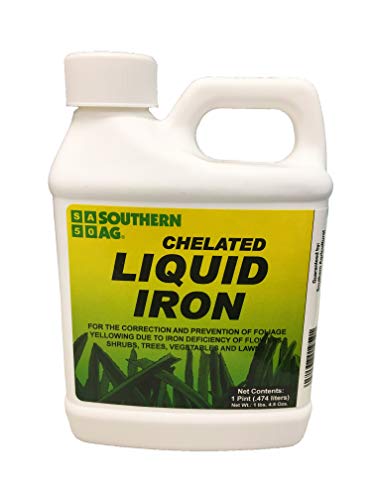
Southern Ag Chelated Liquid Iron
A 5% chelated liquid iron for foliar application at 8-16 fl oz per 1,000 sq ft. It gives deep green color without pushing growth, ideal for summer color and for correcting iron chlorosis on centipede and high-pH soils where sulfate forms lock up. Keep it off concrete to avoid staining.
Texas A&M AgriLife notes that for warm-season turf, with the exception of iron on high-pH soils, micronutrients rarely need to be applied to home lawns. If a soil test does not flag a deficiency, skip the "complete" micronutrient blends. Iron is the one micronutrient worth applying on its own, and only for color or to correct visible chlorosis.
Reading a Deficiency: Iron Chlorosis vs Nitrogen Hunger
Yellowing is the most common complaint, and the pattern tells you which nutrient is involved. Iron chlorosis shows as interveinal yellowing on new growth: blades turn yellow while veins stay green, first on the youngest leaves. University of Georgia ties it to high soil pH, high phosphorus, excess nitrogen during green-up, and heavy thatch. The fix is iron plus correcting the cause. Nitrogen deficiency shows as uniform pale color across the whole leaf, starting on the oldest leaves first. The fix is a modest nitrogen feeding, but only inside the 65-85°F window and under the species' annual budget.
Confusing the two is how people overfeed centipede: they see yellow, assume nitrogen hunger, and apply a complete fertilizer whose phosphorus deepens the iron lockout. On a low-input grass, treat yellowing as iron first.
Equipment and Application Technique
The grass that punishes over-application the hardest (centipede) is also the one where spreader accuracy matters most. Apply granular nitrogen in two perpendicular half-rate passes (for example, two passes at 0.5 lb N each to reach 1 lb) for uniform coverage without striping. Keep product off driveways and sidewalks to prevent runoff into storm drains, and sweep stray granules back onto the lawn. Water it in with about 0.25 inch within 24 hours to move nitrogen to the root zone and prevent foliar burn, but do not feed right before heavy rain.

Scotts Elite Broadcast Spreader with EdgeGuard
A dual-rotor broadcast spreader with a 6 ft pattern and EdgeGuard for accurate, even granular application. Even coverage matters most when feeding low-N grasses like centipede that are unforgiving of over-application, and the two-perpendicular-pass technique keeps you from striping or burning.
No Fall or Winter Nitrogen: The Winterkill Rule
The most damaging late-season mistake is feeding nitrogen too late. Warm-season grasses need to harden off and enter dormancy with full carbohydrate reserves to survive winter. Late nitrogen keeps the grass tender and actively growing when it should be shutting down, which delays dormancy and leaves the crown vulnerable to the first hard freeze.
Penn State Extension (Winterkill of Turfgrasses): late-fall nitrogen should be avoided because it delays dormancy and increases winterkill risk. The final nitrogen feeding should occur in late summer to early fall, at least about one month before the first expected killing frost. Any late feeding should be low-nitrogen and high-potassium, because potassium builds the cold hardiness that nitrogen undermines.
Clemson gives concrete centipede dates that make a good citable anchor: the last nitrogen goes down before August 15 in the SC Upstate and before September 1 on the coast, then the lawn transitions to a high-potassium product such as 15-0-15 for dormancy. Apply the same logic to your region: count back about a month from your average first frost, make that your nitrogen cutoff, and switch any later feeding to potassium.
Plan the rest of the dormant-season program now. Our winter dormancy care guide covers what to do (and not do) once the grass goes brown, the when to stop mowing guide pairs the last cut with the last feeding, and if you overseed bermuda with ryegrass for winter color, time that final warm-season feeding around the transition in our fall overseeding for warm-season lawns guide.
Look up your average first fall frost date, count back one month, and write that date on the calendar as your hard nitrogen cutoff. After that date, the only thing that goes on the lawn is potassium (for cold hardiness) or iron (for color). No nitrogen, on any warm-season grass, especially centipede and bahia.
Through the Heat: Feed the Active Window, Not the Stress
Warm-season grasses are built for heat. While fescue and bluegrass go into summer survival mode, bermuda and zoysia hit their stride in the 80s. But there is still a ceiling: during peak summer heat combined with drought stress, pause nitrogen even on aggressive growers, because pushing growth into moisture stress invites disease and wastes nitrogen the grass cannot use. Feed while soil and air support growth in the roughly 65-85°F range, pause during peak heat and drought, and lean on iron for color in those stretches.
Our summer stress management guide covers how warm-season grass thrives through summer with the right mowing height, and the irrigation timing by soil temperature guide helps you water the active window so nitrogen is not lost to drought-stressed turf. Cool-season lawns run the opposite schedule: their heavy feeding is in fall, not late spring. If you also manage fescue or bluegrass, see the cool-season fertilization schedule for the mirror-image calendar and spring lawn fertilization for how spring feeding differs between the two grass families.
Common Mistakes That Cost You Turf
These errors show up most in extension warnings and homeowner post-mortems. Avoiding them puts you ahead of most warm-season lawn owners.
Feeding before full green-up. The single biggest mistake. Soil at 4 inches sustaining 65°F plus visible active growth is the trigger, not the calendar. Texas A&M and University of Georgia both say do not apply nitrogen before full green-up.
Exceeding the per-application ceiling. Never more than 0.5-1 lb N per 1,000 sq ft in one shot. Reach the annual total by spacing 2-4 feedings, not one big dose that burns turf, builds thatch, and runs off into storm drains.
Treating centipede like bermuda. Centipede declines from too much nitrogen. Cap it at 1 lb per year, never add phosphorus without a soil test, and use iron for color.
Adding phosphorus to a yellow lawn. High phosphorus locks up iron and worsens chlorosis. Diagnose yellowing as iron first, and only add phosphorus when a soil test calls for it.
Late-season nitrogen. Feeding past your one-month-before-frost cutoff delays dormancy and invites winterkill. After the cutoff, only potassium or iron goes down.
Using nitrogen for summer color. Forcing growth in summer heat means more mowing and more disease. Use iron, not nitrogen, in the hottest stretches.
Verify and Monitor: Tie Every Feeding to the Ground
The whole program comes down to one habit: check the soil before you feed. Before the first application, confirm a sustained 65°F at 4 inches plus uniform active growth. Through the season, feed only inside the 65-85°F window. Before the last feeding, count back a month from your frost date, then switch to potassium and iron.
Regional averages are estimates. Your yard, soil, microclimate, and shade pattern all shift the timing. The only way to nail it is to know your actual soil temperature at the depth where root-zone growth happens.
Verify the lever
Confirm your soil temperature before you feed
Enter your city or ZIP code to see real-time soil temperatures from over 380 USDA and NOAA stations, so you can confirm your warm-season green-up trigger and active-growth window before spending a dollar on fertilizer.
SoilTemps.com tracks soil temperatures from over 380 USDA SCAN and NOAA USCRN stations nationwide alongside the thresholds that govern warm-season feeding, so every fertilizer decision rests on what is happening in the ground rather than what the calendar says.