
Quick Answer: What Dormant Turf Needs in Winter
Dormancy is not death. Cool-season grass slows toward dormancy once soil consistently falls below 45°F and goes fully dormant near 32°F, while warm-season grass stops growing below roughly 55-60°F soil and goes dormant near 50°F. The brown lawn is alive underground, so your winter job is mostly protective: minimize traffic, water only on warm freeze-free days during dry spells, and resist the urge to fertilize or mow early in spring.
Quick Answer
Check your local soil temperature right now
Enter your city or ZIP code to see real-time 2-inch soil temperatures from the nearest USDA or NOAA monitoring station, and know whether your lawn is sliding into dormancy, fully dormant, or starting to wake up.
A brown winter lawn triggers a predictable instinct: do something. Water it, feed it, rake it, walk it down to check whether it is alive. Most of those instincts are wrong, and a few of them cause the exact damage you are trying to prevent. The single most useful fact about winter lawn care is that dormancy is a survival strategy, not a death sentence, and the grass is doing fine without your intervention.
This guide is built around soil temperature because that is what actually governs dormancy and green-up. Air temperature swings 30 degrees in a January thaw without the soil at 2 inches moving more than a degree or two. The numbers and timing here are drawn from Penn State, the University of Minnesota, Purdue, Michigan State, Clemson, Texas A&M, NC State, Iowa State, Rutgers, and the University of Nebraska-Lincoln. The throughline is the same one that governs every other seasonal lawn decision: watch the ground, not the calendar.
What Winter Dormancy Actually Is
Dormancy is the grass plant pulling its resources below ground. When soil cools past the growth threshold, the plant stops producing chlorophyll in its blades, lets the top growth go brown, and shifts energy into root maintenance and carbohydrate storage. University of Nebraska-Lincoln Extension describes dormant turf as fully alive underground: roots keep taking up water and nutrients for daily metabolic activity and for the carbohydrate reserves that drive spring regrowth. The brown you see is conserved tissue, not dead tissue.
Cool-Season Versus Warm-Season Dormancy
The two grass families dormant differently. Oregon State University reports that cool-season grass growth begins when soil reaches 40-45°F and is optimal at 65-75°F; once soil consistently falls below 45°F, cool-season lawns slow toward dormancy, and they go fully dormant near 32°F. Cool-season turf often holds partial green color through mild winters and browns only during hard freezes.
Warm-season grasses shut down more completely. Texas A&M AgriLife Extension (Beard and DiPaola) finds that warm-season grasses begin transitioning to dormancy when air temperatures drop to about 40-45°F, growth stops as soil falls below roughly 55-60°F, and full dormancy sets in near 50°F. Bermuda, zoysia, St. Augustine, and centipede turn uniformly brown and straw-colored and stay that way until soil rewarms in spring.
Why the Distinction Matters
The reason this distinction is not academic is that it changes what you do. Cool-season lawns can benefit from a late winterizer feeding and may need occasional winter water. Warm-season lawns get no fall nitrogen and almost never need winter irrigation. A practice that helps one family of grass wastes product or causes harm on the other.
According to Michigan State University Extension, cool-season roots begin extending when soil reaches about 50°F, while shoots surge at 55-65°F. Roots break dormancy and grow well before the blades green up. That underground head start is exactly why patience in early spring pays off, and why feeding too early sabotages it.
Soil Temperature Thresholds for Dormancy and Green-Up
The thresholds below are universal across regions. What changes by location is duration, winterkill risk, and the calendar date the soil happens to cross each line. For tracking these crossings, a soil thermometer at the 2-4 inch depth is the single most useful tool.
| Grass Type | Growth Slows | Full Dormancy | Spring Green-Up |
|---|---|---|---|
| Kentucky bluegrass | 45°F | ~32°F sustained | 50°F roots, 55-65°F shoots |
| Tall fescue | 45°F | ~32°F sustained | 50°F roots, 55-65°F shoots |
| Bermudagrass | 60°F | ~50°F sustained | 65°F at 4 in, nights above 60°F |
| Zoysiagrass | 60°F | ~50°F sustained | 65°F+ (greens up latest) |
| St. Augustine | 60°F | ~50°F sustained | ~65°F |
| Centipede | 60°F | ~50°F sustained | ~65°F |
Read as bands at the 4-inch depth, which is how the city pages date each lawn's transitions: warm-season growth slows across the 50 to 60°F band, with 60°F the first sign and dormancy at the bottom of it; cool-season top growth slows across the 40 to 50°F band (the table's 45°F sits in the middle of it) and stops near 40°F, while the roots stay active until the soil nears freezing. Green-up runs the other way, warm-season as 4-inch soil holds 65°F and cool-season roots from about 50°F.
Two things to keep in mind reading this table. First, soil temperature changes slowly relative to air. A 50°F January afternoon does not green up a cool-season lawn whose soil is frozen solid at 2 inches. Second, the green-up numbers are why early spring nitrogen is a mistake: roots are extending at 50°F long before the blades signal it, and pushing top growth too soon burns the reserves those roots depend on. More on that in the spring prep section, and in detail in our cool-season fertilization schedule.
Winter Watering: When It Helps and When It Hurts
Winter watering is the most misunderstood dormant-season practice. Done at the wrong time it causes winterkill; done at the right time it prevents desiccation and speeds spring green-up. The deciding factors are soil moisture, soil temperature, and what the forecast holds.
The Pre-Freeze Watering That Matters Most
The most valuable winter watering happens before winter. University of Minnesota Extension and Colorado State University (via Denver Water) note that watering lawns and perennial plants before the soil freezes lets plant crowns rehydrate going into winter. Crowns that enter the freeze hydrated tolerate the cold far better than crowns that go in dry. If you do one thing for winter water management, do a deep watering in late fall before the ground locks up.
Watering Through a Dry Winter
During long winter dry spells, the same sources advise watering once a month on warm days, when the soil is not frozen and no freeze is pending. This prevents crown dehydration, especially on sunny south-facing lawns and exposed sites, and it speeds spring green-up. The rules:
- Soil is not frozen at the surface.
- Air temperature is above 40°F.
- No hard freeze is forecast for at least 24 hours.
- The lawn has gone several weeks without precipitation or snow cover.
Apply water in mid-morning so the surface dries before the evening temperature drop. This is the same logic that governs warm-season summer dormancy watering: dormant turf still loses moisture and still needs a baseline to protect its crowns, just at a far lower rate than actively growing grass.
Recognizing Winter Desiccation
Desiccation is drying injury that happens when turf loses water faster than frozen soil and roots can replace it. University of Minnesota Extension offers a sharp, quotable rule: be wary of desiccation when air temperature runs more than 20°F above soil temperature. It is worst on elevated, wind-exposed areas with little snow cover, and it shows up as browning and thinning of the canopy that does not recover normally in spring. South-facing slopes that catch winter sun and wind are the classic trouble spots.
Watering immediately ahead of a hard freeze is one of the few winter actions that reliably causes damage. Water on the crowns can freeze and rupture cells, and a sheet of surface ice blocks gas exchange and suffocates roots. The safe window is a warm day with at least 24 hours of freeze-free weather ahead. When in doubt, wait for the next mild stretch.
Understanding Winterkill: The Four Failure Modes
Winterkill is the umbrella term for turf that does not survive the dormant season. Penn State Extension identifies four abiotic types in the northern US, and knowing which one threatens your lawn tells you what to do about it.
Crown Hydration: The Most Common Killer
Crown hydration is the most common and destructive type. It occurs in late winter following freeze-thaw cycles, when a rapid freeze follows a thaw. During the thaw, crowns rehydrate and resume a little metabolic activity; when a hard freeze follows fast, the water inside those crowns freezes and kills the tissue. Purdue University notes the injury is worst in annual bluegrass, which breaks dormancy and takes up water sooner than creeping bentgrass. If your lawn carries a lot of annual bluegrass (Poa annua), late-winter freeze-thaw swings are your highest risk.
Ice Encasement, Desiccation, and Direct Cold
The other three modes round out the picture. Ice encasement suffocates turf through anoxia under a solid ice layer. Purdue University reports that ice cover kills annual bluegrass after roughly 45-90 days, while creeping bentgrass tolerates about 90-120 days before death can occur. Desiccation, covered above, is drying injury on exposed sites. Direct low-temperature kill happens when the cold simply exceeds the plant's hardiness, which is rare for adapted species but a real risk for marginally hardy warm-season grass at the cold edge of its range.
A 3-4 inch snow cover insulates soil near a stable 30-32°F even when the air plunges below zero, which is warmer than bare frozen ground and prevents the freeze-thaw swings that drive crown hydration. The damage comes from packed snow, ice layers, and concentrated foot or vehicle traffic, not from an even blanket of snow. Distribute shoveled snow rather than piling it on one strip of lawn.
The Cool-Season Winterizer: Timing and Potassium
The winterizer is the last cool-season feeding of the year, and it is a cool-season practice only. The goal is not to push growth. It is to load the plant with potassium for cold tolerance and a measured dose of nitrogen that gets stored and released into early spring.
Why Potassium Is the Star
Clemson University Home and Garden Information Center is direct on this: potassium plays the key role in winterizing because it enhances cold tolerance of turfgrasses. That is why winterizer products carry a high third number (the K in N-P-K). The nitrogen still matters, but in late fall it is largely stored as carbohydrates rather than burned on top growth, which is what gives a well-timed winterizer its reputation for strong early spring green-up.
Timing the Application to Soil Temperature
Apply the winterizer while soil is in the 45-50°F range, before it drops below roughly 50°F, so roots can still take it up. Once the soil passes below the low 40s, uptake slows and you are mostly fertilizing the spring weeds. This is exactly the kind of window a soil thermometer earns its keep on. For the full annual cool-season feeding plan that this application closes out, see our cool-season fertilization schedule.
A high-potassium winterizer like Jonathan Green Winter Survival fits this window. It runs a 10-0-20 analysis, so the potassium dose for cold tolerance is the headline, and the modest nitrogen gets stored rather than spent.
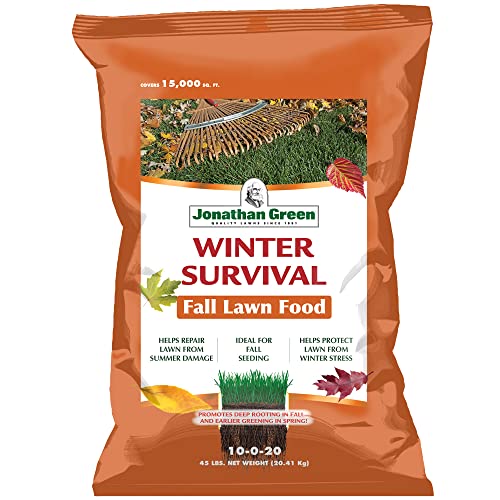
Jonathan Green (12414) Winter Survival Fall Lawn Food 10-0-20
A high-potassium cool-season winterizer built for the job extension sources describe: the heavy K boosts cold tolerance while the light nitrogen is stored for early spring green-up. Apply in fall before soil drops below about 50°F. Covers 15,000 sq ft.
For a lower-rate, organic feeding, an option like Espoma Organic Fall Winterizer suits the light application Clemson describes. Clemson University defines a light application as one-half pound or less of actual nitrogen per 1,000 square feet, which an organic 8-0-5 with extra potassium delivers without burn risk.

Espoma Organic Fall Winterizer 8-0-5 (30 lb)
An organic, low-burn winterizer with extra potassium for a gentle fall feeding. The 8-0-5 analysis lands near the half-pound-of-nitrogen-or-less light rate Clemson recommends, with slow release that will not push tender late-season growth. Covers about 5,000 sq ft.
Warm-Season Lawns Get No Winterizer
Warm-season grasses are sliding into full dormancy by the time a cool-season winterizer would go down, and they cannot use it. Clemson University sets the last warm-season nitrogen at August 15 in the Upstate and September 1 on the coast, at least two months before the first average frost date. Feeding bermuda or zoysia in late fall wastes product, raises runoff risk, and can leave the turf less cold-hardy heading into winter. See the warm-season fertilization schedule for the correct timing.
Snow Mold: Prevention Before Cure
Snow mold is the disease most associated with dormant turf. It shows up at snowmelt as circular patches of matted, dead-looking grass where snow lingered longest. The good news is that the cultural controls are the same lawn-care fundamentals you should be doing anyway.
Gray Versus Pink Snow Mold
The two types differ in severity. NC State Extension explains that gray snow mold (Typhula) needs snow cover and temperatures of 32-40°F and is generally cosmetic, recovering on its own. Pink snow mold (Microdochium nivale) is more aggressive, can occur without snow in cool wet weather, and can kill grass to the roots. Pink snow mold is the one to take seriously, and it is why mild, wet winters in the transition zone can produce disease even where snow never sits. The temperature-by-disease relationship for the rest of the year is mapped in our lawn disease by temperature guide.
Cultural Controls Come First
Penn State Extension lists the prevention checklist, and none of it requires chemicals: mow into the fall so the canopy goes into winter short, avoid heavy fall nitrogen that pushes succulent growth, do not pile long-lasting snowbanks on turf, and rake leaves before they get wet and mat down the canopy. A thick wet leaf layer is a snow mold incubator. The leaf removal point connects directly to knowing when to stop mowing in fall: the final cuts and the last leaf cleanup are your primary snow mold defense.
At snowmelt, NC State Extension advises raking matted areas to break the crust and let air and light reach the crowns, which speeds recovery. Most lawns rebound without further treatment.
For a typical home lawn, the first-line snow mold defense is cultural: short fall mowing, no heavy late nitrogen, no snow piles, and leaves cleared before they mat. Preventive fungicide is reserved for high-value turf like golf greens, sports fields, and new seedings, and even then it has to be timed precisely. Do the free things well and most homeowners never need the spray.
When Fungicide Is Justified
If you manage high-value turf, Penn State Extension notes preventive fungicides must be applied before the first permanent snow cover, typically late November, and favors multi-active-ingredient tank mixes that include a contact such as chlorothalonil. A homeowner-accessible systemic like propiconazole is labeled for both pink and gray snow mold, but the editorial caveat is important: it is a preventive tool for high-value turf, not a substitute for the cultural controls above, and on its own it is weaker than the tank mixes extension sources recommend.
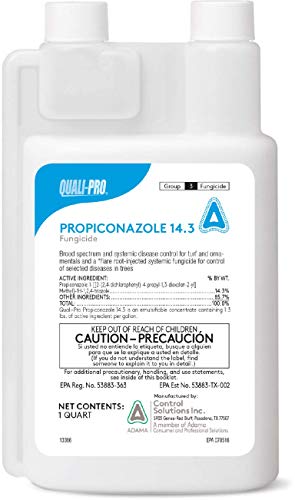
Quali-Pro Propiconazole 14.3 Systemic Turf & Ornamental Fungicide (32 oz)
A homeowner-accessible systemic fungicide labeled for pink and gray snow mold. For preventive use it must go down before permanent snow cover. Extension guidance reserves snow mold fungicide for high-value turf and favors tank-mixing with a contact fungicide, so treat this as a supplement to cultural controls, not a replacement.
Traffic, Voles, and Road Salt
Three physical threats round out winter lawn protection: foot traffic on brittle turf, vole tunneling under snow, and de-icing salt along pavement.
Stay Off Brittle Dormant Turf
Frozen and frosted blades and crowns are brittle. Concentrated foot traffic, vehicles, or equipment shatters the cells and leaves thin or dead tracks that appear as patches at green-up. Reroute regular paths off the lawn for the winter, and if snow cover is thin, marking the route with stakes helps household members remember.
Vole Damage Shows Up at Snowmelt
University of Minnesota Extension describes vole damage as crisscrossing surface runways about one to two inches wide that appear at snowmelt, plus 1-inch holes and quarter-inch gnaw grooves on tree bark near the ground. The damage is rarely permanent: rake the dead grass and reseed, and the surrounding turf fills the trails. Prevent it by mowing until the lawn is fully dormant, with a final height around 2 inches, and by clearing dense cover and brush where voles shelter.
Mitigating De-Icing Salt
Iowa State University Extension and Rutgers explain that sodium-chloride rock salt injures roadside turf through sodium and chloride ion toxicity and osmotic stress, dehydrating roots even in moist soil, while sodium displaces potassium and calcium in the soil. Mitigate it by flushing affected strips with water once temperatures moderate, applying pelletized gypsum to displace sodium, and switching to less-damaging deicers such as calcium chloride or magnesium chloride on your own walks.
| Winter threat | Telltale sign | First response |
|---|---|---|
| Crown hydration | Dead patches after a late freeze-thaw | Reseed at green-up; favor non-Poa species |
| Snow mold | Matted circular patches at snowmelt | Rake to break crust; cultural prevention next fall |
| Vole runways | 1-2 inch surface trails, 1-inch holes | Rake and reseed; mow short and clear brush in fall |
| Road salt | Browned, thinned strip along pavement | Flush with water, apply gypsum, switch deicers |
| Foot traffic | Thin tracks along walking routes | Reroute paths; mark with stakes |
Regional Timing: Winter Severity by USDA Zone
The soil-temperature thresholds are the same everywhere. What shifts by zone is how long dormancy lasts, which winterkill mode dominates, when the winterizer window opens, and when the lawn greens up. Warm-season dormancy and green-up rows apply only to zone 6-9 lawns running bermuda, zoysia, St. Augustine, or centipede; zones 3-5 are cool-season dominated.
| USDA Zone | Region | Dominant Winterkill Risk | Winterizer Window | Cool-Season Green-Up |
|---|---|---|---|---|
| 3 | N. MN, WI, ME, VT, upstate NY, MT | Desiccation, ice encasement, crown hydration | Late Sept-mid Oct | Late April-May |
| 4 | MN, WI, MI, N. NE, ND/SD | Crown hydration, ice encasement | Early-mid Oct | Mid-late April |
| 5 | S. Great Lakes, IA, S. NE, KS, PA uplands | Freeze-thaw crown hydration | Mid Oct | Early-mid April |
| 6 | Mid-Atlantic, OH valley, transition | Pink snow mold (even without snow) | Mid Oct | Late March-early April |
| 7 | NC, VA, TN, OK, N. TX | Desiccation, road salt | Cool-season only | Bermuda greens up April-May |
Soil-temp thresholds are universal; zone shifts duration and risk, not the thresholds.
A few zone-specific notes. In zones 3-4, prolonged snow cover makes gray snow mold pressure highest and crown hydration plus ice encasement the top killers; creeping bentgrass and Kentucky bluegrass are the survivors here. Zone 5 is the freeze-thaw belt where crown hydration leads. Zone 6 is the transition zone, where pink snow mold can show in cool wet spells without any snow, and warm-season lawns go off-color all winter. In zone 7 and warmer, the winterizer is strictly a cool-season fescue practice; warm-season lawns get no fall nitrogen at all.
Spring Prep: Patience Over Aggression
Everything you do, or refrain from doing, in late winter and early spring is about protecting the carbohydrate reserves the roots have been guarding all winter. The temptation is to feed and mow at the first hint of green. Resist it.
Monitor Soil Temperature, Not the Calendar
Track 2-4 inch soil temperature through late winter. Cool-season growth resumes as soil sustains 50°F; warm-season green-up waits for 65°F at the 4-inch depth and nights above 60°F. A dial soil thermometer makes this a no-battery daily glance, and it is the same tool that gated your fall winterizer window. For technique on reading it correctly, see the soil thermometer guide.

Luster Leaf 1630 Rapitest Dial Soil Thermometer (stainless steel)
A no-battery dial soil thermometer for tracking the 45-50°F winterizer window in fall and the 50-65°F spring green-up thresholds that gate fertilizing and mowing decisions. Stainless steel stem, simple to read, nothing to charge.
For a more durable waterproof probe, a sealed digital model holds up to repeated trips into cold, wet soil at the 2-4 inch depth.
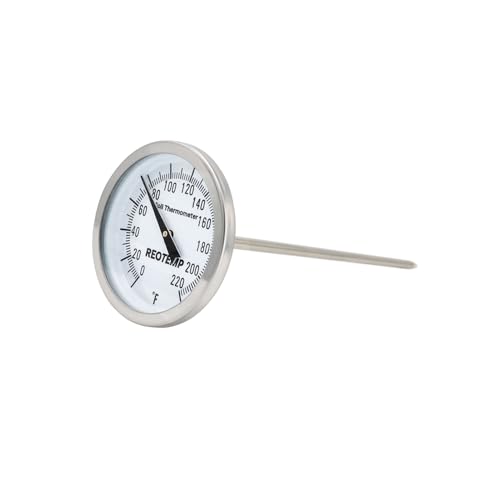
REOTEMP K82-3 Soil Thermometer, 5-inch stem, waterproof (0-220°F)
A durable waterproof probe for measuring soil temperature at the 2-4 inch depth used in dormancy and green-up timing. The sealed body shrugs off cold, wet late-winter ground, and the long stem reaches true root-zone temperature instead of surface readings.
Avoid the Early Spring Mistakes
Michigan State University Extension is explicit: wait to fertilize cool-season lawns until May, never fertilize frozen soil, and start mowing only once grass reaches about 3 inches, without scalping. The reasoning is the root-versus-shoot timing from earlier: high spring nitrogen rates drive excessive foliar growth that burns the carbohydrate reserves roots need for development and disease resistance. The pre-emergent decision follows the same soil-temperature logic, opening around 50-55°F; our cool-season fertilization schedule lays out the full spring-through-fall feeding plan.
- Do not fertilize early. Hold nitrogen until soil hits 50°F and growth resumes, and never on frozen ground.
- Do not scalp the first mow. The brown material is dormant tissue, not dead. Mow at normal height once grass reaches 3 inches.
- Do not rush pre-emergent. Wait for the 50-55°F soil window, which arrives in March in the South and April-May in the North.
Fertilizer spread on frozen ground does not get taken up. It sits on the surface, runs off with snowmelt into storm drains and waterways, and contributes nothing to your lawn. Michigan State University is unambiguous: never fertilize frozen soil. Wait for the thaw, the 50°F soil reading, and visible growth before the first feeding.
Recovering Winterkilled Patches
Where crown hydration, ice, or salt killed sections of turf, you will see it at green-up as patches that stay brown while the rest of the lawn greens. Purdue University recommends scratching the soil surface for seed-to-soil contact and applying a high-phosphorus starter fertilizer at a minimum of 1.0 lb of P2O5 per 1,000 square feet, plus a light raking of matted areas to speed recovery of surviving turf. For a full bare-spot or whole-lawn rebuild, our affordable cool-season renovation and spring overseeding guides cover seed selection, rates, and the watering schedule.
Verify the lever
Track your soil temperature into green-up
Enter your city or ZIP code to monitor real-time 2-inch soil temperatures from the nearest USDA or NOAA station, so you know the moment your lawn crosses 50°F and growth resumes, and you can hold off on fertilizer and mowing until then.