
Quick Answer: When Is the Best Time to Spray Broadleaf Weed Killer on Warm-Season Turf?
Wait for the green-up gate to clear. Two operational signals tell you the lawn is ready: it has been fully greened up across the whole canopy, and it has needed its second mowing of the year at full summer cut height. Air temperatures should be between 60 and 85°F for several days running. Above 85°F (or above 90°F on St. Augustine and centipede), most 2,4-D-based products start damaging the lawn.
For most cool-season homeowners, soil temperature drives the timing. For warm-season turf, green-up state is the primary lever, not soil temperature.
What you need
- Pre-measured packet: Celsius WG (packet)
- Liquid concentrate: Trimec Southern (32 oz)
- Mixes and sprays either one: Chapin 1-gallon pump sprayer
Get Personalized Timing
See your local soil and forecast
Enter your city or ZIP code to check soil temperatures from the nearest USDA monitoring station and see when your spring broadleaf window opens.
This guide is for warm-season turf: St. Augustine (including Floratam), centipede, bahia, bermuda, zoysia, carpetgrass, and buffalograss. If you have Kentucky bluegrass, fescue, or perennial ryegrass, stop here and read the cool-season version instead. The chemistry that's safe on warm-season turf often injures cool-season turf, and the cool-season chemistry that works on bluegrass and fescue can kill St. Augustine and centipede outright.
You're on the warm-season guide. The cool-season version covers Kentucky bluegrass, fescue, perennial ryegrass, and the cool-season blends common across the Northeast, Upper Midwest, and transition zone. Different chemistry, different timing levers, different weeds. Read When to Apply Broadleaf Weed Killer in Spring for that.
The Three Levers: Green-Up, Air Temp, Weed Phenology
Warm-season turf timing is anchored on green-up state before air temperature, and on weed phenology as a visual confirmation that things are translocating. Soil temperature still tells you whether the ground has warmed enough for the turf to be growing, but it's a secondary check, not a hard threshold.
Green-Up Gate: The Most Important Rule
This is the rule the rest of the guide rests on. Multiple Southern extensions converge on it.
UGA Extension Bulletin B978 (Patrick McCullough, Weed Control in Home Lawns): "Do not apply postemergence herbicides during the green-up (transition from winter dormancy to active growth) process of warm-season turfgrasses."
Clemson HGIC, Managing Weeds in Warm Season Lawns: "For most postemergence herbicide products do not make applications to established warm-season lawns during the spring green-up period. Wait until the lawn is fully greened before treating. Turf damage may occur following some broadleaf herbicide applications if used during turfgrass green-up, especially in more sensitive turfgrasses, such as centipedegrass and St Augustinegrass."
LSU AgCenter, Spring Lawn Care: "After waiting 2 to 3 weeks after green-up, you can use Weed and Feed products labeled for your lawn grass. Certain products can be applied safely to centipedegrass and zoysia after the second mowing."
NCSU TurfFiles uses the same establishment logic for newly seeded turf: "broadleaf herbicides cannot be applied until the turfgrass has grown enough to withstand two to three mowings, or become extensively tillered and established."
The functional homeowner test: have I mowed twice this spring at summer cut height? If yes, the green-up gate is clear. Celsius WG is the labeled exception that can be applied during green-up if you absolutely must spray earlier (UF/IFAS and Clemson HGIC both flag this).
When Each Family Greens Up
In the same locale, the sequence is bermuda → zoysia → St. Augustine ≈ centipede → bahia. Buffalograss is on its own track and breaks dormancy mid- to late spring.
Bermuda: greens up first. Trigger is sustained nighttime air above 60°F and 4-inch soil at 65°F. Deep South: mid-March. Upper transition zone: late April.
Zoysia: 1 to 2 weeks behind bermuda in the same locale. Denser thatch holds more cold air at canopy.
St. Augustine: later than bermuda and zoysia, especially in the Piedmont. Clemson: "The date of initial turf green-up can be quite variable. In the coastal and more Southern regions of South Carolina, this generally will occur sometime during April, but further inland, this may be as late as mid-May."
Centipede: runs with St. Augustine in coastal SC, behind it in the Piedmont. Most herbicide-sensitive of the warm-season family; the Clemson maintenance calendar is strictest about the green-up gate for centipede.
Bahia: greens up last and stays dormant longest. UF/IFAS notes that "approximately 85% of bahiagrass production occurs during the six warmest months (April through September)." Bahia in north Florida and south Georgia commonly greens up in April.
Buffalograss: breaks dormancy in mid- to late spring, well after K-31 fescue and Kentucky bluegrass. CSU Extension and K-State both place buffalograss green-up in May for the central Plains transition zone.
Air-Temperature Window
Floor: 60°F. Below 60°F, broadleaf herbicides aren't translocating well even on lawns that are technically growing. Texas A&M AgriLife: "Broadleaf herbicides will not be effective when daytime temperatures are less than 60°F."
Ceiling: 85°F. UGA B978 carries the label-style language for 2,4-D + MCPP three-way products: "DO NOT apply to turfgrasses if air temperatures are expected to exceed 85°F within 24 hours of application." UF/IFAS adds the same 85°F rule to atrazine on St. Augustine. LSU applies it to Trimec-type products on St. Augustine generally.
Clemson HGIC's species maintenance calendars (centipede, St. Aug, zoysia, bermuda) push the cutoff to 90°F in summer specifically, but the 85°F rule controls during the spring window this guide is about. Above 85°F, switch to Celsius WG or metsulfuron for St. Augustine. Both have looser temperature ceilings than the standard three-way.
Weed Phenology
Phenological cues are thinner for warm-season broadleaf than for cool-season. The cleanest practical cue is operational, not floral: have I mowed twice? If yes, the lawn is photosynthetically active and the broadleaves rooted in it are translocating systemic auxin chemistry.
Forsythia and azalea bloom are pre-emergent crabgrass cues, not broadleaf cues. Dogwood bloom is sometimes anecdotally tied to bermuda green-up in the Deep South but isn't anchored in tier-1 publications. Don't over-rely on it.
Regional Spring Window
| Region | Window | Notes |
|---|---|---|
| Deep South (FL, S. GA, S. AL, S. MS, S. LA, S. TX) | Late February to April | Tightest band. The 85°F ceiling can close as early as mid-April for inland Florida and the lower Gulf coast. Switch to Celsius WG once daytime highs are routinely 85°F. |
| Coastal SE (NC coast, SC, mid GA, mid AL, mid MS, mid LA) | March to May | Most comfortable working window. Bermuda green-up late March; full mow-twice gate mid-to-late April. Centipede and St. Augustine often not gate-cleared until early May. |
| Southwest (AZ, NM, S. CA, NV) | April to June | Drier than the SE; the moisture-stress qualifier on every label ("do not apply to turf under moisture stress") is often the binding constraint, not temperature. Phoenix and Las Vegas can cross the 85°F ceiling for daily highs by mid-to-late April. |
| Transition zone (zoysia in St. Louis, bermuda in Kansas City) | April to May | Bermuda and zoysia often not fully greened up until early May. Genuinely short window. Wait for full canopy and a second mowing before treating, even if the 85°F clock is short. |
Per-Family Chemistry Matrix
The single most important table in this guide. Match your turf species (top row) to a chemistry (left column). Tolerant means labeled for use. Sensitive means labeled prohibition or documented injury. Caution means labeled but with rate, temperature, or cultivar restrictions.
| Active Ingredient | St. Augustine (incl. Floratam) | Centipede | Bahia | Bermuda | Zoysia | Carpetgrass | Buffalograss |
|---|---|---|---|---|---|---|---|
| Celsius WG (thiencarbazone + iodosulfuron + dicamba) | Tolerant (Floratam labeled) | Tolerant | Sensitive | Tolerant (incl. hybrid) | Tolerant | n/a | n/a |
| Atrazine | Tolerant (caution above 85°F on Floratam) | Tolerant | Sensitive | Caution: dormant only | Tolerant | n/a | Sensitive (kills) |
| Simazine | Tolerant | Tolerant | n/a | Tolerant | Tolerant | n/a | n/a |
| Trimec Southern (reduced-load 2,4-D + MCPP + dicamba) | Tolerant at 0.37–0.55 oz/1,000 | Tolerant at 0.37–0.55 oz/1,000 | Tolerant | Tolerant at 0.75 oz/1,000 | Tolerant at 0.75–1.1 oz/1,000 | Caution | Caution above 85°F |
| Standard 3-way (Trimec Classic, SpeedZone) | Caution: low rates only; injury on Floratam | Caution: temporary yellowing | Tolerant | Tolerant | Tolerant | Caution | Caution above 85°F |
| Image (imazaquin) | Caution (label-restricted on St. Aug per UF/IFAS) | Tolerant | n/a | Tolerant | Tolerant | n/a | n/a |
| Sulfentrazone (Dismiss) | Tolerant | Tolerant | Tolerant | Tolerant | Tolerant | Tolerant | Tolerant |
| Quinclorac (Drive XLR8) | Sensitive (label prohibition) | Sensitive (label prohibition) | Sensitive (label prohibition) | Tolerant | Tolerant | Sensitive | n/a |
| Triclopyr | Sensitive | Sensitive | Sensitive | Caution: injurious at high rate | Caution: minor injury at low rate | Sensitive | n/a |
| Carfentrazone (QuickSilver) | Tolerant | Tolerant | n/a | Tolerant | Tolerant (delay 14d after emergence) | n/a | n/a |
| Metsulfuron (MSM Turf) | Tolerant | Tolerant | n/a | Tolerant | Tolerant | n/a | n/a |
| MSMA | Not legal residentially | Not legal residentially | Not legal residentially | Not legal residentially | Not legal residentially | Not legal residentially | Not legal residentially |
A few read-across notes:
- St. Augustine homeowners: your best options are Celsius WG, atrazine (below 85°F), or Trimec Southern at the reduced 0.37 to 0.55 fl oz rate. The cool-season Trimec, SpeedZone, and Surge bottles can injure your lawn even at label rate.
- Bermuda homeowners: Celsius WG, standard three-way, and quinclorac are all labeled. Atrazine is fine while bermuda is dormant but injures actively-growing bermuda.
- Centipede: the most herbicide-sensitive of the warm-season family. Celsius WG and atrazine are the safest bets. Two-step the application: full label-rate may still cause yellowing, so ramp up.
- Zoysia: tolerant of most chemistries, but green-up is later than bermuda and the green-up gate matters more here. Z. matrella vs Z. japonica respond differently to herbicide during transition (peer-reviewed work confirms this) but no homeowner label distinguishes the two.
- Bahia: short list. Sulfentrazone (Dismiss) and Trimec Southern are labeled. Most other options either skip bahia or are explicitly prohibited.
- Buffalograss: rarely treated for broadleaf in the way bermuda or zoysia is. Sulfentrazone (Dismiss) is labeled. Atrazine kills it. CSU permits glyphosate spot-treats on fully dormant buffalograss only.
Common Warm-Season Broadleaf Weeds
These are the ones cool-season homeowners typically don't see. Per-weed: visible ID, season of concern, what works, what struggles.
| Weed | Scientific | ID | Season | What works | Citation |
|---|---|---|---|---|---|
| Lawn burweed (sticker weed) | Soliva sessilis / S. pterosperma | Low parsley-like leaves; spine-tipped burs in spring | Winter annual | Pre-emergent isoxaben late Sep–early Oct; post-emergent atrazine, three-way, metsulfuron, or Celsius WG Dec–Feb before bur-set | UF/IFAS NW District 2019; Clemson HGIC |
| Doveweed | Murdannia nudiflora | Long fleshy dayflower-family leaves; thick stems rooting at nodes; small purple-blue flowers | Late summer annual | Pre-emergent atrazine (St. Aug/centipede), S-metolachlor, indaziflam timed close to soil-temp 65°F at 4 inches; post-emergent Celsius WG | UF/IFAS EP576 |
| Florida pusley | Richardia scabra | Small white star-shaped flower clusters; rough hairy opposite leaves; low mat | Summer annual | Pre-emergent prodiamine, pendimethalin Feb–Mar; atrazine on St. Aug/centipede; post-emergent 2,4-D + dicamba combos | UF/IFAS EP610 |
| Virginia buttonweed | Diodia virginiana | Opposite lance-shaped leaves clasping stem; small white 4-petaled axillary flowers | Perennial | Metsulfuron, trifloxysulfuron, or Celsius WG; summer timing better than spring; Blindside (metsulfuron + sulfentrazone) often outperforms metsulfuron alone | UGA B1397; Clemson HGIC |
| Yellow oxalis | Oxalis stricta | Three heart-shaped leaflets (like clover but heart-shaped); yellow 5-petaled flowers; explosive seed pods | Perennial | Sulfentrazone, metsulfuron, dicamba + 2,4-D, Celsius WG; atrazine on labeled grasses | UF/IFAS EP385 |
| Carolina dichondra | Dichondra carolinensis | Small kidney-shaped leaves on trailing stems; petiole at leaf edge (not center, that's dollarweed) | Perennial | Atrazine (St. Aug/centipede), Celsius WG; cultural control (reduce moisture) is primary | UF/IFAS |
| Common lespedeza | Kummerowia striata | Three smooth oval leaflets with parallel veins; wiry stems; low prostrate growth | Summer annual legume | Atrazine or simazine pre-emergent at low-50s F soil; metsulfuron-based products post-emergent; three-way also effective | UGA B1395; Clemson HGIC |
| Spotted spurge | Euphorbia maculata | Prostrate mat; small oval opposite leaves with maroon spot; milky white sap | Summer annual | Pre-emergent dithiopyr, isoxaben, prodiamine before soil hits 60°F; post-emergent three-way on young plants; sulfentrazone. ALS-resistant biotypes documented in Georgia | Texas A&M AgriLife; Penn State |
| Florida beggarweed | Desmodium incanum | Three oval leaflets (larger than lespedeza, hairy); pink to rose flowers; sticky seed pods | Perennial / summer annual | Sulfentrazone, Celsius WG, three-way on labeled grasses. Triclopyr injures St. Augustine | UF/IFAS EP591 |
| Asiatic hawksbeard | Youngia japonica | Basal rosette of dandelion-like lobed leaves; thin flower stalk with small yellow flower heads | Winter annual rosette | Three-way on the rosette, metsulfuron, Celsius WG; treat small in late winter/early spring before flowering | UF/IFAS EP636 |
| Dollarweed / pennywort | Hydrocotyle spp. | Round perfectly circular bright green leaves; petiole attached at center (umbilicate) | Perennial | Atrazine (St. Aug/centipede), 2,4-D, dicamba, imazaquin. Cultural control essential: reduce irrigation | UF/IFAS Gardening Solutions |
A few cool-season-overlap weeds also show up in warm-season lawns:
Henbit, common chickweed, white clover, dandelion, plantain, wild violet are all controllable on warm-season turf. St. Augustine homeowners should use atrazine or Celsius WG instead of standard three-way because of 2,4-D sensitivity. Dicamba in particular handles wild violet better than 2,4-D.
Lawn Burweed: The Sticker Weed
This weed deserves its own section because it's the most-searched warm-season weed in southern states and homeowners almost always ask about it at the wrong time.
The trap: you notice burweed in March, April, or May when you step on the spiny burs barefoot. By then, the spines have already formed and the herbicide cannot remove them. Killing the plant kills it dead and brown but the burs persist on the dead skeletons and continue to hurt for the rest of the season.
The fix: treat in December, January, or early February. The plant is small, vegetative, and easy to kill. Burs aren't yet hardened.
Pre-emergent strategy:
- Apply isoxaben (Gallery) in late September to early October, before night temperatures drop into the 55 to 60°F range.
- Granular pre-emergents need ~0.5 inch of irrigation or rainfall to activate.
- Safe on St. Augustine, centipede, bahia, zoysia, bermuda.
Post-emergent rescue (December to February):
- Three-way: 2,4-D + dicamba + MCPP. Watch the St. Augustine 2,4-D rate.
- Atrazine: best for St. Augustine and centipede.
- Metsulfuron (MSM Turf, Manor).
- Celsius WG: works at higher temps and is the only product Clemson HGIC specifically allows during spring green-up.
If you're reading this in spring and you're already getting stuck, you can spray now and the plant will die. The spines will not. Spring control is for next year's plants, not this year's pain.
Chemistry: What's in That Bottle (And Why)
The five families that do almost all the work on warm-season turf, in order of "modern, broad, safe" to "narrow, restricted, professional-only."
Celsius WG (the modern broad-spectrum option)
Bayer/Envu, EPA Reg. 432-1507. Three actives: thiencarbazone-methyl 8.7% + iodosulfuron-methyl-sodium 1.9% + dicamba 57.4%. The two ALS inhibitors plus dicamba give it both fast knockdown and slow systemic kill on hard-to-control perennials.
Tolerant turf per the label: bermuda (including hybrid), zoysia, centipede, and St. Augustine cultivars Floratam, Palmetto, Bitter Blue, Common, Amerishade, Raleigh, Sapphire, Delmar, Captiva.
Prohibited: bahia, all cool-season turf.
Why it matters: Celsius WG is the only common selective post-emergent that UF/IFAS and Clemson HGIC flag as safe to apply during spring green-up. It also tolerates higher temperatures than 2,4-D-based products, with spot treatments on St. Augustine permitted above 90°F (the label notes temporary growth regulation). Rate: 0.057 to 0.113 oz per 1,000 sq ft. Rainfast 4 hours.

Celsius WG (0.226 oz easy-mix packet)
Thiencarbazone + iodosulfuron + dicamba. The modern broad-spectrum post-emergent for bermuda, zoysia, centipede, and St. Augustine including Floratam. The only common selective UF/IFAS and Clemson allow during spring green-up. Rainfast 4 hours.
Atrazine (the St. Augustine and centipede workhorse)
Group 5 photosystem-II inhibitor (triazine). Federally registered for residential turf on St. Augustine, centipede, zoysia, and dormant bermuda. Sold in concentrates (Atrazine 4L) and at lower percentages in granular weed-and-feed (Bonus S Southern Weed and Feed at 1.05% atrazine on a fertilizer carrier).
Watershed and state caveats: Wisconsin prohibits atrazine on residential turf entirely under ATCP 30, with 101 watershed-defined prohibition areas. The atrazine label directs users to the Atrazine Watershed Information Center (atrazine-watershed.info, 1-866-365-3014) to confirm whether use is allowed in their watershed. Not for sale or use in Hawaii, Alaska, or US territories. New York has had repeated legislative attempts to ban atrazine; check the NY DEC pesticide product database before purchasing.
Floratam caution: UF/IFAS notes Floratam tolerance breaks down above 85°F. Apply only when temperatures are below the ceiling.
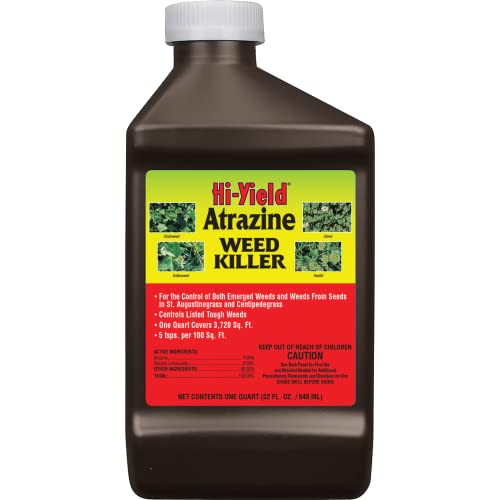
Hi-Yield Atrazine Weed Killer (32 oz)
2,4-D-free post-emergent for St. Augustine and centipede. Controls dollarweed, dichondra, oxalis, henbit, and many other broadleaves. Also active on emerging crabgrass. Maximum 8.6 fl oz per 1,000 sq ft per application. Check the Atrazine Watershed Information Center for your area before applying.
Trimec Southern (the lower-load three-way)
PBI/Gordon, EPA Reg. 2217-725. Active ingredients: 2,4-D 18.74%, MCPP-P 17.37%, dicamba 3.85%. The "Southern" label is not a rate cut on Trimec Classic; it's a different formulation with lower 2,4-D and higher MCPP-P specifically tuned for centipede and St. Augustine tolerance.
Rates per 1,000 sq ft:
- St. Augustine and centipede: 0.37 to 0.55 fl oz
- Bermuda: 0.75 fl oz
- Bluegrass, fescue, zoysia: 0.75 to 1.1 fl oz
Temperature window: 50°F to 90°F. Do not apply during spring green-up. Rainfast 8 hours; do not irrigate within 24 hours.
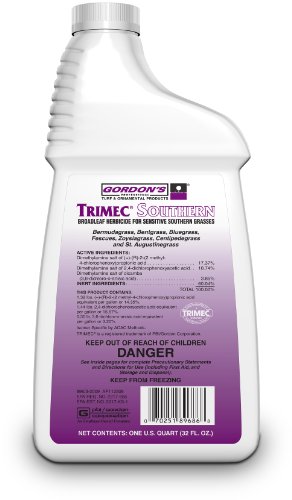
PBI Gordon Trimec Southern Broadleaf Herbicide (32 oz)
Reduced-load 2,4-D + MCPP-P + dicamba formulation tuned for St. Augustine and centipede tolerance. Apply at 0.37-0.55 fl oz per 1,000 sq ft on sensitive southern grasses. Rainfast 8 hours.
Sulfentrazone (Dismiss)
Group 14 PPO inhibitor. Tolerant on every common warm-season species: bermuda, zoysia, centipede, St. Augustine, bahia, buffalograss, carpetgrass. Adds yellow nutsedge and kyllinga activity on top of broadleaf coverage.
Important formulation note: do not add a non-ionic surfactant. NIS produces visible turf injury and the label specifically does not recommend it. Rainfast 4 hours.

FMC Dismiss Turf Herbicide (6 fl oz)
Sulfentrazone-based PPO inhibitor. Broadly tolerated across all common warm-season turf. Adds yellow nutsedge, kyllinga, and sedge control. Visible injury within 24-48 hours. Do NOT add NIS surfactant.
Image (imazaquin)
Group 2 ALS inhibitor (imidazolinone). Labeled for St. Augustine (with caution; UF/IFAS lists it as restricted), centipede, bermuda, and zoysia. Speciality use: nutsedge, dollarweed, and a few hard-to-kill broadleaves like wild garlic and wild onion.
Critical timing rule: the Image label says do not apply before or during turf transition or during periods of very slow growth. That puts spring green-up firmly in the no-apply window. Apply after green-up is complete and before fall dormancy. Slow-acting: 1 to 2 weeks to symptoms, 3 to 4 weeks to full control.
Quinclorac (Drive XLR8)
BASF, EPA Reg. 7969-130. Group 4 synthetic auxin with cellulose biosynthesis inhibitor activity. Tolerant on bermuda and zoysia only. Labeled as injurious to St. Augustine, centipede, bahia, and carpetgrass. Drives both crabgrass and white clover; rainfast 30 minutes; methylated seed oil (MSO) is required, not optional. Don't apply above 80 to 85°F.

BASF Drive XLR8 (Quinclorac), 64 oz
Liquid quinclorac for bermuda and zoysia only. Kills crabgrass post-emergence AND white clover in the same application. Rainfast in 30 minutes. Mix with MSO. Do NOT apply to St. Augustine, centipede, or bahia.

Southern Ag Methylated Seed Oil (MSO), 32 oz
Required adjuvant for quinclorac. Mix 1.5 tablespoons MSO per gallon of water alongside Drive XLR8. Without it, the herbicide barely works on crabgrass.
Carfentrazone (QuickSilver)
Group 14 PPO inhibitor. Fast contact partner. Tolerant on bermuda, zoysia, centipede, and St. Augustine (delay 14 days after emergence on zoysia). Rainfast 1 hour. Common tank-mix partner with three-way for cool-spring speed.

QuickSilver T&O Herbicide (8 oz)
Carfentrazone-ethyl 21.3%. EPA Reduced Risk classification. Rainfast in 1 hour. Visible weed injury within 24 hours. Best as a tank-mix partner with three-way or atrazine for cool-spring speed.
MSMA (no longer available residentially)
EPA canceled MSMA for residential lawns, parks, athletic fields, and forestry in 2009. The 2013 amended cancellation order kept it off residential turf permanently. The 2022 Registration Review reaffirmed the residential cancellation. Surviving uses are limited to golf courses (spot only, max 100 sq ft per spot, max 25% of acreage per year), sod farms, and highway rights-of-way (two broadcasts per year).
If you find old containers in your garage, you cannot legally apply them to your lawn. The 2013 order canceled residential use of existing stocks. For the situations MSMA used to handle, the modern alternatives are Celsius WG (broadleaf and grassy weeds on bermuda/zoysia/centipede/St. Augustine), quinclorac (crabgrass and broadleaves on bermuda/zoysia), and sulfentrazone (sedges and broadleaves across all warm-season turf).
Application Mechanics: Six Things You Have to Get Right
University extensions and labels converge on a tight checklist. Skip any one and the application fails or causes collateral damage.
1. Mow timing: 1 to 2 days before AND after
Standard rule across Celsius, Trimec Southern, sulfentrazone, atrazine, and Image. Why before? The herbicide is absorbed through leaf surface area, and freshly mowed weeds have less leaf to intercept the spray. Why after? Systemic auxins and ALS inhibitors need time to translocate down to roots. Cutting the leaves shortly after spraying removes herbicide before it gets to the meristem.
2. Rainfast window
| Product | Rainfast |
|---|---|
| Celsius WG | 4 hours (avoid rainfall within 48 hours per label runoff caution) |
| Carfentrazone (QuickSilver) | 1 hour |
| Sulfentrazone (Dismiss) | 4 hours |
| Quinclorac (Drive) | 30 minutes |
| Trimec Southern | 8 hours; no irrigation within 24 hours |
| Atrazine post-emergent | 2 to 3 day rain-free window for foliar efficacy |
3. Wind speed: 3 to 10 mph
Below 3 mph (calm) risks temperature inversion drift. Above 10 mph, particle drift carries the spray off-target. Warm-season regions are especially prone to morning inversions in summer; spray mid-morning once the sun has lifted the inversion.
Drift-reduction nozzles operating at 15 to 30 psi produce larger droplets that resist drift without sacrificing coverage:

TeeJet AIXR Air Induction Flat Spray Nozzles (12-pack)
Air induction flat-fan tips that produce large air-filled droplets. Drift management without losing coverage. Important if you're spraying anywhere near vegetable gardens, tomatoes, redbud, or sycamore. Yellow tips = 0.2 GPM at 40 psi (the typical homeowner range).
4. Air temp: 60 to 85°F (90°F for Celsius WG)
Below 60°F broadleaves aren't translocating much. Above 85°F most 2,4-D and dicamba products start damaging warm-season turf, especially St. Augustine and centipede. Above 90°F, switch to Celsius WG or metsulfuron. The Floratam variety of St. Augustine is particularly heat-sensitive.
5. Time of day: mid-morning, after dew dries
For liquid applications, wait for dew to dry off the lawn so the herbicide can adhere directly to leaf surfaces without dilution. Avoid early morning in summer (inversion risk) and avoid midday peak heat once temps are climbing toward 85°F.
6. Active-growth check: full canopy, mowed twice, no wilt
Quick visual sweep before you mix anything: lawn is fully greened up, has been mowed at least twice this spring at summer cut height, no drought wilt, no late freeze in the next 48 hours. If any of these is off, wait.
Spot-Spray Over Broadcast
For most homeowners, broadleaf weeds in warm-season turf are scattered, not blanket-distributed. Spot-spraying delivers product to actual targets and minimizes off-target risk. Two sprayer formats cover most yard sizes:
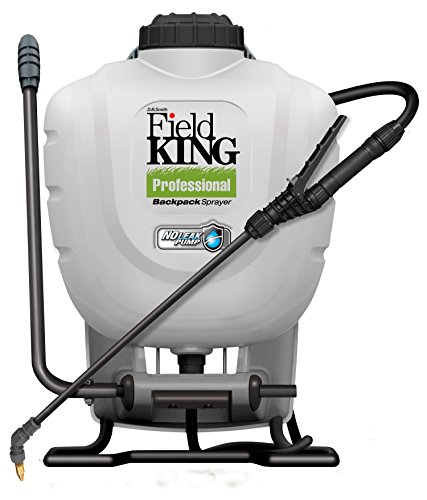
Field King 4-Gallon Backpack Sprayer
Pro-grade backpack sprayer with internal no-leak pump and an included pressure regulator that holds 25 psi. The right tool for lawns over ~5,000 sq ft.

Chapin 20004 SureSpray 1-Gallon Pump Sprayer
Hand-pump tank sprayer with adjustable cone nozzle, 34-inch hose, and easy-fill funnel-top opening. Translucent tank lets you see what's left. Right size for spot-treating in lawns under ~5,000 sq ft.
Florida Summer Fertilizer Ordinances
Many Florida counties (Pinellas, Hillsborough, Sarasota, Manatee, Lee, Charlotte, Collier, St. Petersburg, Tampa, Palm Beach, and others) prohibit application of any fertilizer containing nitrogen or phosphorus from June 1 through September 30. Palm Beach extends through October 31.
What's restricted: N and P fertilizers. Iron, potassium, and other micronutrients are typically allowed. Each county and several cities have their own exact ordinance.
What's NOT restricted: plain herbicides on their own. You can spray Celsius WG, atrazine, three-way, sulfentrazone during the blackout window. The ordinances target nutrient runoff, not herbicide active ingredients.
The catch: "weed and feed" products contain both a herbicide and a fertilizer. They're restricted during the blackout because of the fertilizer half. Homeowners often interpret this as "all weed control is banned in summer," which is incorrect.
Check your specific county or city ordinance for the current dates.
Pollinator Considerations
No warm-season state has a hard "do not apply herbicide because pollinators" rule for residential lawns. Pollinator protection on labels mostly applies to insecticides, not herbicides. The voluntary best practice from every Southern extension service:
- Spray in the evening when bees aren't foraging.
- Don't spray plants in flower. Mow off the flower heads of weeds (clover, dandelion, henbit, dichondra) 1 to 2 days before spraying.
- Read the bee box on your label. Most warm-season broadleaf herbicides don't carry one, but many homeowners spray multiple products at once and the insecticide cautions still apply.
Drift and Neighbor Concerns
The fundamentals are the same as for cool-season application: 3 to 10 mph wind, coarse droplets, no spray when rain is forecast within 24 hours. Two warm-season-specific concerns:
Atrazine in surface water. Atrazine is one of the most-detected herbicides in surface and groundwater in the SE. EPA's December 2024 mitigation update (CE-LOC of 9.7 ug/L) tightened restrictions for agricultural users in high-concentration watersheds. Residential lawn use isn't directly covered by the mitigation menu, but homeowners should follow the label, avoid application when rain is imminent, and avoid spraying near impervious surfaces that drain to storm sewers.
2,4-D and dicamba volatility above 85°F. Above 85 to 90°F, ester forms of 2,4-D and certain dicamba formulations can volatilize hours after application and drift onto neighbors' tomatoes, grapes, redbud, and sycamore. Use amine forms in summer, or switch entirely to Celsius WG, which is not in the same volatility class.
Reseeding and Sodding Restrictions
Most warm-season lawns are installed by sod, sprig, or plug rather than seed, so the cool-season "wait 4 weeks before reseeding" rule converts to a "wait before sodding" rule.
After post-emergent broadleaf (three-way, Celsius WG, sulfentrazone, metsulfuron): 3 to 4 weeks before laying new sod. After atrazine used as a pre-emergent: residual can persist 3 to 6 months. Always check your specific label.
For new sod installation: wait until the new lawn has been mowed at least 3 to 4 times before applying any herbicide on top. That's roughly 4 to 6 weeks of growth for most warm-season species. Floratam St. Augustine and other newer cultivars are extra-sensitive and some sources recommend waiting a full growing season.
Verify the Lever
A soil thermometer pays for itself the first season:

Soil Thermometer (instant-read probe)
Instant-read probe thermometer for measuring soil temperature at a 2-3 inch depth. Useful for verifying that the ground has warmed enough for warm-season turf to be actively growing. Pairs with the SoilTemps station data for your local trend.
Get Your Local Timing
Timing is local. The "when to apply broadleaf weed killer on warm-season lawns" answer depends on your specific climate, when your turf greened up this year, and whether your nearest USDA monitoring station is reporting steady or volatile soil temps. We track this for every city in the country:
Personalized Timing
Get your city's lawn-care schedule
See your full 12-month lawn-care timeline: when each task opens, what to apply, and how it tracks against your local soil temperature data.