
Quick Answer: When Should You Apply Fall Pre-Emergent?
The ideal window for fall pre-emergent is 2-inch soil at 65–70°F during the cooling season. Your SoilTemps schedule can open earlier, above that band and up to 75°F, when its calendar window is open and local historical soil temperatures show the season is cooling. You do not need to wait for three consecutive days in the ideal band on that path. Annual bluegrass (poa annua) and the winter annual weeds germinate as shallow soil cools below roughly 70°F, so the barrier must be down and watered in before that happens. For most of the country that means September; the Deep South often waits until October.
What you need
- Liquid, needs a pump sprayer: Prodiamine (Barricade)
- Granules, for a spreader: Scotts Halts (pendimethalin)
Quick Answer
Check your local 2-inch soil temperatures now
Enter your city or ZIP code to see real-time soil temperature data from the nearest USDA monitoring station.
Most homeowners know about spring pre-emergent for crabgrass. Far fewer know the second application window, and it is the one that determines what your lawn looks like all winter.
Winter annual weeds run on the opposite clock from crabgrass. They germinate in the cooling soil of early fall, grow quietly through winter, then flower and dump seed in spring before dying off in summer heat. By the time you see them, the damage is done and the next generation of seed is already in your soil.
This guide covers the fall trigger, what it stops, the one major conflict to check before you apply, and how the timing shifts from Minnesota to the Gulf Coast.
What Fall Pre-Emergent Actually Targets
The headline target is annual bluegrass (Poa annua), the most widespread winter annual grassy weed in American lawns. It germinates in cool, moist fall soil, forms dense light-green clumps, and produces seedheads even when mowed short. On a dormant, tan bermuda or zoysia lawn, every poa annua plant reads as a bright green flag. NC State Extension notes that once the plants are visible in winter, control gets much harder; the seed is the stage you can beat.
The same fall barrier also intercepts the common winter annual broadleaf weeds:
- Henbit and purple deadnettle, the purple-flowered mats of late winter
- Common chickweed, which thrives under cool, wet conditions
- Corn speedwell and annual bluegrass companions like little barley in the South
All of these share the poa annua lifecycle: fall germination, winter growth, spring seed production. One properly timed fall application addresses the whole class.
The Trigger: Soil Falling Through 70°F
In spring you wait for soil to warm to a threshold. In fall you act as it cools through one. That direction flip is the single most common fall timing mistake, and it is why a calendar date borrowed from a neighbor two states away fails.
The university guidance converges on the same band:
University of Georgia Extension times the application ahead of soil falling through the 70°F mark: September 1 to 15 in North Georgia and October 1 to 15 in South Georgia, ahead of the main poa annua flush.
NC State Extension describes poa annua germination beginning as soil temperatures fall below roughly 70°F for several consecutive days in late summer and early fall.
Clemson Cooperative Extension puts the South Carolina window in early September through mid-October, explicitly tied to cooling soil rather than a fixed date.
Penn State Extension notes poa annua germinates most heavily in late summer and early fall as soil moisture returns and temperatures drop, with germination continuing into cool weather.
Watch the 2-inch reading and your city’s schedule. The 65–70°F band is the ideal target; an open fall schedule can also show the task as ready above that band, up to 75°F. Waiting for soil in the low 60s means the first and largest poa annua flush has likely already germinated through the gap.
SoilTemps uses local historical soil temperatures to identify the cooling part of the year, rather than requiring a falling three-day weather trend. During the task’s calendar window, that cooling season and a 2-inch reading from 65°F through 75°F can open the task without the usual sustained-reading check. The 65–70°F band remains the ideal; 75°F is SoilTemps’ ceiling for an earlier opening, not a university application threshold. Before the calendar window starts, the separate early-opening path still requires sustained readings in the ideal band. Your city’s lawn care schedule also applies its existing local restrictions.
Early Beats Late in Fall Too
The spring rule carries over: when in doubt, go early.
The asymmetry is the same one crabgrass imposes. Apply a few weeks early and the product simply waits in the soil; microbial breakdown slows as soil cools, so an early-fall application loses little potency before germination begins. Apply late and the first flush of poa annua is already up, and no standard pre-emergent will stop an established seedling.
Fall adds one more reason to lean early: the germination window is long. Poa annua does not germinate in a single burst the way crabgrass does in spring. It keeps coming through fall and, in mild climates, through winter warm spells. An early start preserves residual for the back half of that window, and a split application (below) covers the rest.
The Overseeding Conflict: Choose One
This is the check that must happen before anything goes in the spreader.
Pre-emergent herbicides cannot tell weed seed from grass seed. A fall application carries a reseeding restriction of roughly 12 weeks, which closes the entire fall seeding window. If you are overseeding a cool-season lawn this fall, or winter-overseeding bermuda with ryegrass, skip the pre-emergent on those areas. You cannot have both on the same turf in the same season.
How to make the call:
- Cool-season lawn, overseeding this fall: seeding wins. Fall is the best seeding window of the year (see the fall overseeding guide), and a thick stand of turf is itself the best long-term poa annua defense. Apply pre-emergent next fall instead.
- Cool-season lawn, not seeding: pre-emergent is an easy yes if poa annua, henbit, or chickweed showed up last winter.
- Warm-season lawn, staying dormant: the strongest case of all. A clean pre-emergent application is the difference between a uniform tan lawn and a polka-dotted one in January.
- Warm-season lawn, overseeding with ryegrass: the ryegrass seeding has the same conflict. Choose the winter color or the weed barrier, not both.
The one partial exception is mesotrione (Tenacity), which tolerates cool-season seeding, but its pre-emergent residual is short and it is not a poa annua program on its own. Treat it as a seeding-time tool, not a fall barrier.
Regional Timing Windows
Soil cools on a south-moving schedule, so the fall window does too. These calendar ranges are starting points. Compare your local schedule with the 65–70°F ideal band and its earlier-opening rule above that band.
| Region | Typical window | Notes |
|---|---|---|
| Upper Midwest, Northeast, Mountain North | Late August to mid-September | Soil cools early; poa pressure is real but fall overseeding usually takes priority on cool-season lawns |
| Transition zone (mid-Atlantic, KY, TN, KS, MO) | September | The classic September application; both grass types in play, so the overseeding conflict check matters most here |
| Deep South (GA, AL, MS, LA, east TX) | Mid-September to mid-October | UGA: Sept 1-15 in North Georgia, Oct 1-15 in South Georgia; coastal soils hold heat longer |
| Gulf Coast and Florida | October | Soil can sit above 70°F deep into fall; split applications carry control through mild winters |
A year with a late heat wave can push these windows back by two or three weeks, and an early cold front can pull them forward. That variance is the argument for watching the soil reading instead of the calendar.
Split Application for Season-Long Control
In the South and lower transition zone, poa annua germinates in waves whenever fall and winter soil wanders back into its comfort range. A single September application at a typical rate thins out by December, right when a mild stretch can trigger another flush.
Application 1 (when your fall window is open): Apply Prodiamine at 1/2 to 2/3 of the maximum annual rate, following the label. The 65–70°F band is the ideal soil target; the local schedule can open earlier under the rule above. Its long residual anchors the program.
Application 2 (roughly 8 to 10 weeks later): Apply the remainder to extend the barrier through the winter germination stretch. Clemson Cooperative Extension specifies this 8-to-10-week follow-up interval for season-long annual bluegrass control.
University of Georgia Extension supports a winter follow-up application for later-germinating plants, and Clemson's program makes the second application standard in South Carolina. North of the transition zone, where soil drops out of the germination range quickly and stays there, one well-timed application is usually enough.
Best Products for Fall Pre-Emergent
The same three active ingredients from the spring program handle fall duty, and the selection logic carries over. All are Group 3 root inhibitors; always follow the label for your grass type and never exceed the maximum annual rate across your spring and fall applications combined.
1. Prodiamine (Best for the Standard Fall Program)
Common Brand Name: Barricade
The long residual that makes Prodiamine the spring top pick matters even more in fall, where the germination window stretches for months. Low water solubility keeps it in place through fall rain, and cool-soil microbial slowdown stretches its effective life further.
Best Used For: The first (or only) application during your open fall window, ahead of the main poa annua germination flush.
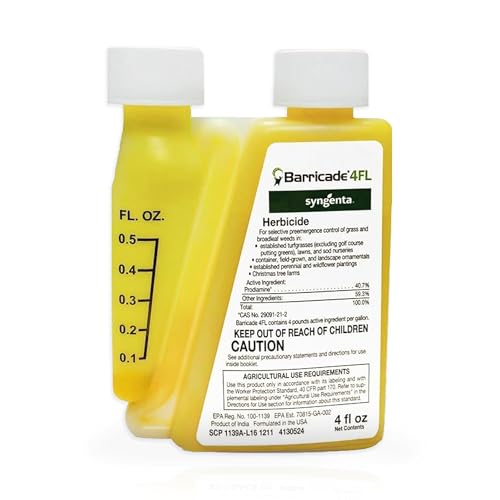
Prodiamine 4FL (Barricade)
Professional-grade pre-emergent with up to 16 weeks of residual control. The anchor for fall poa annua programs.
2. Dithiopyr (Best if the First Flush Beat You)
Common Brand Name: Dimension
Dithiopyr's documented early post-emergent activity applies to crabgrass; against poa annua it works as a pre-emergent like the others. It still earns the late-application role on residual logic: poa annua germinates in waves through fall and winter, so a barrier that goes down after the first wave still blocks every wave that follows. If your soil already dipped below 70°F a week or two ago, this is the recovery play.
Best Used For: Late applications, or the second half of a southern split program.
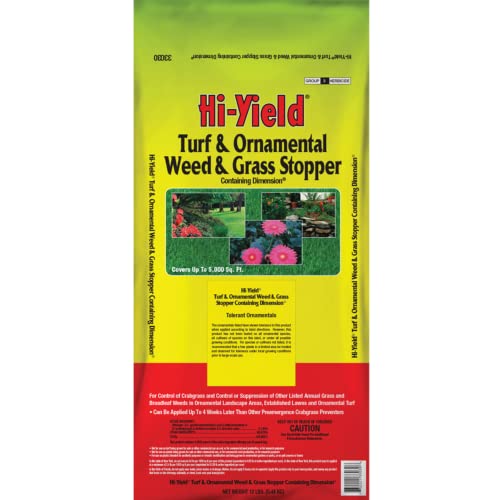
Dithiopyr (Hi-Yield Weed & Grass Stopper)
Up to 12 weeks of pre-emergent control. The recovery option when fall timing slips: a late barrier still blocks the later poa annua germination waves.
3. Pendimethalin (Standard Consumer Option)
Common Brand Name: Halts, Pendulum
Widely available and effective, with a shorter 6 to 8 week practical residual that makes it best suited to the two-application approach in fall. Water it in promptly; it is more sensitive to sunlight degradation than Prodiamine.
Best Used For: Consumer fall programs with a planned second application.

Pendimethalin (Scotts Halts)
Widely available consumer-grade pre-emergent. Shorter 6-8 week residual makes it ideal for split application programs.
Water It In Before the Front Arrives
The barrier activates only after the product moves into the top layer of soil. Plan for 0.25 to 0.5 inches of rain or irrigation within a few days of application.
Fall gives you a natural assist: the cold fronts that drop soil temperature usually arrive with rain. Applying a day ahead of a forecast front waters the product in and marks the same cooling event that pushes soil toward the germination threshold. Avoid applying in the heat; if afternoon air temperatures are still pushing above 85°F, wait for the cooler stretch that is usually only days away in September.
For sprayer setup, mixing order, and the checkerboard pass technique, the liquid pre-emergent application guide covers the full process step by step.
What If Poa Annua Is Already Up?
Then the pre-emergent window has closed for those plants, though a late application still blocks the fall and winter germination waves that have not happened yet. For the plants already up, homeowner post-emergent options are thin, especially on cool-season lawns where selective control is genuinely difficult.
The practical play is to limit the damage: bag clippings in spring when seedheads appear to reduce seed return, keep the lawn dense and tall to shade the soil, and put next fall's application on the schedule now. Poa annua seed persists in soil for years, so one disciplined fall beats one heroic spring.
Track Your Local Soil Temperatures Today
The fall schedule combines the current soil reading with the local cooling season and the task’s calendar window. Check those together so a short warm spell does not obscure an open window.
At SoilTemps.com we track 2-inch soil temperatures from over 380 USDA SCAN and NOAA USCRN stations nationwide. Your city's lawn care schedule shows whether your fall pre-emergent window is approaching, open, or past, including an earlier opening above the 65–70°F ideal band and up to 75°F.
Is your fall window approaching?
Enter your city or ZIP code to check your local 2-inch soil temperature and whether your fall pre-emergent window is open.