
Quick Answer: When Should You Spray Broadleaf Weeds in Fall?
Spray perennial broadleaf weeds between early September and the first hard freeze, while weeds are still green and daytime air temperatures sit in the 50s to low 70s. Fall is the most effective broadleaf window of the year: weeds are pumping carbohydrates down to their roots for winter, and systemic herbicide travels with that flow for a kill that reaches the root instead of burning the top.
Quick Answer
Check your local soil temperatures now
Enter your city or ZIP code to see real-time soil temperature data from the nearest USDA monitoring station.
Most homeowners spray weeds in spring, when dandelions are blooming and the problem is impossible to ignore. Extension agronomists spray in fall, when the same dandelion is quietly stocking its taproot for winter and will carry herbicide straight down into it.
This guide covers why the fall window outperforms spring, the temperature rules that define it, what to use on each grass family, and how to sequence spraying around fall overseeding.
Why Fall Beats Spring for Broadleaf Control
Systemic broadleaf herbicides (2,4-D, dicamba, triclopyr, MCPP) kill by traveling through the plant's vascular system. Where they travel depends on the season.
In spring, a perennial weed pushes everything upward: stored root carbohydrates flow into new leaves and flowers. Herbicide applied into that upward current concentrates in the top growth, which browns dramatically while the taproot or rhizome below survives. The weed is back within weeks, which is why spring-sprayed dandelions seem immortal.
In fall, the current reverses. Shortening days signal the plant to move carbohydrates from leaves down into roots for winter storage, and a systemic herbicide rides that flow to the organ that actually matters. Purdue University, the University of Minnesota, and Iowa State University all rank fall as the premier window for perennial broadleaf control on this mechanism, with the gap largest for the deep-rooted, hard-to-kill species: ground ivy, wild violet, white clover, and dandelion.
Fall also catches the next generation early. Winter annuals like henbit and common chickweed germinate in cooling fall soil (the same flush a fall pre-emergent intercepts), and any seedlings that slip through are at their most herbicide-sensitive stage in October.
One well-timed fall application does more than two spring applications against perennial weeds. If you only spray broadleaf herbicide once a year, spray it in fall.
The Temperature Rules
The fall window is bounded by air temperature and weed condition rather than a single soil threshold:
- Open: weeds green and actively growing, daytime air in the 50s to low 70s. The same September-to-October stretch where 2-inch soil temperatures fall through the 50s and 60s.
- Best conditions: a mild stretch a few days after rain, weeds unstressed, no rain expected for 24 hours, wind under 10 mph.
- Closing: hard freezes that brown the foliage. A weed that has shut down for winter cannot translocate herbicide.
Formulation chemistry extends the late edge of the window. Amine formulations (most consumer liquids) work best with air above roughly 50°F. Ester formulations penetrate waxy leaves better and keep working in the 40s, which is why late-season products like SpeedZone lean on them. If you are spraying in late October or November, reach for an ester or a product built for cool weather.
Hot weather is the other boundary, mostly relevant to early September in the South: above the mid-80s, volatility and turf injury risk rise, the same ceiling that applies in late spring.
The Overseeding Conflict, Round Two
Fall's two best lawn projects, overseeding and broadleaf control, interfere with each other in both directions. The rules:
Seeded first? Wait until the new grass has been mowed two to three times before spraying, typically four to six weeks after germination. Spraying first? Most labels require three to four weeks between application and seeding. Plan the sequence before either bag is opened.
A workable fall calendar for a cool-season lawn doing both: overseed in early September as soil falls through the 60–70°F window (the fall overseeding guide covers it), mow the new grass into late October, then make the broadleaf application in the last week the weeds are green. The fall broadleaf window is long enough to accommodate the wait; the seeding window is not, so seeding goes first.
Spot-spraying with a small pump sprayer threads the needle on partially overseeded lawns: treat the established areas now, skip the seedling zones until they have their mowings.
What to Use: Cool-Season Lawns
The cool-season product logic from the spring broadleaf guide carries into fall, with the cool-weather products earning their keep late in the window.
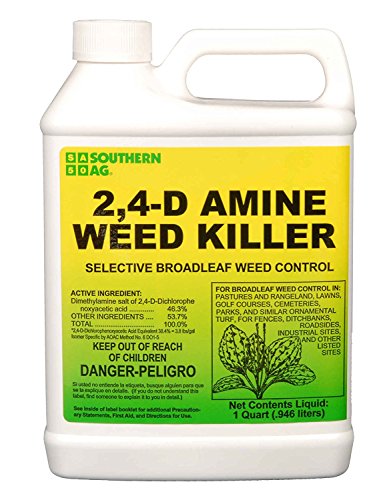
Southern Ag Amine 2,4-D Weed Killer (32 oz)
The workhorse systemic for dandelion and plantain in mild fall weather. Inexpensive, effective, and at its best in the September-to-mid-October stretch.
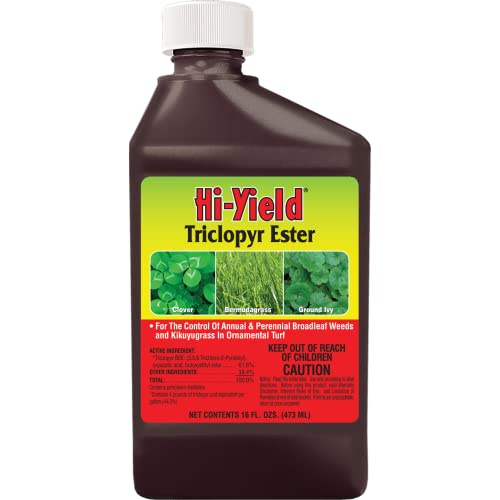
Hi-Yield Triclopyr Ester (8 oz)
The fall specialist for ground ivy and wild violet, the two weeds that benefit most from fall timing. Ester formulation keeps working as temperatures drop into the 40s.
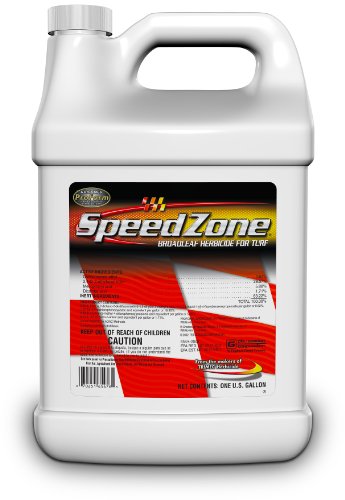
PBI Gordon SpeedZone EW Broadleaf Herbicide (128 oz)
Four-way mix with carfentrazone for visible results in days, built for cool weather. The late-window choice when frost is already in the forecast.
What to Use: Warm-Season Lawns
Warm-season lawns spend fall sliding toward dormancy, which changes both the product list and the risk profile. Bermuda and zoysia tolerate the standard three-way mixes; St. Augustine and centipede do not, and need their own chemistry.
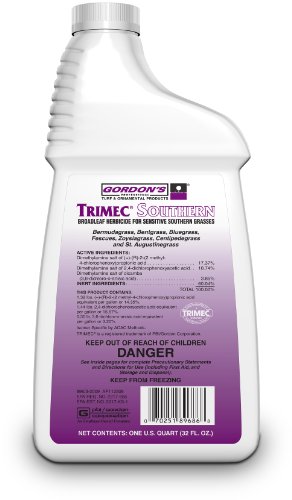
PBI Gordon Trimec Southern Broadleaf Herbicide (32 oz)
The three-way mix rebalanced for southern grasses. Labeled for bermuda and zoysia; follow the label's reduced rates on St. Augustine and centipede.

Celsius WG (0.226 oz easy-mix packet)
The safe systemic for St. Augustine and centipede, effective on a broad weed list without the 2,4-D injury risk. Works best while the lawn still has some green.
One timing trap unique to warm-season lawns: the transition weeks when the lawn is half green and half brown are when it is most easily injured. Either spray early in fall while the lawn is still fully green, or wait for full dormancy, when winter annuals can be treated with little risk to the sleeping turf. The schedule's winter dormant herbicide task covers that second window for warm-season cities.
Application Notes That Matter More in Fall
- Mow before, not after. Spray two or three days after a mowing so weeds have leaf surface to absorb through, then leave the lawn uncut for two or three days after so the herbicide translocates before the treated tissue is removed.
- Skip the irrigation for a day. Foliar herbicides need 24 dry hours on the leaf. Fall dew is fine; rain or sprinklers are not.
- Spot-spray season. Fall weed pressure is patchier than spring. A one-gallon pump sprayer covering individual weeds uses a fraction of the product of a blanket pass and keeps herbicide off the lawn that does not need it.

Chapin 20004 SureSpray 1-Gallon Pump Sprayer
The right scale for fall spot-spraying. Mix a quart, walk the lawn, treat what is actually there.
Track Your Local Conditions
The fall broadleaf window closes when growth stops, and growth stops when soil and air say so, not the calendar. Watching your local readings tells you how much runway is left.
At SoilTemps.com we track 2-inch soil temperatures from over 380 USDA SCAN and NOAA USCRN stations nationwide. Your city's lawn care schedule sequences the fall tasks, weed control, feeding, and seeding, against your actual local conditions.
How much fall window is left?
Enter your city or ZIP code to check your local soil temperature trend and plan the fall weed application.