For cool-season lawns (fescue, bluegrass, ryegrass), fall is the best time to plant grass seed in North Carolina, with spring the second choice: fall seedlings face less weed competition and mature before summer heat. The window opens as 2-inch soil falls back through 70°F, and germination slows sharply once soil drops below 50°F, typically around November 29.
Soil Temperature in North Carolina
The current average 2-inch soil temperature across North Carolina is 70°F. Readings range from 54°F to 80°F, from 3 USDA and NOAA monitoring stations. Soil across North Carolina is running 2°F below the seasonal normal of 72°F for mid-September, based on 3 of 3 stations with historical records. North Carolina spans USDA hardiness zones 7a to 8b, cool-season grass country. Last updated September 14, 2026.
Current Planting Conditions
Soil across North Carolina is cooling off its summer peak at an average of 70°F at 2 inches. The fall poa annua pre-emergent window is in play as readings fall through the 65–70°F band, and cool-season overseeding follows close behind.
Best Time to Plant Grass Seed in North Carolina
North Carolina spans both grass families: cool-season lawns are more common toward the cooler, northern parts of the state and at elevation, warm-season lawns toward the warmer south.
Spring is the second choice: the window opens when soil first holds 50°F and narrows as soil passes 65°F, typically by May 9.
For warm-season lawns (bermuda, zoysia, St. Augustine), the best time to plant grass seed in North Carolina is late spring into early summer, when soil is warming and a full growing season lies ahead. The window opens when 2-inch soil reaches 65°F and keeps rising, and closes as soil cools back through 65°F, typically around October 11.
| Region | Typical spring window opens | Typical fall window opens | Stations |
|---|---|---|---|
| Eastern North Carolina | February 28 | October 3 | 2 |
| Central North Carolina | March 5 | September 10 | 2 |
Fall seeding also needs a stop date: new seedlings want about six weeks of growth before frost arrives. Your city page estimates the last safe seeding date from its nearest station: see when to plant in Charlotte, when to plant in Raleigh or when to plant in Greensboro. Readings current through September 14, 2026: North Carolina averages 70°F at 2 inches right now; the Current Planting Conditions section above reads that number against the season.
Typical dates are computed from historical 2-inch soil temperature averages at 4 monitoring stations in North Carolina; your own window depends on your nearest station's readings.
Average Soil Temperature by Month in North Carolina
Historical 2-inch soil temperature normals for North Carolina: the median across 4 in-state stations with multi-year records. Any given year runs ahead of or behind these values; the live average at the top of this page shows where this year stands.
| Month | Average 2-inch soil temperature |
|---|---|
| January | 43°F |
| February | 46°F |
| March | 53°F |
| April | 62°F |
| May | 69°F |
| June | 76°F |
| July | 80°F |
| August | 78°F |
| September | 73°F |
| October | 64°F |
| November | 55°F |
| December | 47°F |
Shaded spring cells fall in the 50°F to 55°F pre-emergent window at 2-inch depth. The highlighted row is the current month.
Grass Seed Germination in North Carolina
Grass seed germination
Grass seed germination temperatures across North Carolina. Soil warmth varies by location, so check a city page for the live reading and what germinates there now.
| Grass species | Seeding soil temp (2 in) | Days |
|---|---|---|
| Kentucky bluegrass | 60–70°F | 14-30 |
| Tall fescue | 60–70°F | 7-12 |
| Perennial ryegrass | 60–70°F | 5-10 |
| Fine fescue | 60–70°F | 7-14 |
| Bermudagrass | 75–90°F | 10-30 |
Monitoring Stations in North Carolina (3)
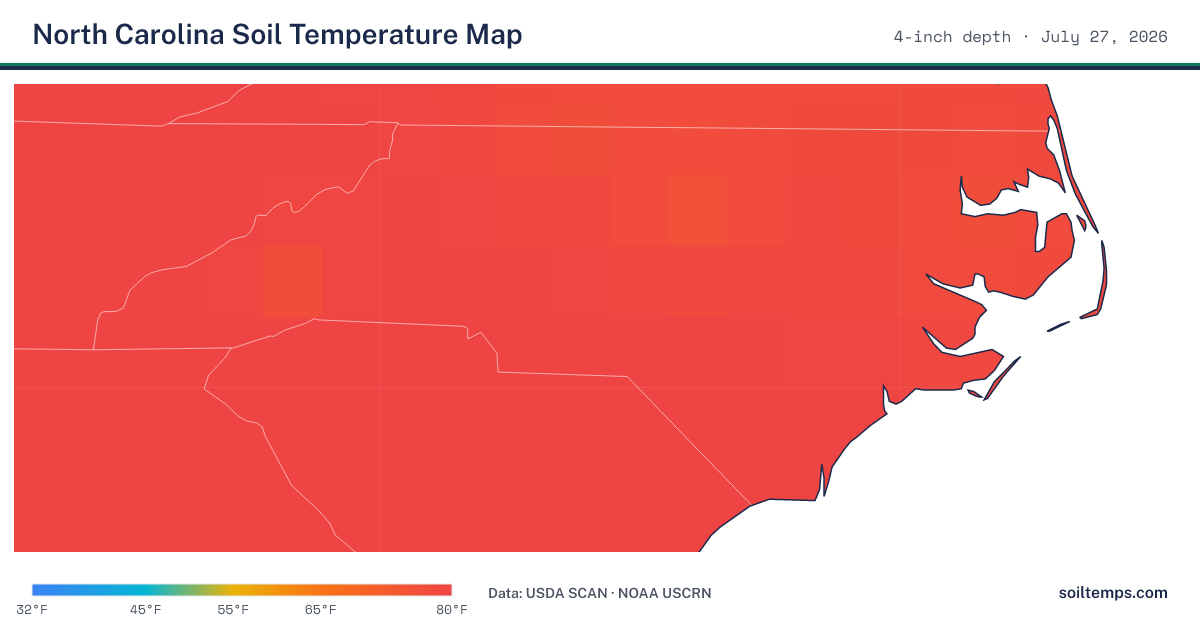
For root-zone timing (fertilizer, aeration, weed control), see the 4-inch soil temperature for North Carolina. For accumulated-heat timing, see growing degree days for North Carolina. For how wet the ground is versus normal, see soil moisture for North Carolina. See the North Carolina soil temperature map for the full station view.

Interpolated from the latest 4-inch readings and refreshed daily.
| Station | 2" Temp | Last Reading |
|---|---|---|
| Tidewater #1 (Washington) | 78°F | 2026-09-14 |
| Durham 11 W | 80°F | 2026-09-14 |
| Asheville 13 S | 54°F | 2026-09-14 |
Cities in North Carolina (65)
| City | ZIP | Current Temp |
|---|---|---|
| Albemarle | 28001 | 80°F |
| Apex | 27502 | 80°F |
| Asheboro | 27203 | 80°F |
| Asheville | 28801 | 54°F |
| Boone | 28607 | 54°F |
| Burlington | 27215 | 80°F |
| Camp Lejeune | 28542 | 78°F |
| Cary | 27511 | 80°F |
| Chapel Hill | 27514 | 80°F |
| Charlotte | 28201 | 82°F |
| Clayton | 27520 | 80°F |
| Clinton | 28328 | 80°F |
| Concord | 28025 | 82°F |
| Creedmoor | 27522 | 80°F |
| Davidson | 28035 | 77°F |
| Dunn | 28334 | 80°F |
| Durham | 27701 | 80°F |
| Eden | 27288 | 77°F |
| Elizabeth City | 27906 | 78°F |
| Fayetteville | 28301 | 80°F |
| Fort Bragg | 28307 | 80°F |
| Franklin | 28734 | 54°F |
| Gastonia | 28052 | 54°F |
| Goldsboro | 27530 | 80°F |
| Greensboro | 27395 | 80°F |
| Greenville | 27833 | 78°F |
| Henderson | 27536 | 80°F |
| Hendersonville | 28739 | 54°F |
| Hickory | 28601 | 54°F |
| High Point | 27260 | 77°F |
| Huntersville | 28070 | 77°F |
| Jacksonville | 28540 | 78°F |
| Kannapolis | 28081 | 77°F |
| Kernersville | 27284 | 77°F |
| Kinston | 28501 | 78°F |
| Laurinburg | 28352 | 82°F |
| Lenoir | 28633 | 54°F |
| Lexington | 27292 | 77°F |
| Lincolnton | 28092 | 54°F |
| Lumberton | 28358 | 82°F |
| Matthews | 28104 | 82°F |
| Monroe | 28110 | 82°F |
| Mooresville | 28115 | 77°F |
| Morganton | 28655 | 54°F |
| New Bern | 28560 | 78°F |
| North Wilkesboro | 28656 | 77°F |
| Pinehurst | 28370 | 80°F |
| Raleigh | 27601 | 80°F |
| Reidsville | 27320 | 77°F |
| Rockingham | 28379 | 82°F |
| Rocky Mount | 27801 | 78°F |
| Roxboro | 27573 | 80°F |
| Rural Hall | 27045 | 77°F |
| Salisbury | 28144 | 77°F |
| Sanford | 27330 | 80°F |
| Shallotte | 28459 | 84°F |
| Shelby | 28150 | 54°F |
| Southern Pines | 28387 | 80°F |
| Statesville | 28625 | 77°F |
| Thomasville | 27360 | 77°F |
| Wake Forest | 27587 | 80°F |
| Waynesville | 28785 | 54°F |
| Wilmington | 28401 | 70°F* |
| Wilson | 27893 | 80°F |
| Winston Salem | 27101 | 77°F |
Modeled estimate where no monitoring station is within 99 miles; all other readings are measured at USDA and NOAA stations.
Lawn Care Timing Guides for North Carolina
- When to Overseed Your Lawn in Fall: The 60-70°F Soil Window
Fall is the best time to overseed a thin lawn.
- When to Aerate Your Lawn by Grass Type and Soil Temperature
Core aeration relieves compaction, but timing decides whether the lawn recovers in a week or struggles for a month.
- When to Apply Pre-Emergent in Fall: Stop Poa Annua at 70°F
Apply fall pre-emergent when 2-inch soil falls back through 70°F and keeps declining; that crossing is when poa annua and winter annual weeds sprout.
- Fall Broadleaf Weed Control: The Best Kill Window of the Year
Fall is when broadleaf herbicide works hardest.
Soil Temperature FAQ for North Carolina
What is the current soil temperature in North Carolina?
The current average 2-inch soil temperature across North Carolina is 70°F. Readings range from 54°F to 80°F depending on location and elevation, from 3 USDA and NOAA monitoring stations. Soil across North Carolina is running 2°F below the seasonal normal of 72°F for mid-September, based on 3 of 3 stations with historical records.
When should I apply pre-emergent in North Carolina?
Apply pre-emergent herbicide when soil at 2 inches reaches 55°F for several consecutive days. Timing varies across North Carolina, so check your city's page for station-specific readings and the pre-emergent timing recommendation.
When can I plant grass seed in North Carolina?
North Carolina spans USDA hardiness zones 7a to 8b, cool-season grass country. For cool-season grasses (fescue, bluegrass), the fall window typically opens around September 30 and the spring window around February 28; for warm-season grasses (bermuda, zoysia), the window typically opens around May 9, based on historical 2-inch soil temperature averages at 4 in-state stations. Timing varies by location, so check your city's planting window for the dates specific to your area.