
Quick Answer: When Should You Apply Goosegrass Pre-Emergent?
If your lawn has had no pre-emergent this spring, apply it while soil at 2 inches is rising through 55-60°F, so the barrier is in place before goosegrass starts germinating at 60°F. Your schedule opens the task once soil has held in that band for 3 days. Goosegrass comes up 2 to 6 weeks after crabgrass (NC State, Purdue, Rutgers, Penn State and Tennessee), so a lawn that already had a crabgrass pre-emergent often needs a second application where goosegrass has been a problem. Tennessee and Penn State place it 6 to 8 weeks after the first, and the product label sets the minimum spacing. Homeowners can use prodiamine, pendimethalin or dithiopyr (UF/IFAS); Rutgers says oxadiazon cannot be applied to residential lawns. A pre-emergent will not kill goosegrass that is already up. For plants you can see, skip ahead to If Goosegrass Is Already Up and the pre-emergent vs post-emergent guide.
What you need
- Liquid, needs a pump sprayer: Prodiamine (Barricade)
- Granules, for a spreader: Scotts Halts (pendimethalin)
Quick Answer
Check your local 2-inch soil temperatures now
Enter your city or ZIP code to see real-time soil temperature data from the nearest USDA or NOAA monitoring station.
You put down crabgrass preventer in early spring, the lawn stayed clean through May, and then a flat, silvery grass weed spread out along the driveway in July. That may be goosegrass, which gets through because it sprouts weeks after crabgrass, when an early-spring barrier has started to fade.
Goosegrass waits for warmer soil than crabgrass does, so it needs its own window, a few degrees higher and a few weeks later.
This guide covers what goosegrass is and why it comes up late, the soil temperatures the sources give and why your schedule's window sits just below them, where goosegrass is a lawn-wide problem and where it is a spot problem, how to time a second application after a crabgrass pre-emergent within the label limits, the soil fixes that keep it out, and the pre-emergents a homeowner can buy.
What Goosegrass Is and Why It Comes Up After Crabgrass
Goosegrass (Eleusine indica) is a summer annual grass. It grows in a low clump from a central taproot, with leaves that are white or silver at the base, and the University of Tennessee says a single plant can produce up to 50,000 seeds. Rutgers says it sets seed and dies at the first frost in the Northeast, so each year's plants come from the seed left behind; UF/IFAS says that in Florida's tropical climates it often survives as a short-lived perennial.
Its seeds need warmer soil than crabgrass seeds. NC State Extension says goosegrass germinates when soil reaches 60°F, usually at least two weeks after crabgrass. Purdue puts the gap at about two to three weeks, Rutgers and Penn State at 3 to 4 weeks, and Tennessee at four to six weeks. Germination then keeps going: Tennessee says it starts sometime in late April there and continues throughout the summer, and Rutgers says crabgrass and goosegrass germinate through August in New Jersey.
That late start is the problem for a lawn on a single crabgrass program. Tennessee says the fact that goosegrass germinates later than crabgrass makes a sequential application strategy essential. Penn State says that because goosegrass needs warmer soil, controlling both weeds in the same lawn can be challenging.
The Trigger: 55-60°F at 2 Inches, Before Germination at 60°F
The sources give the temperature at which goosegrass starts to come up. A pre-emergent has to be in the soil before that, so the window on your schedule sits just below it.
| Source | Soil temperature | Depth | How it is read |
|---|---|---|---|
| NC State TurfFiles (2022) | Germinates at 60 to 65°F; starts at 60°F | Not stated | Not stated |
| UF/IFAS SS-AGR-488 | Start applications at 60°F | Not stated | 24 consecutive hours |
| Penn State Extension (2025) | Apply before soil reaches 62 to 65°F | 2 inches | Daily maximum |
| Kansas State University | Germination begins above 65°F | Not stated | For several weeks |
NC State and UF/IFAS both put the start at 60°F. Penn State is the only one of these sources to give a depth, 2 inches, and it reads the warmest part of the day: apply before the daily maximum reaches 62 to 65°F. Kansas State is the latest of the four.
SoilTemps reports the 2-inch daily average, which runs below the afternoon high. A day whose maximum reaches 62 to 65°F has a lower daily average, so your schedule closes the window at 60°F. It opens the window at 55°F, the same way the crabgrass task opens at 50°F, in the band just below that weed's germination temperature. The crabgrass band is 50-55°F, so the goosegrass window starts where the crabgrass one ends.
Your schedule opens the goosegrass task once 2-inch soil has held between 55°F and 60°F for 3 days and is still warming. If your lawn has had no pre-emergent this spring, apply when the task opens. Do not wait for 60°F: that is when NC State says goosegrass starts to germinate, and the barrier needs to be watered in before the first seeds sprout. If you already applied one for crabgrass, time the second from that application, as the next sections explain.
In a spring that warms fast, the crabgrass and goosegrass tasks can show in the same week. If you have applied neither, apply now: the Barricade and Halts labels both list crabgrass and goosegrass. Then plan the second application in the next section.
Where Goosegrass Is a Problem
Goosegrass grows in warm-season and cool-season lawns alike. NC State says it competes very successfully with both during summer months, and is most competitive in thin, open turf and turf subject to intense traffic or use. How much of a lawn it takes over depends on where you live.
Your schedule decides whether to show the task from your area's normal summer and winter temperatures and its climate type, and from how cold the soil in your area normally gets in winter. It shows the task where winters are mild and summers are warm enough for warm-season grass, which covers the South and the transition zone, and leaves it off where winters are cold or summers stay cool. Your soil readings then set when the task opens. Goosegrass invades both kinds of lawn, so the task shows on cool-season and warm-season schedules alike.
Southern and Warm-Season Lawns
UF/IFAS Extension says goosegrass is problematic in all major turfgrasses in Florida, and that in Florida germination can occur throughout the year under favorable conditions. Treat the whole lawn on a Southern program, and expect to apply more than once: UF/IFAS says most pre-emergents will need sequential reapplications for persistent control, at label intervals of typically 5 to 12 weeks.
The Transition Zone
Tennessee says goosegrass is found in many turf areas throughout the state, most commonly in the high-traffic areas of sports fields, golf courses, and residential and commercial lawns. Its program starts at crabgrass timing, February to early March in West Tennessee and mid-March to early April in East Tennessee, with the second application 6 to 8 weeks later. Penn State says goosegrass is found throughout Pennsylvania and is most prevalent in the southeastern part of the state, with crabgrass applications running from mid-March to late April depending on location there.
The task does not depend on your grass here: a tall fescue lawn gets it just as a bermuda lawn next door does, since goosegrass grows in both.
Cool-Season Lawns in the North
Farther north, goosegrass is a spot problem. Purdue says it is less common in northern areas of the Midwest like Michigan, Minnesota and Wisconsin. Where it does show up in cool-season lawns, Rutgers finds it in highly trafficked areas with compacted soil and poor turf cover, and Penn State in compacted soils, high-traffic areas and thinning turf.
So in the North, treat the spots. Apply the goosegrass pre-emergent to the strip along the driveway, the path the dog runs, the corner by the mailbox: wherever goosegrass came up last summer. Then fix the compaction in those spots (see the soil section below) so the turf there can thicken.
Where Winter Soil Stays Above 55°F
Where winter soil stays above 55°F, a rising 55-60°F reading may not come in a typical year. In South Florida the soil never cools into the goosegrass band, so your schedule has no goosegrass row and gives calendar guidance instead. If your own 2-inch readings never drop below 55°F over the winter, time it by the calendar:
- Florida: UF/IFAS says pre-emergent applications are typically scheduled for the week of (or a week before) March 1, March 15 and April 1 in south, central and northern Florida, and notes that fluctuating weather has made the calendar dates less accurate.
- Southern California: the Scotts Halts label says to apply before March 1 in southern California, and by mid-February for best results on thin lawns.
- Other warm-winter areas: none of the sources in this guide gives a date. Follow the product label and your county extension office's timing.
Goosegrass every summer but no goosegrass task on your schedule? Time it by hand: apply while your 2-inch soil reading is between 55°F and 60°F and rising. If you already applied a crabgrass pre-emergent, apply 6 to 8 weeks after it. In the North, treat only the spots where goosegrass grew last year.
The Second Application After a Crabgrass Pre-Emergent
A crabgrass pre-emergent put down in early spring can start to wear off just as goosegrass begins to sprout. Tennessee, Penn State and Rutgers call for a second application, and Purdue and the Barricade label add one under heavy goosegrass pressure:
| Source | Second application |
|---|---|
| University of Tennessee W170 | 6-8 weeks after the initial application |
| Penn State Extension | Often needed 6 to 8 weeks after the initial crabgrass application |
| Rutgers FS1309 | 6 to 8 weeks after the first, for a sequential program |
| Purdue | 60 days after the first, under severe goosegrass pressure |
| Scotts Halts label | Repeat in 8 weeks for goosegrass |
| Barricade 4FL label | 60-90 days after the first, under heavy goosegrass pressure |
The goosegrass application may be your lawn's second pre-emergent of the year, so check your product's yearly limit before you apply:
- Scotts Halts (pendimethalin): no more than twice a year, with at least two months between applications.
- Barricade 4FL (prodiamine): any number of applications, as long as the year's total stays under the limit for your grass. Per 1,000 sq ft that is 1.1 oz for bermuda, zoysia, St. Augustine, centipede, bahia and tall fescue, 0.70 oz for Kentucky bluegrass and perennial ryegrass, and 0.55 oz for fine fescue.
Lawn with a crabgrass pre-emergent this spring: the second application goes on 6 to 8 weeks after the first (Tennessee, Penn State, Rutgers), and with Halts at least two months after it, as its label requires. The first application keeps covering the lawn until then. That date can fall after your schedule's goosegrass row has closed for the season; apply on it anyway.
Lawn with no pre-emergent yet this year: apply when your schedule opens the goosegrass task. Where goosegrass pressure is heavy, repeat as the label directs: 8 weeks for Halts, 60 to 90 days for Barricade.
Mind the Barricade limit: two Barricade applications must stay under your grass's yearly limit together. On Kentucky bluegrass, perennial ryegrass and fine fescue, that limit allows one application at the label's goosegrass rate and no second, and less if Barricade already went down for crabgrass. A lawn of those grasses that needs two applications fits the Halts schedule: twice a year, at least two months apart.
Water it in: the Barricade label calls for at least 0.5 inch of rain or irrigation within 14 days, before weed seeds germinate.
Fix the Soil Goosegrass Likes
A pre-emergent stops this year's seedlings. The spots goosegrass picks will keep inviting it back until the turf there thickens.
Relieve compaction. Tennessee says goosegrass thrives in compacted, poorly drained soils, and that core aeration and altering traffic patterns relieve compaction and improve aeration and drainage. NC State says a severe infestation may indicate the need for aerification. Aerate before you apply the pre-emergent: the Scotts Halts label says not to rake or aerify after application, since that disturbs the barrier. The aeration timing guide gives the dates for your grass.
Move the traffic. Rutgers says traffic management combined with proper fertilization makes the turf more competitive against goosegrass. Shift a worn path with a stepping-stone line or a gate moved a few feet.
Grow a dense lawn. Rutgers calls a dense stand of turf an effective way to prevent goosegrass, and says deep, infrequent watering favors lawn grasses, whose roots run deeper than goosegrass seedlings. On a cool-season lawn with bare patches left by goosegrass, Rutgers recommends a late summer or early autumn overseeding to fill the voids before the next spring's seedlings. See the fall overseeding guide.
Pre-Emergents Homeowners Can Use for Goosegrass
The strongest goosegrass pre-emergent is off the table for home lawns. Purdue calls oxadiazon the most consistent pre-emergent for goosegrass, and Rutgers says it is more effective on goosegrass than dithiopyr, prodiamine and pendimethalin. But Rutgers says oxadiazon cannot be applied to residential turfgrass, and Penn State says the oxadiazon granules cannot be used on residential properties in Pennsylvania. UF/IFAS names indaziflam alongside oxadiazon as the most effective, and lists it among its professional-grade products, outside its homeowner list. Clemson says not to apply Specticle G (indaziflam) to a lawn seeded less than 16 months before.
That leaves the list UF/IFAS gives: stand-alone homeowner pre-emergents are limited to dithiopyr, pendimethalin and prodiamine products. The sources differ on how well these do on goosegrass. Penn State says all three have shown good pre-emergent control of goosegrass and crabgrass in Pennsylvania, and Tennessee found the pre-emergents it tested gave similar goosegrass control when used according to the label. Rutgers says split applications and higher rates of prodiamine have given moderate to good goosegrass control in its research, and that dithiopyr on its label program gave moderate control.
Skip weed-and-feed for this job. UF/IFAS says weed-and-feed products have limited activity on goosegrass, because the fertilizer timing does not match goosegrass germination.
Dithiopyr (Dimension) is the third homeowner option. Penn State says it controls goosegrass when applied before seedlings emerge, and controls early emerging crabgrass up to the 1-tiller stage. That early post-emergent effect does not extend to goosegrass: Rutgers says dithiopyr does not provide early post-emergence control of goosegrass.
Rutgers says goosegrass, more than crabgrass, has a history of developing herbicide resistance when herbicides with the same mode of action are used year after year, and that dithiopyr and prodiamine share a mode of action. Rutgers places pendimethalin in the same herbicide group as prodiamine (WSSA Group 3). UF/IFAS lists prodiamine among the herbicides goosegrass has developed resistance to. If goosegrass comes through your pre-emergent in the same spots every year, kill those plants with a post-emergent before they set seed. Rutgers says controlling plants that survive a pre-emergent this way delays resistance.
1. Prodiamine (Best for Heavy Goosegrass and Long Programs)
Common Brand Name: Barricade
The Barricade 4FL label lists goosegrass among the weeds it controls. It says a single application of 21 to 48 oz per acre controls goosegrass in many areas, and that under heavy goosegrass pressure or a long growing season, a first application of 21 to 26 oz per acre (about 0.5 to 0.6 oz per 1,000 sq ft) followed by a second 60 to 90 days later works best. It may be applied more than once a year within your grass's yearly limit, and all applications must go down before weed seeds germinate. On a lawn, the label allows reentry once the dust has settled and the turf or soil is dry.
Plan any seeding before you buy. The label's wait before overseeding runs from 4 months at its lowest rate to 12 months at its highest in the South, so at goosegrass rates you are looking at 4 to 12 months.
Best Used For: Southern and transition-zone lawns with heavy goosegrass, where a second application has to fit inside the yearly limit, and owners with a pump sprayer.
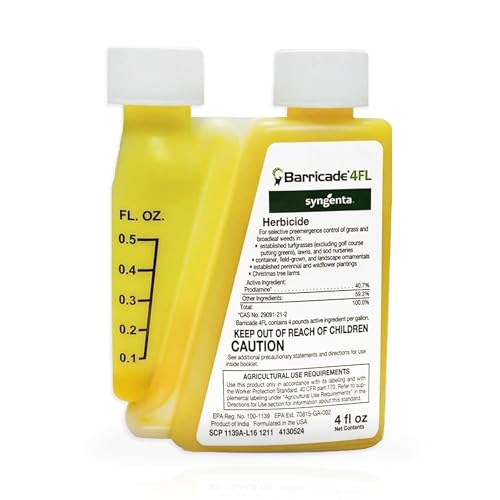
Prodiamine 4FL (Barricade)
Liquid prodiamine whose label lists goosegrass. Under heavy pressure the label pairs a first application with a second 60 to 90 days later, within your grass's yearly limit. Activate with at least 0.5 inch of rain or irrigation within 14 days.
2. Pendimethalin (Best for a Spreader and a Two-Application Year)
Common Brand Name: Scotts Halts
The Scotts Halts label lists goosegrass, with a note: for goosegrass control, repeat the application in 8 weeks. It allows no more than two applications a year, at least two months apart, so a lawn that got Halts for crabgrass has room for exactly one goosegrass application. The label says rain, snow or freezing weather after application will not affect it. Rutgers notes that on residential turf, pendimethalin is limited to one application at 2.0 lb of active ingredient per acre or two at 1.0 to 1.5 lb.
Halts blocks new grass, too: the label says not to plant grass seed for four growing months after use.
Best Used For: Smaller lawns and spot treatments in the North, owners with a broadcast or handheld spreader, and a simple crabgrass-then-goosegrass year with two Halts applications 8 weeks apart.

Pendimethalin (Scotts Halts)
Repeat in 8 weeks for goosegrass · Twice a year at most · Spreader granules
Pendimethalin granules for a spreader whose label lists goosegrass and says to repeat in 8 weeks for it. No more than twice a year, at least two months apart. Rain after application does not affect it.
3. Mesotrione (Only When Seeding a Cool-Season Lawn)
Common Brand Name: Tenacity
The goosegrass task and spring seeding are either/or: prodiamine and pendimethalin stop grass seed along with weed seed. Rutgers says that, with the exception of mesotrione, none of the pre-emergents it lists should be applied if you plan to seed within several weeks. Mesotrione applied at seeding gives 2 to 4 weeks of pre-emergent crabgrass and goosegrass control, and Rutgers recommends Tenacity at seeding and again four weeks later. It says not to apply mesotrione to bentgrass, fine fescue or zoysia. Penn State also lists mesotrione among the post-emergent herbicides labeled for goosegrass, and says it works best on newly emerged plants.
If you are seeding a warm-season lawn this spring, leave the goosegrass pre-emergent off the area you seed, and pull goosegrass seedlings by hand while they are small.
Best Used For: A cool-season lawn being seeded in spring where goosegrass has been a problem.

Tenacity Herbicide (Mesotrione)
Mesotrione, the one pre-emergent Rutgers allows at seeding. Applied at seeding it gives 2 to 4 weeks of crabgrass and goosegrass control; Rutgers repeats it four weeks later. Not for bentgrass, fine fescue or zoysia.
Common Mistakes
Counting on the early-spring crabgrass application for the whole summer. Goosegrass comes up 2 to 6 weeks after crabgrass and keeps germinating into summer. Plan the second application 6 to 8 weeks after the first (at least two months apart with Halts, as its label requires).
A third Halts bag in one year. The label allows two applications a year, two months apart. If you need more coverage than that, switch to a prodiamine product within its yearly limit.
Buying oxadiazon for a home lawn. Purdue calls it the most consistent goosegrass pre-emergent, and Rutgers says it cannot be applied to residential turfgrass.
Spraying quinclorac on goosegrass. Rutgers says quinclorac does not control goosegrass. Check that a post-emergent's label names goosegrass.
Aerating after the pre-emergent goes down. The Scotts Halts label says not to rake or aerify after application. Aerate first, then apply.
Treating the whole lawn in the North. Goosegrass in a Northern cool-season lawn sits in the compacted, worn spots. Treat those and fix the soil there.
If Goosegrass Is Already Up
A pre-emergent stops seeds as they sprout and does nothing to a plant that is already growing. For goosegrass you can see:
- Pull small plants. Tennessee says goosegrass's central root makes it easier to remove than many weeds, and small plants come out by hand.
- Use a post-emergent labeled for goosegrass. Penn State lists fenoxaprop (Acclaim Extra), mesotrione (Tenacity) and topramezone (Pylex), and gets the best results on plants with fewer than 4 tillers (side shoots). Rutgers says goosegrass is still relatively easy to control at the 1- to 2-tiller stage.
- Check the label for goosegrass. Rutgers says quinclorac, a common crabgrass post-emergent, does not control goosegrass.
The pre-emergent vs post-emergent guide explains how the two kinds of herbicide differ and how to read a weed's growth stage. Then use this guide to stop next year's seedlings.
Track Your Local Soil Temperatures Today
Goosegrass follows soil temperature, so the date its window opens moves by weeks from one spring to the next and from one city to another.
SoilTemps.com reads 2-inch soil temperature at more than 300 USDA SCAN and NOAA USCRN stations and gives each city its nearest one; a city with no station nearby gets a Modeled reading. Your city's lawn care schedule shows the crabgrass and goosegrass pre-emergent tasks where they apply, so you can see both windows and how far apart they fall this year.
Is your goosegrass window open?
Enter your city or ZIP code to check your local 2-inch soil temperature and see whether your goosegrass pre-emergent window is coming up, open, or past.